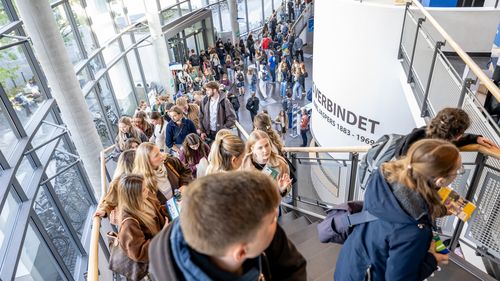
More than 60 experts discuss diversity issues at a conference organised by the Institute of Special Needs Education and Rehabilitation.
"Diversity at universities - participation through hearing sensitivity" is the topic of an interdisciplinary conference that took place today at the University of Oldenburg. Organised by the Institute of Special Needs Education and Rehabilitation, the conference was attended by more than 60 experts from various disciplines from all over Germany as well as students - with and without speech comprehension impairments.
How can "excellent teaching" be implemented in universities that are characterised by diversity? This question was at the centre of the conference sponsored by the Randstad Foundation. Students not only have different talents and interests, qualifications and socio-cultural backgrounds - they also differ in their hearing sensitivity. Students should not be excluded due to their impairments, emphasised Prof. Dr Gunilla Budde, Vice President for Studies and Teaching. On the contrary, it is about "tapping into the potential and resources of a student body that is heterogeneous in every respect".
Barbara Corleis, doctoral student and initiator of the conference, sums up the problem: "If hearing or understanding language does not succeed, the acquisition of knowledge and skills must fail." If many people speak in one room, it disturbs everyone - but especially students with hearing impairments or with another native language. Hearing aids and cochlear implants amplify background noise. The result is often an unbearable babble of voices that makes it impossible to understand speech. "The challenge is to organise courses at universities in such a hearing-sensitive way that everyone can actively participate," says the scientist.
The experts discussed the demand for excellent teaching from the perspective of teachers as well as students with and without speech comprehension impairments. This involved questions of university didactics as well as diversity and academic management. The academics discussed aspects of pedagogy for the hearing-impaired, looked at new findings from noise impact research and discussed problems of rehabilitation and participation.
Despite all the differences in detail, the experts agreed that everyone involved benefits from a hearing-sensitive higher education didactic qualification programme that makes full use of the communicative, spatial-acoustic, technical and organisational possibilities.
With this in mind, the "Hearing-Sensitive University of Oldenburg" working group has been involved in research, teaching and counselling since 2006. Participants include students, graduates and teachers of rehabilitation education, physics, psychology, sociology and education.