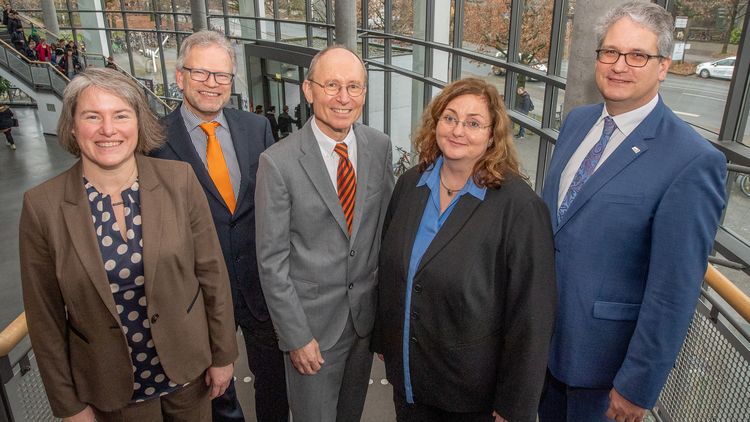

In addition to their own research and teaching, they help steer the fortunes of the university: the part-time Vice Presidents Sabine Kyora, Esther Ruigendijk and - new to the Presidential Board - Meinhard Simon. Their two-year term of office began on 1 January.
They have big plans for 2018 and 2019: the three part-time Vice Presidents of the University, who were confirmed by the University Senate on the recommendation of President Prof Dr Dr Hans Michael Piper. Biologist Prof Dr Meinhard Simon is the new Vice President for Research and Transfer. Linguist Prof. Dr Esther Ruigendijk as Vice President for Young Academics and International Affairs and German scholar Prof. Dr Sabine Kyora as Vice President for Academic Affairs, Teaching and Equal Opportunities are taking up their second two-year term of office.
At the hearing in the University Senate, Kyora emphasised research-based learning as an increasingly firmly anchored profile element of the university. Following a conference on student research in 2016, the world conference planned for 2019 in Oldenburg also emphasised this. In teacher training, it has been possible to bring subject specialists, didactics experts and educational researchers even closer together and to dovetail theory and practice even better. Now it is important to work towards renewed funding in the "Teacher Training Quality Initiative" in order to provide additional impetus. With regard to equal opportunities, Kyora emphasised the university's active efforts to recruit highly qualified female academics - "especially in fields where they have been underrepresented to date". In her second term of office, she also wants to continue working on a centralised equality plan and a diversity concept.
Ruigendijk explained that she wants to continue working to improve the situation of young female and male academics. The first steps have been taken, such as the newly designed personnel development programme for junior and mid-level researchers. Her goal is an appropriate proportion of permanent positions where appropriate and necessary - for example to strengthen teaching. "We also want to create more positions for academics with doctorates and present career prospects transparently," says Ruigendijk, including academic appointments outside of academia. With regard to internationalisation, the university has succeeded in anchoring this even more firmly as a strategic cross-cutting issue. Together with her colleague Kyora, she is dedicated to the internationalisation of teacher training courses and the orientation year for refugees, for example. In the future, she will also strive to further increase the university's attractiveness for international students - whether for exchange semesters or the entire degree programme.
Simon says she wants to contribute to further advancing the structural framework conditions, research initiatives and projects of Oldenburg's academics, who are very successful in many disciplines. "This includes identifying and initiating promising and innovative projects, whether in research networks or in individual projects with potential for future collaborations," says Simon. He is looking forward to contributing his experience in this area to the work of the Executive Board. He is taking over a well-appointed department with experienced staff from his predecessor, physicist Prof Dr Martin Holthaus, whose task he sees as intensive co-operation with the other departments.
President Piper praised the "extremely expert, constructive and forward-looking" collaboration of the past two years, which he looks forward to continuing, and thanked Holthaus for his "outstanding" work. "In Meinhard Simon, we are gaining a proven and highly committed researcher as his successor."