
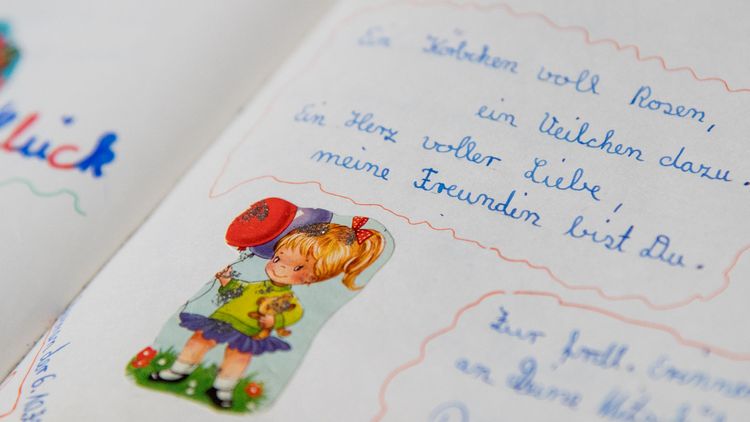

How do values develop in different political systems? Social scientist Stefan Walter explores this question in an unusual way: He analyses entries in poetry albums.
The cover is velvety, flowers adorn the cover. Carefully written and lovingly illustrated, the book pages are filled with words of wisdom and sayings such as "Diligence in your youth will later bear golden fruit". For many generations, poetry albums were and are a treasure that they treasure for a lifetime. They harbour memories of school friends, teachers, parents, grandparents and acquaintances.
These albums are also a treasure for Dr Stefan Walter - but from a scientific perspective: the sayings in the slim volumes reflect, among other things, the values of the people who wrote them. For example, whether they were religious, valued work and achievement, or whether they praised friendship or strength of character. "As a social scientist, I am interested in how these ideas change over time," says Walter.
Finding the change in values in everyday objects
Researchers usually use surveys to gather information on how people's views change. However, this method also has disadvantages, explains Walter: as soon as respondents know that they are part of a study, their answers may be influenced by the questions. A circumstance that could distort the results of a study. Walter wanted to avoid this typical problem of empirical social sciences, known as "reactivity", and find the change in values in everyday objects.
In his search for a suitable topic for his doctorate, his choice fell on poetry albums. - A stroke of luck, as it turned out. As an adolescent, Walter had kept one himself and in his research he found what he could remember: "Attitudes and values are often very explicitly reflected in the sayings," Walter reports. And the short texts were not written in response to specific questions. The albums also have a long tradition. People have been writing to each other in the family album since the 16th century - a custom that was originally practised by adults.
What effect did the political framework have?
However, this changed in the middle of the 19th century. Since then, it was children and young people, especially schoolgirls, who frequently kept poetry albums until the end of the 20th century. "The books allow us to observe values over a long period of time and compare how they develop in different political systems," says Walter. He is also interested in how the political conditions in the GDR and the former West Germany affected the entries in the albums.
However, before Walter, who is a research assistant at the Institute of Educational Sciences, could begin his work, he first had to collect albums. For two years, he used his personal environment and academic networks to find people who wanted to make their memory books available for research. In the end, he received 84 albums from 65 participants, which had been created between 1949 and 1989. He also asked the senders about important facts such as age, place of residence or when they had kept the album.
"Every generation has its own sayings"
This method of collecting the albums is not representative. Nevertheless, thanks to careful work, it is possible to examine connections and recognise fundamental trends, explains Walter. He evaluated around 2,800 entries, analysed the texts and sorted the sayings into 20 value categories. Among other things, he found that there are very typical, traditional sayings, such as "Noble be man, helpful and good", which appear again and again. However, the researcher also found that entries are not repeated over time: "Every generation has its own sayings," he reports.
Walter also found general tendencies - for example, that religious sayings were mainly written down by family members. Or that verses that thematise religiosity or a sense of duty appeared less and less frequently in the albums over time. Walter interprets this as an expression of modernisation. However, it was not only the themes themselves that changed over time, but also the way in which the entries reflected values: "At the end of the 1940s and in the 1950s, the sayings were very imperative," says Walter, adding that the values were unequivocally reflected. "Work! Joy comes naturally!" can be found in an album from 1960, for example.
Retreat to traditional values typical of repressive states
Over time, the entries in poetry albums from West Germany in particular reflected classic bourgeois values such as education or the pursuit of knowledge less and less. When they did, they tended to be implicit - for example, when an English teacher praised the knowledge of foreign languages in his entry. In the "GDR albums", on the other hand, this change is barely discernible: "The discourse is frozen here," says Walter. Teachers in particular, who wrote in their pupils' albums, often fell back on the classics. For the social scientist, this shows that the state ideology of the GDR was not reflected in the values of the citizens. On the contrary: "The retreat to traditional values is typical of repressive states. Such attitudes make people less vulnerable," he explains.
The results of his doctoral thesis and subsequent analyses confirm Walter's belief that a look at poetry albums provides a differentiated view of values in East and West - even beyond surveys. The social scientist continues to study the topic and hopes to gain further insights for his research into the short texts. "After all, the results are not set in stone," he says. His dream is to collect and archive even more poetry albums in order to make them accessible to researchers in the long term.
In a public lecture on Thursday, 31 January, in the lecture hall of the Landesmuseum Natur und Mensch Oldenburg (Damm 38-44), Stefan Walter will talk about his research on poetry albums. The lecture entitled "Why poetry albums? Albums as an object of research and collection" begins at 6.15 pm. The event is part of the series of lectures "Forschungsgegenstände: Knowledge Production at (University) Collections", offered by the Institute of Material Culture together with the Institute of Biology and Environmental Sciences and the University's Library and Information System.