
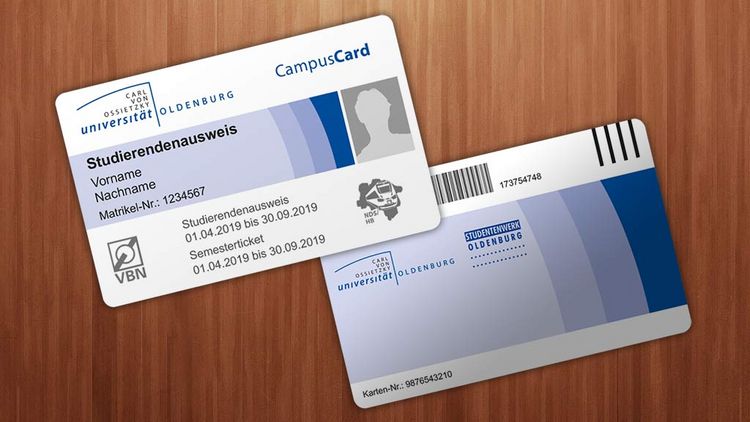

Student ID card, time recording chip, semester public transport pass: anyone entering and leaving the University of Oldenburg currently needs several cards. That is set to change soon. The new CampusCard is due to be launched in the spring. Preparations are underway; for example, students are currently being asked to upload a photo of themselves to Stud.IP. What can the card do? Who will it be introduced for, and when? Vice-President Jörg Stahlmann provides an overview in this interview.
QUESTION: Mr Stahlmann, under your leadership, the university is set to introduce a CampusCard. What benefits do you expect it to bring?
ANSWER: First and foremost, our students are set to benefit from the CampusCard: we are replacing their paper ID cards with a durable, forgery-proof card that will offer them added value in future. However, our staff, visiting students and guests at the university will also benefit.
QUESTION: What can the card do?
ANSWER: First and foremost, it serves as proof of affiliation with the university. Library users will be able to borrow books with it in future. For students, the CampusCard will also serve as a semester public transport pass – replacing the current fold-out ticket. Furthermore, the card will enable cashless payments in the canteen, the use of lockers and, for our staff, the digital recording of working hours. Existing systems will be gradually migrated to the CampusCard.
QUESTION: When will students receive their new CampusCard?
ANSWER: The roll-out is taking place in stages. Students will be the first to receive the card, namely for the 2019 summer semester. The CampusCard will be issued in the spring.
QUESTION: Will the card be valid straight away?
ANSWER: Yes. For students, it will immediately replace the paper ID card and serve as a semester public transport pass. In future, students will need to activate the card’s functions – such as the semester public transport pass – themselves each term at terminals that will then be available on the campus. This can only be done once the re-registration for the following semester has been completed in full and by the deadline. The card can then also be topped up with credit at the machines.
QUESTION: What does the introduction of the card mean for processes within Student Services?
ANSWER: At present, the student ID card and the semester public transport pass are still sent out every six months as a fold-out leaflet. This is very time-consuming. With the CampusCard, this paper document is no longer needed, and we gain more time for student services.
QUESTION: Similar card systems are already in use at other universities and higher education institutions – including Jade University of Applied Sciences. Are there any synergies?
ANSWER: We benefit greatly from the experience others have already gained. This includes Jade University of Applied Sciences, where – as at Emden/Leer University of Applied Sciences – a card system is already in use. There are even concrete synergies via the Studentenwerk, which also runs the canteens at those campuses. For example, our new CampusCard will also be able to be used to pay in the canteens there.
QUESTION: Will it then only be possible to pay by card in the canteen in future?
ANSWER: No. Nobody will be forced to top up their CampusCard with money in order to buy food.
QUESTION: What about the security of the data on the card?
ANSWER: The card will meet all data protection requirements, as it contains only the personal user data that is absolutely necessary for its functions. Ultimately, it merely establishes an encrypted connection to the systems running in the background. If the card is lost, no information can be read from it. As for the personal information visible on the card: this is limited to the details already shown on the student ID booklet and the library card – for example, surname, first name and student ID number. Only the passport photo is new and is required for the card to function as a semester public transport pass. As a visual form of identification, the CampusCard thus offers additional protection against misuse.
QUESTION: The university’s decision to introduce a CampusCard was helped to take shape by the AStA in 2016 – the student union presented its own proposal. Is it still involved in the process?
ANSWER: The student representatives played an important role and, through their initiative, accelerated a process that was also desired by the Presidential Board. Since then, the CampusCard has been a university project, requiring investment in new processes, hardware and infrastructure. The AStA remains an important project partner – not least because, as a contractual partner of the transport association, it must make the necessary arrangements for the semester public transport pass.
QUESTION: What are the next steps?
ANSWER: We are currently working flat out to prepare the system for our students. On the one hand, this involves processes relating to enrolment. On the other hand, it also already includes the services linked to the use of the canteen and library. In addition, decisions need to be made regarding the technical system – from the multifunctional chip card to the terminals mentioned.