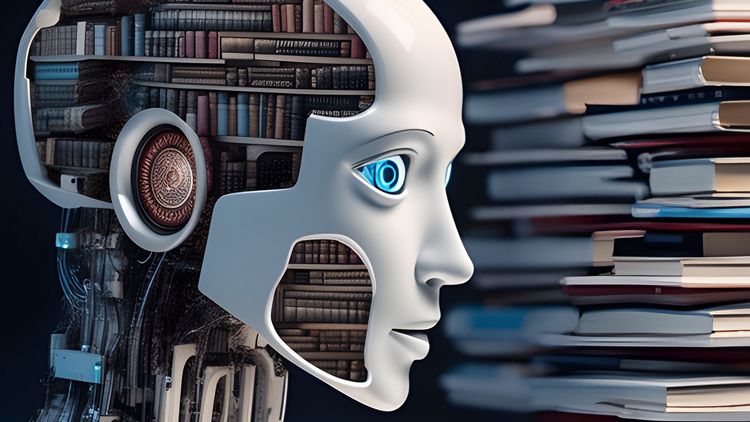

The use of artificial intelligence (AI) at universities is the topic of a new research group headed by Heinke Röbken. The team is investigating fields of application and the use of AI in research, administration, studying and teaching.
How do universities use artificial intelligence (AI) in research, administration, studying and teaching? A new research group, coordinated by university researcher Prof Dr Heinke Röbken from the University of Oldenburg, is looking into this question. Bielefeld University and the Northern Business School in Hamburg are also involved in the project "KIWIT: Functions and Consequences of Artificial Intelligence in the Organisation of Science and Higher Education - Innovation Analysis and Transfer Development". The Federal Ministry of Education and Research (BMBF) is initially funding the project in the "Science and Higher Education Research" funding priority with a total of almost two million euros over four years, of which around 660,000 euros will go to the University of Oldenburg.
The interdisciplinary research group looks at the fields of application and use of AI from a sociological, information and management science perspective. The aim is to investigate the effects of AI-based technologies on the academic and university system over a longer period of time - on the one hand with regard to the research activities of academics with a focus on the humanities and social sciences, and on the other hand with regard to university organisation and the practice of studying and teaching. The team will also look at knowledge-intensive organisational and working structures beyond the academic world.
AIas a tool and subject of research
The researchers not only view AI as a research object, but also use the technology itself as a tool to analyse large, freely accessible databases on the internet. In doing so, they want to gain new information about the scientific system and its structure and uncover previously unknown patterns. The team plans to develop and test new AI applications itself and combine these processes with social science methods.
The research group will have around 20 members, including six doctoral candidates, student assistants and research assistants as well as a renowned scientific advisory board. In addition to Röbken, the four-member management team includes the organisational sociologist Prof. Dr Stefan Kühl from Bielefeld University, the organisational researcher Prof. Dr Marcel Schütz and the computer scientist Prof. Ernst Reinking from the Northern Business School in Hamburg.
The plan is to use AI methods such as machine learning, data mining, text mining, computational linguistics and the machine analysis of social media discussions on the topic of AI together with qualitative approaches such as interviews in the six dissertation projects. The team expects to gain new insights into how AI can be used effectively in academia and in human resources and organisational development in general. Transfer is therefore a particular focus. The researchers want to draw up guidelines for the use of AI in academic organisations and develop further training courses.
The research group is expected to be active for up to eight years. During this time, a website and a blog will report on the progress of the work. A project podcast is also planned. In addition, annual summer schools can network the group's work within the scientific community. The planned publications are aimed at a scientific and an application-interested audience.