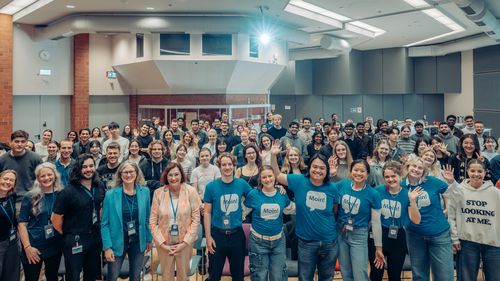
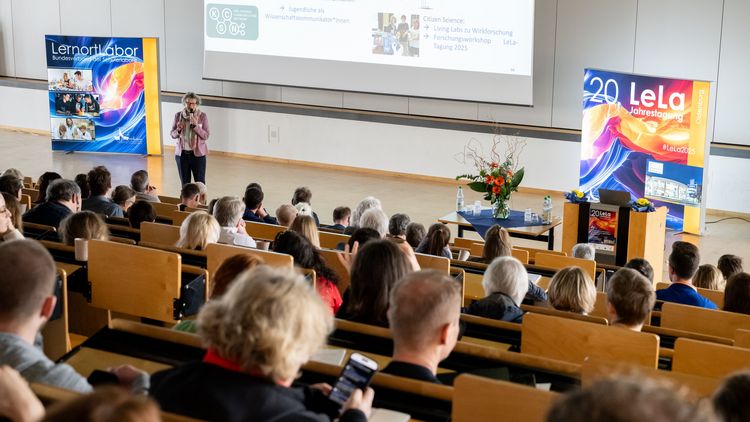

How can school labs promote young talent in the STEM subjects and humanities? Around 180 people from Germany, Austria, Switzerland and Hungary discussed these questions at the 20th annual conference of Lernortlabor e.V., the federal association of school laboratories.
"How is a tide actually formed?" and "Can you represent justice with building blocks?" are two of the many practical experiments that participants at the annual conference were able to engage with at the university and in the region. The federal association organised the multi-day event together with the Oldenburg Teaching-Learning Laboratories (OLELA) and the Didactic Centre (DiZ) at the University of Oldenburg - with a programme both in and outside the city. The guests, including employees from various learning laboratories, for example from museums, science centres and universities, visited the Technology and Nature Learning Centre in Wilhelmshaven, the Oldenburg Regional Environmental Education Centre and the Green School in the Botanical Garden. Eight teaching and learning laboratories at the university also opened their doors: in the physiXS laboratory, for example, visitors were able to try out for themselves how structures form on the coast and how coastal protection works using a simulation basin filled with sand and water. In the ethics workshop, participants realised that there are different dimensions of justice and that these can be represented in different ways. The programme also included lectures, workshops and a poster exhibition.
The eleven Oldenburg teaching and learning labs are available to students and teachers for learning, working and exchanging ideas. They offer space to transfer sound knowledge into practice in an independent and reflective manner, thereby introducing children and young people to scientific topics outside of school. The experiences that students gain with schoolchildren are incorporated into the professionalisation process of the teacher training course and often also into final theses.
School classes from the region regularly visit the laboratories as part of everyday university life. Student teachers from various subjects develop experiments as part of compulsory modules, which they then carry out together with the pupils. "Many experiments extend the curricular content of the respective class levels, for example in topics such as building physics or sustainable energy supply. Everyday objects such as wooden skewers or garden hoses are used, as well as equipment that is only available at university," says Prof Dr Michael Komorek, Head of the physiXS student laboratory. According to the principle of "learning through teaching", the students expand their knowledge and didactic skills through the programmes offered in the teaching-learning lab. "They not only offer pupils an attractive opportunity to experiment or think, but also deal with didactic models and diagnostics," says Komorek.
Dr Sarah Huck, lecturer at the Institute of Philosophy, has this to say about the ethics workshop: "With simple questions and age-appropriate objects such as children's books and building blocks, we can introduce children at primary and elementary level to ethical topics as well as pupils at secondary levels I and II."