

When it comes to the protection and utilisation of nature, we have evidently made oversimplified assumptions up to now. An international team of researchers has analysed more than 1100 grasslands on five continents in order to gain a more differentiated understanding of this ecosystem. Among them: Oldenburg biodiversity expert Helmut Hillebrand.
An ecological puzzle that has been a source of concern to scientists for decades is the question of exactly how biodiversity and productivity - i.e. the creation of new biomass through plant growth, for example - are linked. An international team of researchers, including Hillebrand, has now been able to solve this puzzle and describes the connection between the number of species and productivity in a new way in the renowned research journal "Nature" - namely as a reciprocal relationship.
This means that the previous approach, which saw biodiversity as either a trigger or a consequence of the productivity of an ecosystem, falls short of the mark. The scientists, under the aegis of US ecologist and first author Prof Dr James Grace, developed a statistical model that takes into account various influencing factors such as soil conditions, precipitation and solar radiation - and in this way reveals how biodiversity and productivity are related to each other and to other factors. This should also enable more differentiated predictions to be made on the question of how human intervention in nature can have an impact.
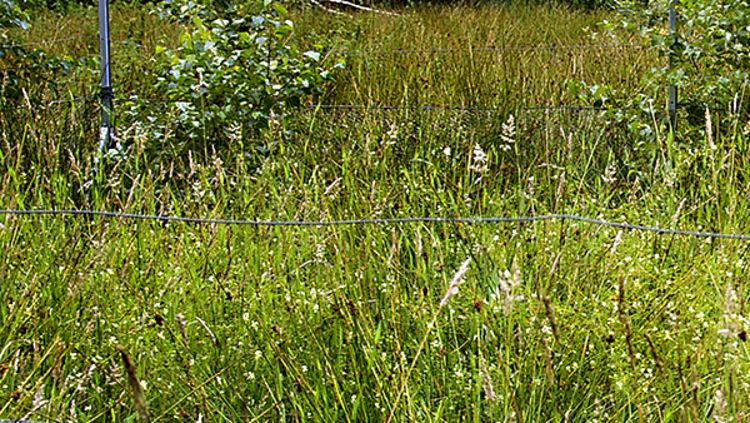
Data from 1126 grasslands on five continents, which the research team collected and jointly analysed in a global experiment using the same methods, form the basis of the model. Grass or pasture landscapes are among the most important terrestrial ecosystems and are quite diverse: conditions in the South American pampas or the North American prairie are different from those in the African savannah, for example - or the rather boggy grassland near Papenburg, the characteristics of which Oldenburg scientist Hillebrand spent seven years compiling for the research network ("Nutrient Network").
Across all these different areas, the scientists can now make statements that generally apply to the grassland ecosystem under natural conditions in the field. "We are now seeing correlations whose significance we previously only knew from controlled experiments," says Hillebrand. For example, the influence of plant biomass on plant diversity can be shown: More biomass leads to shading, a stronger competition for sunlight that some species cannot withstand. The influence of precipitation can also be quantified, for example.
At the same time, the researchers proved that species diversity increases the productivity of grassland. "Among other things, we show that biodiversity plays a central role in the function of the ecosystem," says co-author Hillebrand.
Previous approaches have often failed to do justice to the complexity of ecological reality: "At best, they visualised patterns and ignored the mechanisms," says Hillebrand, who heads the Planktology working group at the Institute of Chemistry and Biology of the Marine Environment (ICBM). Together with other researchers, he now wants to transfer the model to aquatic ecosystems and analyse how strong and which mechanisms are at work in natural habitats below the water surface.