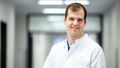
Six years after it was established, the medical degree programme has produced its first graduates. Johannes Grone is one of them. The young doctor is currently undertaking his specialist training in Oldenburg. He feels that his degree has prepared him well for everyday medical practice.
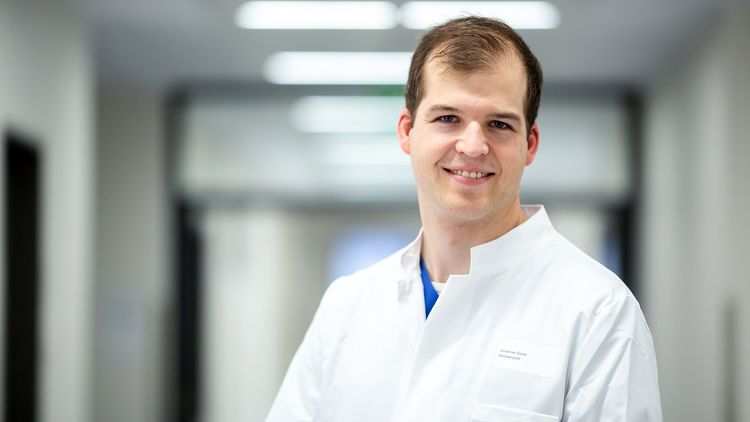
He comes towards us down the hospital corridor: tall, with an open gaze and a friendly smile. Johannes Grone is clearly at ease in his new working environment at Oldenburg Hospital. Just a few months ago, he was one of the very first medical students at the European Medical School Oldenburg-Groningen (EMS); he is one of the first four graduates. “I’m relieved and glad that I managed to complete my degree so well – and now I’m still a bit nervous about what day-to-day medical practice will actually entail,” says the 29-year-old, who was born in Göttingen, describing his current state of mind.
Clinic Director Prof. Dr Andreas Weyland is delighted that Grone has decided to undertake his specialist training at the University Clinic for Anaesthesiology, Intensive Care Medicine, Emergency Medicine and Pain Therapy (AINS) at the hospital, thereby ensuring he remains in Oldenburg: “Over the next five years, he will be working alongside many colleagues here and getting to know all aspects of our speciality.” Weyland is certain that the young doctor is extremely well prepared thanks to his studies. “Johannes Grone has already demonstrated that he is resilient, eager to learn and a team player. He has also internalised a patient-centred approach at the EMS. All of these are essential prerequisites for working here at the hospital.”
“We had the opportunity to get actively involved early on in our studies.”
Grone arrived at the University of Oldenburg in 2012 and, without top marks in his Abitur, secured the very last place on the Medicine programme at School V - School of Medicine and Health Sciences. He brought with him a wealth of experience – gained whilst performing his community service in the ambulance service and during his time as a paramedic. Thanks to his outstanding credits, he was awarded a Germany Scholarship six times and was consistently among the top students. Throughout this time, Grone, together with his 39 fellow students, always saw himself as part of the bigger picture: “We had the chance to help shape the degree programme. That’s truly unique,” he says, his enthusiasm palpable. “Over the next few years, we’ll be able to show that we’ve become good doctors.” The young doctor particularly appreciated the personal support and guidance he received from the experienced doctors in the clinics during his studies. The practice-oriented teaching approach, which is characteristic of Oldenburg University Hospital, was also important to him. “Even in the early years of our studies, we were sometimes treated like doctors during our clinical year. That was very rewarding. We also had the opportunity to play an active role very early on and had direct contact with patients.”
For Andreas Weyland, these particular ‘Oldenburg advantages’ stem from the effective combination of theoretical foundations with practical and communication skills in the model degree programme. Developing this, however, took time. It is therefore not surprising that Grone and his fellow students from the first cohort found the degree programme and the compulsory year at the University Medical Centre Groningen (UMCG) to be a real challenge in many respects. “Many structures still had to take shape; processes weren’t yet well-established at the start.”” Today, he can also see the value in this pioneering role: “I was among the first to gain practical experience in Groningen as well. That definitely strengthened me on my journey.” Here and there, he was able to gradually find his feet as a doctor, which he saw as a major advantage.
For the newly qualified doctor, this period of finding his feet is now over, though the workload remains high. Alongside his specialist training, Grone is currently working on his doctoral thesis, which he is writing at the University Clinic for General and Visceral Surgery at the Pius Hospital in Oldenburg.
He also continues to do voluntary work: for example, with the volunteer fire brigade or as a doctor on call for the Red Cross. He now calls Oldenburg his home, and he still feels a strong connection to the School. “I can imagine getting involved in teaching at some point. I’d also like to conduct research into anaesthesiology or emergency medicine one day,” says Grone. His degree programme, which includes a great deal of research-based learning, will have prepared him well for this.