

In the REENEA project, scientists led by sociologist Jannika Mattes are researching the regional energy transition as a social process. The initial results from Oldenburg are now available - and generated discussion at a stakeholder workshop.
Question: "In your opinion, what characterises the Oldenburg region as an arena for the energy transition?" Answer: "We know our way around there, people speak Platt, there are no mountains". Innovation researcher Prof Dr Jannika Mattes uses a quote to describe what her research team heard during interviews with various stakeholders in the regional energy transition. The list makes the audience smile, but for the researchers it reveals a key insight: Oldenburg's stakeholders are characterised by strong regional ties and strong networks.
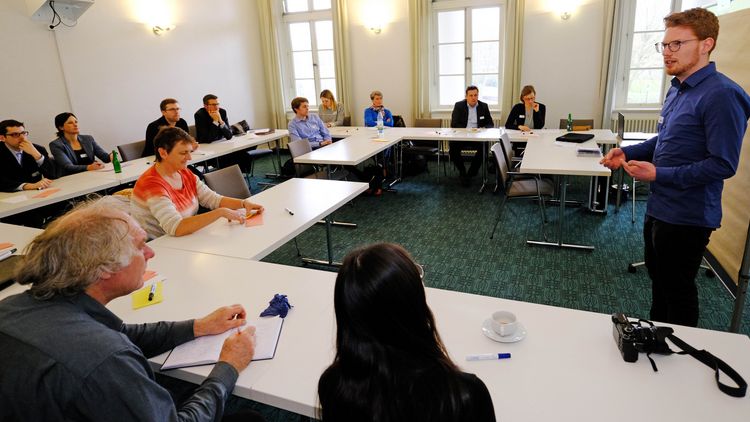
Around 20 participants came to the PFL Cultural Centre on this afternoon at the end of March to discuss the results of the "REENEA - Regional Energy Transition: Social Negotiation, Standardisation and Learning Processes in the Wind Energy Sector" project with the researchers. Among them are scientists from various research institutions such as the DLR Institute of Networked Energy Systems and the ForWind Centre for Wind Energy Research. They will be joined by representatives from energy suppliers, local authorities, banks, planning offices, experts and members of the Oldenburg Energy Cluster OLEC, the largest cross-technology energy network in north-west Germany.
Feedback to interview partners
"We are inviting people to this workshop to review the results of our first case study. We are deliberately seeking feedback from our interview partners from the field," says Mattes. Over the course of the afternoon, the participants also want to develop joint strategies on how the scientific findings can be utilised by politicians, planners, administrative staff and other stakeholders.
Mattes has headed the Emmy Noether Group REENEA for over a year. Alongside her, the team includes Dr Camilla Chlebna, Meike Löhr and Sebastian Rohe, whose interdisciplinary composition draws on expertise from sociology, political science, economic geography and sustainability management. The German Research Foundation is funding the group for a total of five years. During this time, the researchers will analyse the energy transition in a total of six selected regions - with a particular focus on the social processes that make up this process of change. In their interviews, for example, they want to find out how those involved negotiate the decisive processes with each other. What self-image do they develop in the process? What learning processes do they go through? Are there power games and, if so, how are they played out?
Well networked in Oldenburg
For the recently completed Oldenburg case study, the REENEA researchers conducted 26 qualitative interviews - with wind turbine operators, representatives of universities and research institutions, employees of trade associations, civil society actors, various service providers in the industry as well as administrative staff and politicians. The first realisation: people are well connected in Oldenburg - many of the players studied together and took their first career steps at the same time. "Some people perceive Oldenburg as a mecca for the energy transition," explains Mattes.
"We have also noticed a tendency to experiment - which is of course also due to the university and its affiliated institutes, which are very much perceived as the nucleus of renewable energies here," adds the sociologist. Another characteristic is the comparatively high level of social acceptance for wind farms in the region. However, this acceptance is slowly declining and conflicts are increasing.
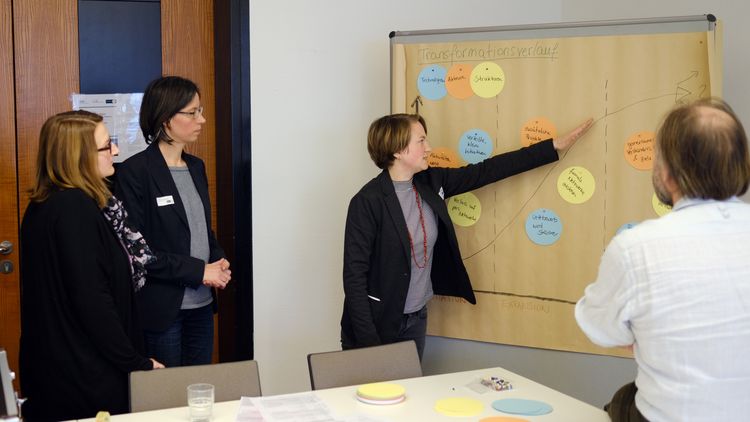
Dwindling acceptance is a trend that was also discussed in the subsequent workshop: What can plant planners, approval authorities, local politicians and civil society do to make wind farms more acceptable? REENEA researchers Sebastian Rohe and Meike Löhr collected cards on a pinboard with key words from the participants, such as: "Explain the end of project to local people in good time", "Get involved in the region in the long term, including socially", "Offer local residents preferential participation in the wind farm". The demand to the approval authorities was similarly clear: "Service instead of prevention authority" is a central keyword here.
The EEG and the consequences
The declining support at national level, for example through the Renewable Energy Sources Act (EEG), which has capped the annual expansion of renewable energies since 2016, was also discussed. The researchers' surveys have already revealed alternative strategies - such as companies endeavouring to expand their business areas or operate more internationally in growth markets.
The next example region the REENEA team is looking at includes the Uckermark - a region in which wind power is currently being expanded particularly strongly. According to initial research, the upward trend is not being well received by residents - many have the feeling that they are not personally benefiting from the prospering energy industry. This is a phenomenon that the researchers will be looking into intensively over the coming months.