
Writing a seminar paper, bachelor’s or master’s thesis can be quite a challenge. Students of the humanities and social sciences can find support through the ‘Writing Support for Term Papers and Theses’ service, run by PhD students.
Narrowing down topics, selecting methods, researching literature, structuring content – anyone facing a seminar paper or dissertation has to answer many questions and make numerous decisions. Keeping track of it all isn’t always that easy.
To give students the opportunity to discuss any hurdles, problems and questions relating to academic writing with an experienced writer in a relaxed setting, the ‘Writing Support for Coursework and Theses’ scheme has been running for a year . The idea, conceived by the initiators Rea Kodalle, Anke Görres and Dr Maxi Berger, is to bring students and PhD candidates together in writing tandems to engage in dialogue. The programme is a co-operation between the 3GO Graduate School and the ZSKB-Lernwerkstatt. It is aimed at students of the humanities and social sciences and is funded by study quality funds.
Common misconceptions about the writing process
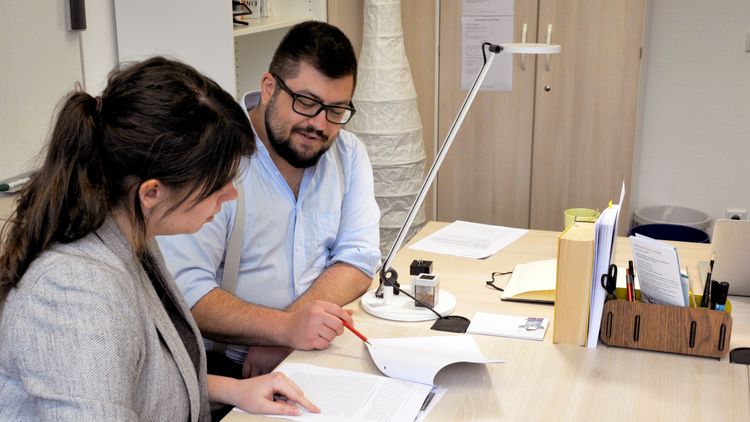
Alexander Max Bauer has been part of a writing tandem since autumn 2018. The former student of politics, economics and philosophy has been working on his PhD since April 2017. “From my own writing projects, I’m all too familiar with the obstacles and pitfalls I’ve fallen into. Furthermore, as a tutor and lecturer, I’ve been able to gain an insight into where common shortcomings and problems lie,” says Bauer, explaining his motivation. In his experience, one of the most serious misconceptions is a false idea of the writing process. He believes it is important to make students aware that the actual writing is only one part of the work and that careful preparatory work and subsequent revision are just as important.
However, when advising students, he sets aside his own ideas of an ideal writing process: “The writing process is highly individual. That’s why it doesn’t help anyone if you pass on your experiences in a patronising manner.” Rather, through targeted questions from their respective tandem partner, students should find the right direction themselves and identify options for making progress with their work. “The ability to solve problems actually lies with the students themselves, not with us,” says Bauer. Helping students to help themselves is the guiding principle.
Bauer’s tandem partner, Janina Schmid*, is currently writing her Master’s thesis in the subject of social sciences. It was her supervisor who suggested she apply for the writing support programme. “At the start, I was quite overwhelmed by the scope of the thesis. It would have worked out somehow – after all, it did with seminar papers and my Bachelor’s thesis. But I’m glad that I now have the opportunity to talk about my concerns and problems with the thesis in a relaxed setting,” she explains. The feedback from her supervisor has been positive: after the first few weeks, progress is already visible, for example in the structure of the thesis.
PhD students develop advisory skills
Each tandem is allocated twelve hours for joint meetings – based on a specific project and a six-month period. To get an idea of the students’ wishes and expectations in advance, they must apply for the programme by submitting a letter of motivation of no more than one page. The PhD students receive a fee for their work.
For them, the project is also a great opportunity to reflect on their own writing process and to acquire advisory skills – not just for the university context. The programme includes regular workshops and coaching sessions for participants, in which staff from the Lernwerkstatt and a professional coach teach them writing and advisory techniques. “It’s a process in which we learn a great deal too,” says Bauer.
Students who would like to take part in the writing support programme during the summer semester can find further information on the 3GO website. All places for PhD students are currently filled.
*Name changed by the editorial team