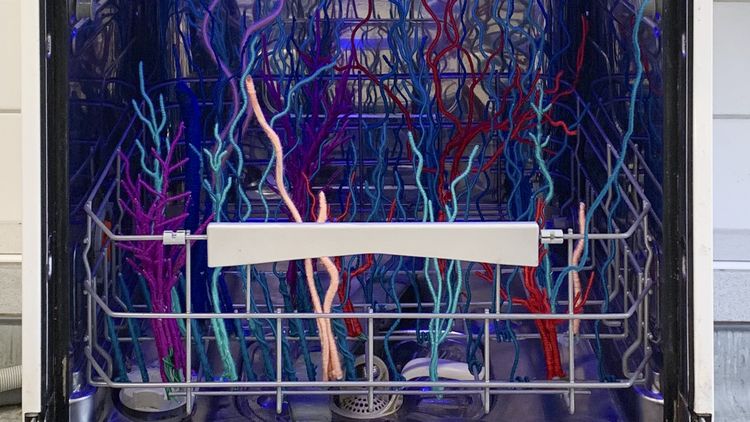
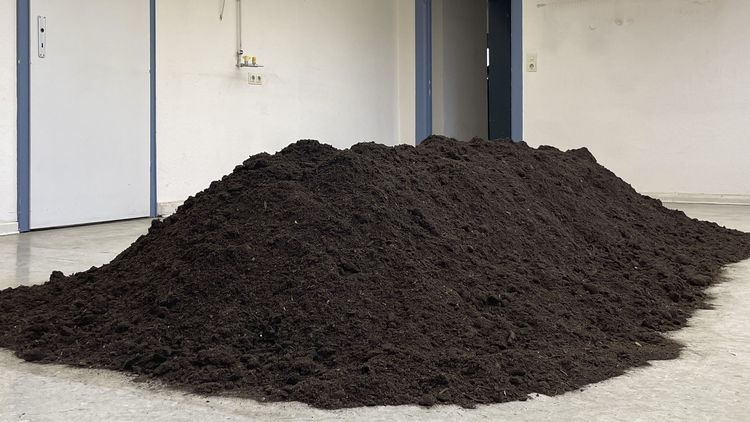
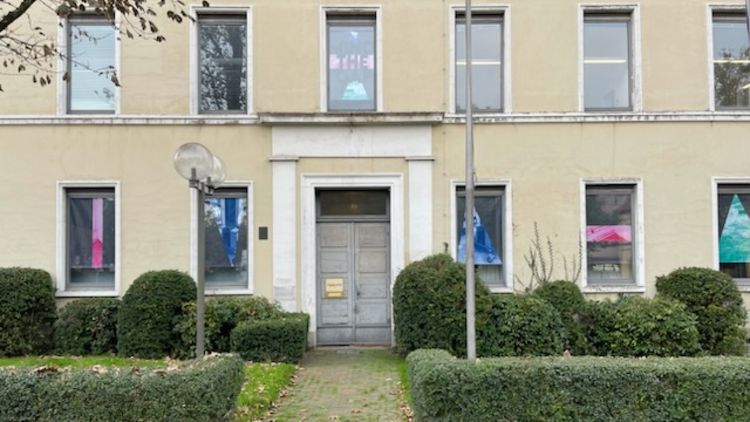


Last semester, 26 art students explored the concept of the niche in sculptures and photographs. Their artistic works can be seen until 9 November in empty rooms at the Landesmuseum Natur und Mensch.
"Mind the Gap - Artistic Searching in the In-Between" is the title of the exhibition, which can be viewed on Thursdays between 6 p.m. and 9 p.m. and on Saturdays from 1 p.m. to 5 p.m. in guided tours. What makes it special: Empty, unrenovated rooms of the Landesmuseum Natur und Mensch served as the starting point and field of experimentation.
"It's exciting to see what happens to our empty rooms when art takes them over," says Dr Ursula Warnke, Director of the Landesmuseum Natur und Mensch, who also teaches at the university. "The connection between art and our themes has a firm place here in the museum, at the latest with the permanent exhibitions organised by a trio of artists. It plays an important role in communication and mediation."
As part of their artistic work, 26 students have spent a semester exploring the tension between the visible and the invisible, the hidden and the processual, and have investigated further questions relating to the definition of architectural, ecological, social and artistic niches. "In contrast to classical sculpture, sculpture in these works was conceived from the perspective of space, focussing on the niche, the hollow, surrounding and intermediate space and bringing the invisible, hidden and processual to the fore," says Anna Holzhauer, sculpture lecturer at the Institute of Art and Visual Culture.
Photography lecturer Franziska von den Driesch adds: "The photographic works also approach the concept of the niche, the gap, the in-between space from very different angles. Classic documentary photography plays a role here, as do experimental analogue and digital techniques. Photography is not understood here as a pure medium of depiction, but as a multi-layered narrative form between the levels of time and reality."
For example, Alina Behrend explored the aesthetics of moorland landscapes, Aileen Castelli documented the interiors of highly specialised specialist shops and niche shops, and Mariele Dierks implemented the idea of the blind spot as an interactive installation.
On 2 and 9 November, presentations by participating students invite visitors to discuss the artworks. Both events start at 6.00 pm. The meeting point for the guided tours on Thursdays and Saturdays is in front of the building (Damm 46). Admission is free, donations are requested.