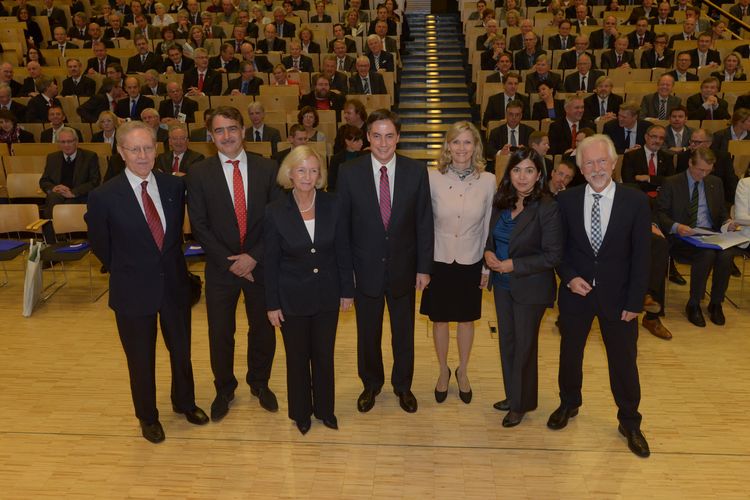

The European Medical School Oldenburg-Groningen (EMS) is regarded as unique in Europe. Around 600 invited guests attended its opening ceremony today in the Audimax at the University of Oldenburg, including Lower Saxony’s Minister-President David McAllister.
Also present were the Dutch Honorary Consul Hylke Boerstra (representing Marnix Krop, Ambassador of the Kingdom of the Netherlands), Lower Saxony’s Minister for Science, Prof. Dr Johanna Wanka, and Aygül Özkan, Lower Saxony’s Minister for Social Affairs, Women, Family, Health and Integration.
“Impetus for the healthcare sector”
The European Medical School Oldenburg-Groningen is the highly visible result of the 30-year co-operation between the Universities of Oldenburg and Groningen, explained Prof. Dr Babette Simon, President of the University of Oldenburg, right at the start of the event. “With its cross-border structure, the European Medical School is unique in Europe. Together, we are breaking new ground in medical teaching and research and providing impetus for the development of the healthcare sector in our region. This will also directly benefit patient care.”
Prof. Dr Sibrand Poppema, President of the Rijksuniversiteit Groningen, emphasised: “With the European Medical School, we now offer a German-language medical programme based on the Groningen model, in addition to Dutch- and English-language medical programmes. This enables us to train doctors for the whole of Europe, particularly for north-western Germany, which is facing a shortage of doctors. ”
Practice- and research-oriented teaching concept / Hearing research in an excellent position
The European Medical School Oldenburg-Groningen (EMS) stands out in particular for its teaching concept, which is both practice- and research-oriented. Research focuses on the key areas of ‘neurosensorics’ and ‘healthcare research’. Hearing research is already excellently positioned within the field of neurosensorics and is recognised both nationally and internationally. This summer, the University of Oldenburg scored highly in the federal and state governments’ Excellence Initiative with its ‘Hearing4all’ cluster of excellence. The University of Oldenburg is leading the consortium on hearing, having submitted the successful proposal jointly with Hannover Medical School and Leibniz University Hannover.
The new University Medicine Oldenburg has been made possible through the university’s collaboration with Oldenburg General Hospital, Oldenburg Evangelical Hospital and Pius Hospital Oldenburg. Close co-operation with the Karl-Jaspers-Klinik and with GPs in the region complements University Medicine Oldenburg.
“Making innovative treatment methods even more widely available”
“With the EMS, we aim to establish first-class medical education at the University of Oldenburg and further expand our research,” emphasised Prof. Dr Eckhart Hahn, Dean of the School of Medicine and Health Sciences, recently established at the University of Oldenburg. This would make innovative treatment methods even more widely available in the region, according to Hahn.
“It is wonderful that there is now a School of Medicine in north-western Germany too,” explained Prof. Dr Folkert Kuipers, Dean of the School of Medicine and Health Sciences and a member of the Executive Board of the Universitair Medisch Centrum Groningen (UMCG). “This will enable Dutch and German medical students to familiarise themselves with healthcare in both countries.”
Medical degree programme has been running since 1 October / High demand, special selection procedure
The first 40 students from Oldenburg on the pilot degree programme in Human Medicine began their studies on 1 October. From day one, a strong practical focus shapes everyday student life. This means that the future doctors have immediate contact with real-world challenges: each week, a patient and their condition are presented; the entire academic week is structured around this case. Problem-based learning, profession-specific communication training and a strong focus on research characterise the degree programme.
There is considerable interest in the new degree programme. 1,253 young people applied for the 40 places, 250 of whom were from countries outside Europe. In addition to A-level results, the university placed particular emphasis on communication skills during the selection procedure.
Students from Oldenburg spend at least one year of their six-year course in Groningen. Students from Groningen also have the opportunity to study for a year in Oldenburg. The aim is to provide students with in-depth insight into another European healthcare system. The degree programme culminates in the State Examination. In addition, EMS students can obtain a Master’s degree in ‘Geneeskunde’ at the partner university in Groningen.
A boost from funding by the State of Lower Saxony / Broad support from the city and region
The State of Lower Saxony is providing around 17 million euros over the first two years to establish the EMS. A total of 57.5 million euros is set to be invested in the project by 2015. Of this, 8.5 million euros comes from the ‘Niedersächsisches Vorab’ programme.
On 12 November 2010, the German Council of Science and Humanities – the most important advisory body on science policy for the federal and state governments – paved the way for the German-Dutch joint project with its favourable vote – and thus for the establishment of a new medical centre at the University of Oldenburg. However, the university has been engaged with the field of medicine since as far back as 1971. At that time, the university’s founding committee had set up a ‘Planning Commission for Medicine’ in the hope of establishing a medical faculty. For financial reasons, these plans could not be realised.
The financing pledged by the Lower Saxony state government and the formation of the EMS Founding Committee gave the EMS a further boost in mid-2011. But broad moral and financial support for the German-Dutch joint venture also came from the city and the wider region. Leading business representatives contributed several million euros.
In the summer of 2012, after more than 20 years, a medical school was thus established in Germany for the first time: the School of Medicine and Health Sciences at the University of Oldenburg.
More on the topic
Press release from the State Chancellery of Lower Saxony at www.stk.niedersachsen.de School V - School of Medicine and Health Sciences