

More people than ever before accepted the invitation to the Parliamentary Evening organised by University Medicine Oldenburg (UMO). Participants learnt how the location in the north-west intends to contribute to improving healthcare in Lower Saxony in the coming years - and what support it needs from state politics to achieve this.
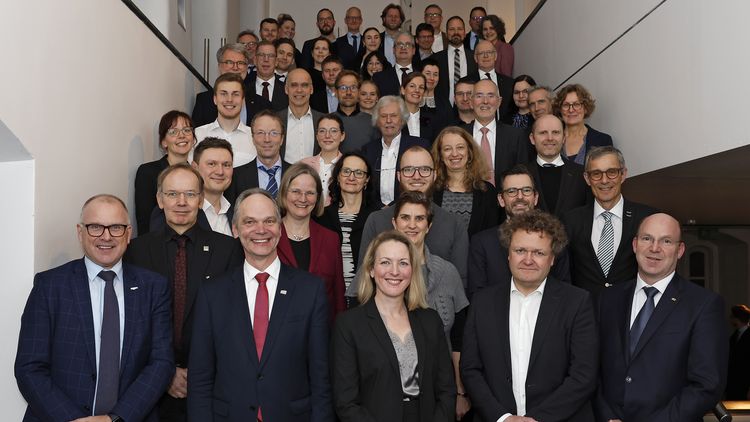
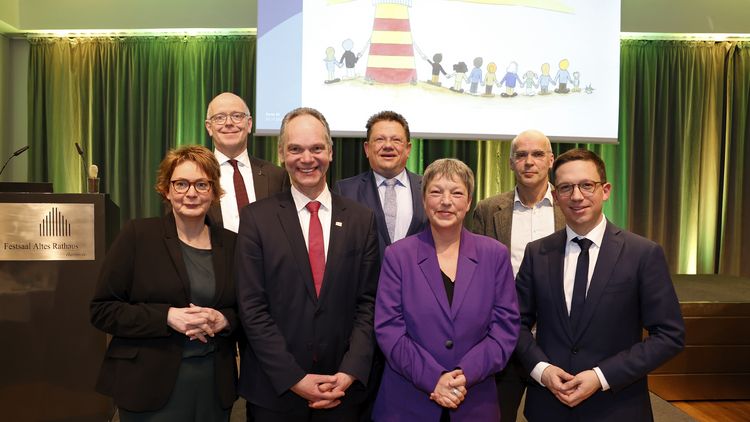
The more than 120 guests were welcomed by, in her own words, a "passionate fan of University Medicine Oldenburg": State Parliament President Hanna Naber. As a native of Oldenburg, she has supported the founding of the still young location from the very beginning. "Oldenburg seems to be well positioned in terms of the training and care situation," she said, summarising what had been achieved.
In addition to several ministers, including Interior Minister Daniela Behrens and Health Minister Dr Andreas Philippi, numerous members of the state parliament, guests from associations and representatives of the cities and districts in the north-west came to the Old Town Hall in Hanover.
Mohrs announces "show of strength"
Science Minister Falko Mohrs clearly stated the topic that unites and concerns everyone: "We need more study places in Lower Saxony because we need more doctors." At the same time, he emphasised the challenges associated with the increase from 120 to 200 medical study places planned for Oldenburg. In particular, the research and teaching buildings required would result in high costs. "It will be a feat of strength," he announced, but left no doubt that this must now be "tackled and led to success".
With University Medicine Oldenburg, he has a good partner at his side, replied University President Prof Dr Ralph Bruder: "This is a feat of strength that we have been mastering for over ten years." He explained what is important for the needs-based expansion of Oldenburg as a medical centre over the next few years from the university's perspective. In addition to the necessary financial support that the university needs to be able to cope with the increase to 200 study places and the implementation of the governance model that has already been developed, which links the university and its cooperating hospitals more closely at an administrative level, the location must be classified as a maximum care provider.
University Medicine Oldenburg as a maximum care provider
The background to this demand is the announcement by politicians to concentrate the services of around 170 hospitals in Lower Saxony and then categorise the hospitals as basic, specialist and maximum care providers. Currently, only the university hospitals in Hanover and Göttingen are categorised as maximum care providers.
In this context, Rainer Schoppik, CEO of Klinikum Oldenburg, pointed out the special structure of University Medicine Oldenburg. The more than 20 university clinics are spread across four co-operation hospitals: the Clinical Centre, the Pius Hospital Oldenburg, the Evangelical Hospital Oldenburg and the Karl Jaspers Clinic. "University Medicine Oldenburg fulfils the requirements of a maximum care provider together," he emphasised. A pragmatic solution was therefore necessary to recognise the quality of care at the location.
The practical example of a five-year-old patient showed how co-operation between the hospitals already works today. Thanks to the cooperation established across hospital boundaries, it was recognised at the age of eight months that she was deaf and appropriate care and treatment with cochlear implants was initiated. In a video clip, guests were able to see that the girl can now hear and speak normally.
Mohrs also emphasised that research on the topic of hearing at the location also has an impact on the region. "The Hearing4all cluster of excellence is something that improves the lives of people in Lower Saxony in concrete terms," he said.
Research for the people in the region
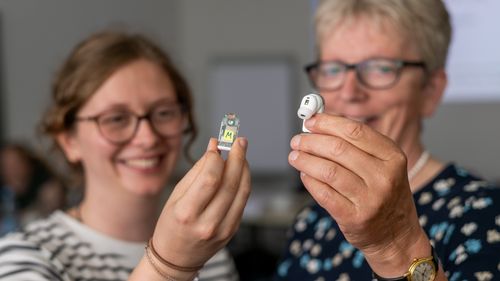
Other research projects that presented their work at the parliamentary evening also aim to improve medical care in Lower Saxony. Among other things, scientists are researching how falls in old age can be effectively prevented so that injuries do not occur in the first place, how technical assistance systems can help people to live in their own homes for as long as possible and how telemedicine could also improve care in remote locations.
Prof Dr Hans Gerd Nothwang, Dean of School V - School of Medicine and Health Sciences, called the university's teaching and research programme "Healthcare4all". On the one hand, Oldenburg trains doctors who have the necessary mindset to improve medical care for people in conjunction with state-of-the-art technology, while on the other hand, these very technologies are also the subject of research. "We want to achieve comprehensive care through responsible digitalisation and participation," he said.