

Urban forests are particularly hard hit by the effects of global warming. As part of the ‘Klimaoasen Oldenburg’ project, researchers and students at the university are investigating how such green spaces can be made more resilient to heat and drought, using the Eversten Holz as a case study.
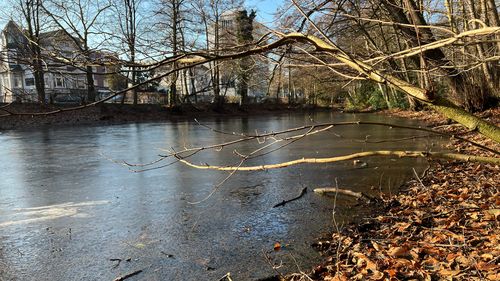
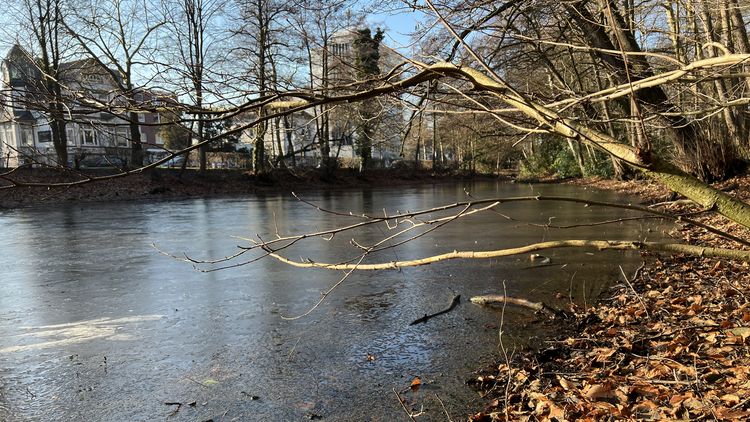
Even in December, the “Pferdetränke” presents a bleak picture. Several shallow puddles are all that remain of the historic water body on the south-eastern edge of the Eversten Holz. The numerous ditches criss-crossing the urban forest also carry no water at the start of winter.
“Climate change is clearly evident in the Eversten Holz,” says Prof. Dr Dirk Albach from the Institute of Biology and Environmental Sciences (IBU). In addition to drought and higher temperatures, falling groundwater levels and storm damage are also taking their toll on the plants, reports the botanist. The woodland, covering a good 22 hectares and situated just one kilometre from Oldenburg city centre, is thus typical of many urban green spaces: These areas often suffer particularly severely from the consequences of global warming – partly because cities are generally hotter than the surrounding countryside, but also because they are subject to greater stress from traffic, air pollution and construction work than more rural forests.
Albach is leading a university project that is taking a closer look at the environmental changes in the Eversten Holz. Based on their observations, the researchers aim to draw conclusions on how the woodland can be adapted to the new conditions. The research forms part of the City of Oldenburg’s ‘Klimaoasen Oldenburg’ (Oldenburg Climate Oases) initiative, which is led by the ‘Natur und Mensch’ State Museum and funded by the Federal Ministry of Housing, Urban Development and Construction under the ‘Adaptation of Urban Areas to Climate Change’ funding programme. The aim of the project, which was launched in early 2022, is to make the Eversten Holz and the Oldenburg Palace Gardens resilient to climate change. A large proportion of the total funding of five million euros is earmarked for the practical redesign of the two green spaces and for engaging with the local community.
Students investigated soil, water, flora and fauna
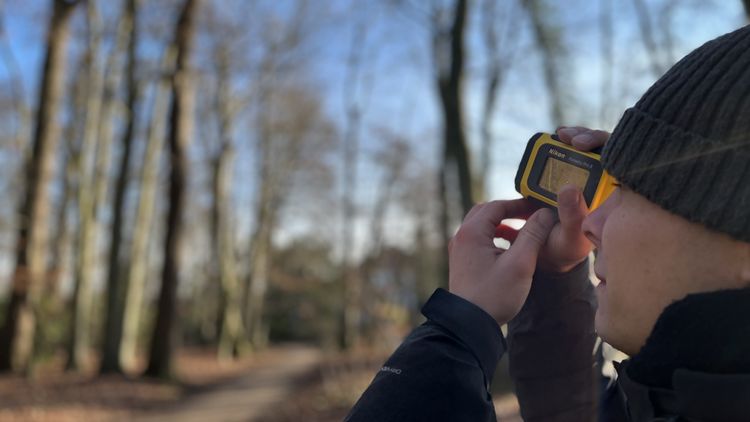
Throughout the three-year project, the university will carry out accompanying research, which will take place exclusively in the Eversten Holz. The findings of the various studies are to be presented at a scientific conference at the end of the project. They will also form part of a travelling exhibition being developed by the State Museum. Dirk Albach is delighted that students are able to carry out biodiversity research on site as part of the project, which has practical benefits. The first step was a comprehensive environmental survey carried out by students on the Environmental Sciences degree programme during the last summer semester. Working in groups of four or five, the participants focused on the topics of soil, water, fauna, flora and land use in the Eversten Holz. They mapped soil types, calculated the amount of carbon stored and determined the groundwater level. They recorded the range of plant species, counted breeding birds and investigated how the local population uses the forest.
“The environmental study forms the basis for a better understanding of the Eversten Holz ecosystem and its development,” explains Albach. One key finding is that this area of woodland is a biodiversity hotspot within the urban area. The coexistence of various habitat types – such as grassy areas, shaded woodland and still waters – means that strictly protected species such as the Alpine newt and the greater mouse-eared bat thrive there. The horse trough, although not in good ecological condition due to pollution and low water levels, nevertheless proved to be a particularly valuable biotope: Specialised ground beetles and amphibians inhabit the banks and the reed beds, bats hunt over the open water, and waterbirds nest in the reeds.
Changes can also be identified – thanks to an environmental study carried out by another group of students back in 2010. For instance, the forest now has more open areas, probably because some trees have fallen victim to drought and storms. As a result, a thicker layer of herbaceous vegetation has formed on the ground, which was previously absent in most areas. The students discovered more invasive species, including the particularly aggressive Japanese knotweed.
The groundwater level is crucial
The team also made a forecast for the future: for native trees such as oaks and beech to be able to survive hot summers in the future, the development of the groundwater level will be the key factor. The city’s project proposal envisages redesigning the drainage system. Currently, it drains water away from the formerly damp woodland, but in future, rainfall is to be retained within the Eversten Holz as far as possible. In addition, the horse trough, which has become silted up due to excessive nutrient inputs, is to be dredged.
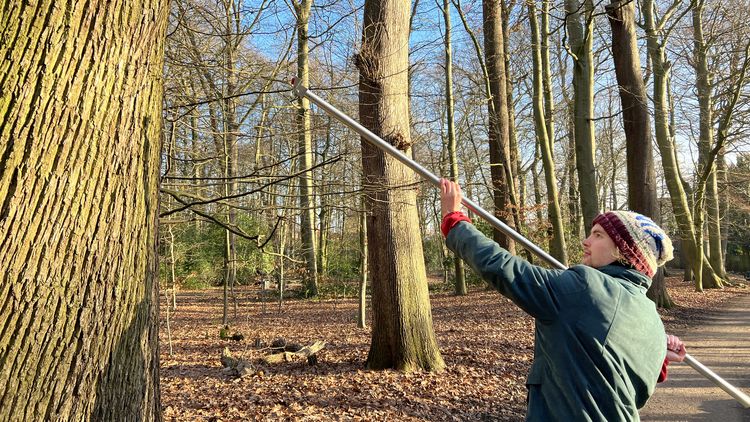
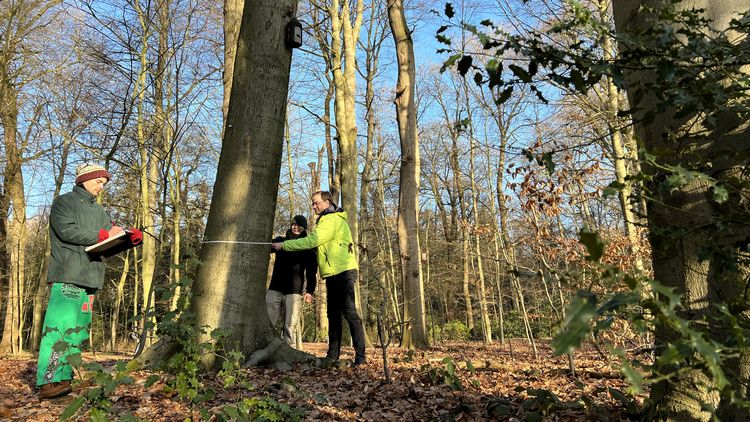
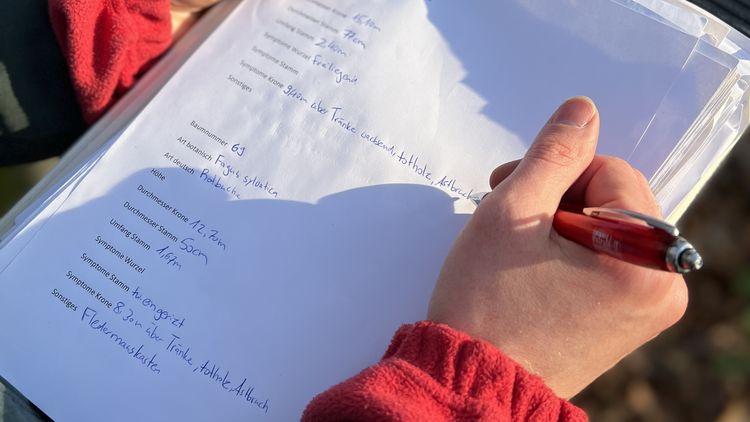
This measure provides the impetus for a further study by the IBU: using modern genetic methods, the community of single-celled organisms is to be analysed before and after the dredging of the horse trough. Another study will use photographs provided by the local community to investigate how the water level of the water body has changed over the past decades. A ‘Forest Research Booklet’ for school pupils has already been produced as part of a final-year dissertation; furthermore, two student assistants have recently begun compiling a tree register of all some 6,000 trees in the Eversten Holz.
“We can now find out why certain plants grow in one place and not in another, which species are under threat, and how their growth is changing as a result of climate change,” explains Albach. These findings are important for determining which species can be planted as replacements for struggling trees such as spruce or birch within the project. Ultimately, other forests in the urban area will also benefit from this – as will the Botanical Garden, of which Albach is the director. “The ‘Climate Oases’ project is just the starting point,” emphasises the researcher. “Even after that, we must continue to work tirelessly to ensure the long-term survival of these urban green spaces.”