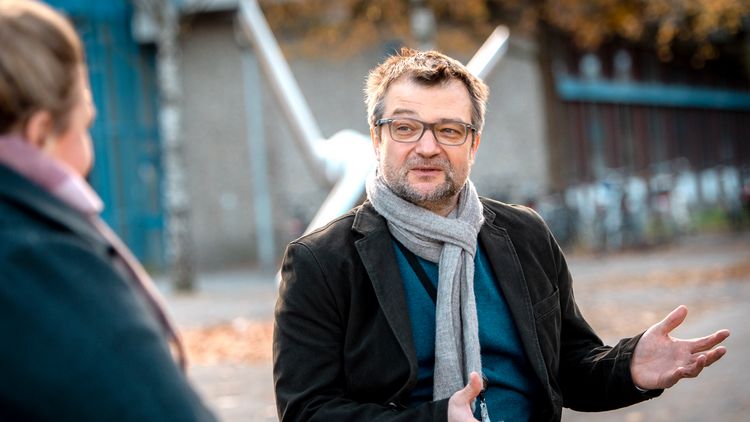

Gunnar B. Zimmermann interviews contemporary witnesses for the oral history project "Remembered Oldenburg University History". Here he slips into the role of the interviewee.
What is so interesting about the history of universities?
Zimmermann: Social change processes can be observed on a small scale at universities. They are places where people are educated who later influence society as leaders, for example. How freely universities operate or the rules under which research and teaching is carried out there therefore also has an external influence.
You talk to many contemporary witnesses. On which topic could you yourself give an exciting interview with a contemporary witness?
I was at the 1989 UEFA Cup final between my club, VfB Stuttgart, and SSC Napoli. While all the players were warming up in exemplary fashion, Diego Maradona put on a show with the ball in front of the main stand where I was sitting. I still have the ticket today.
Do you have a favourite question that you ask all the witnesses?
There is a very open opening question, which I am the only one to announce to everyone in advance: What people and events shaped you before you came to the University of Oldenburg?
How would you answer this question yourself?
My grandmother definitely influenced me. I spent a lot of time with her because my mother went back to school at an early age. I always had a very good time there. I was also influenced by a group of fellow students during my studies. For example, we organised lectures in which professors from different contexts discussed the topic we had chosen. That was the push that showed me that it was my thing to work on something myself, ask questions and find answers.
Can you reveal a little of what you found out in the interviews with contemporary witnesses?
The physicist Prof. Dr Joachim Luther, who co-founded research into renewable energies here in the 1970s, was sceptical about nuclear energy, but was researching a different topic. When he was asked by students about alternatives to nuclear power, he made calculations and recognised the potential of solar energy. So, contrary to what one might think, focussing on this important branch of research was not a strategy.
You have now also recently taken over the management of the university archive. Were you also able to convince Oldenburg as a city?
Yes, I am looking for a place to live. What I really appreciate are the short distances and that it's a bit quieter than Hamburg. I also like the fact that the students characterise the cityscape.
Interview: Sonja Niemann