
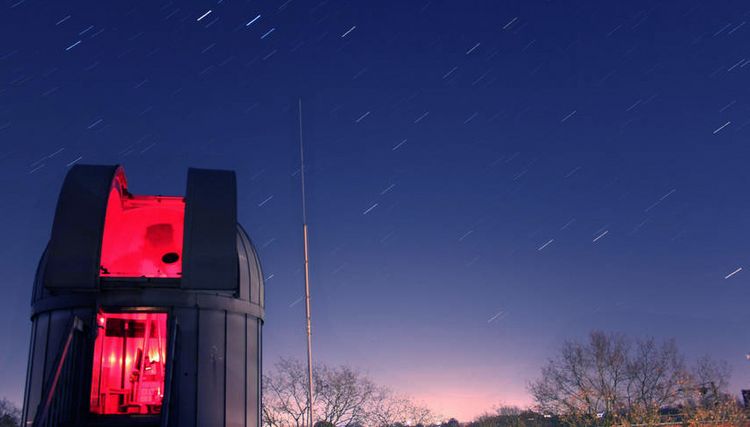

On 21 January 2014, students at the University of London discovered the most important supernova explosion in decades. Scientists at the University of Oldenburg were able to provide early measurement data from the galactic event - which is now being accessed worldwide.
The supernova explosion occurred in the constellation of the Great Bear in the Messier 82 galaxy. Prof. Dr Björn Poppe (Physics), Dr Thorsten Plaggenborg (Chemistry) and Prof. Dr Jutta Kunz-Drolshagen (Physics) have succeeded in taking subsequent brightness measurements before the extraordinary stellar explosion. The scientists at the University of Oldenburg are thus one of the few research groups in the world to have collected early data on the galactic event.
Their measurements have now been published in an international database and are available to scientists from all over the world - who can use the data to develop a theoretical model of the explosions, for example. Astrophysicists are working on this assumption: Findings on the so-called supernova SN2014J have a fundamental influence on the entire understanding of the universe.
"We are currently conducting a study on the use of robotic telescopes at the university. We had the opportunity to use images from NASA's Micro-Observatory Network that were taken shortly after the time of the explosion - even before the London students discovered the supernova," explains Björn Poppe. "We were very quickly able to carry out a series of measurements of the brightness curve."
These measurements are of particular importance, as the brightness initially increases rapidly during a supernova explosion and then gradually levels off once it has reached its maximum. Many physical questions can only be answered with information about the early phase of the brightness increase.
According to common explanatory models, in the "supernovae 1a explosions", mass is initially continuously added to the burnt-out old star - astrophysicists refer to this as a white dwarf - until the gravitational force is sufficient to initiate a new nuclear fusion. This suddenly releases so much energy that the entire star explodes. As the ignition always starts at a similar mass, the course of the explosion allows conclusions to be drawn about the distance to the progenitor star.
"The explosions serve us as 'standard candles', so to speak - as objects that are assumed to always have the same known absolute brightness. The further away they are from Earth, the dimmer they become. As the supernova SN2014J has been the closest explosion to Earth for decades, the measurement results serve to calibrate the 'standard candle' as precisely as possible," explains Plaggenborg. "In addition to gaining a more precise understanding of the physical process, we will be able to better determine distances and make more precise statements about the development of the universe - for example about its age and the speed at which it is currently expanding," adds physicist Kunz-Drolshagen, who heads the "Models of Gravity" Graduate School at the university.
The Oldenburg scientists are now cooperating with the renowned Institute of Astrophysics at the University of California (Berkeley, USA). A working group there was also able to collect early data on the supernova. The measured values are now to be combined in order to document as complete a record of the brightness curve as possible. To this end, students at the university are currently collecting and analysing further data on supernova SN2014J.
More on the topic
Astrophysics University of Oldenburg
Contact
Prof. Dr Björn Poppe
Institute of Physics
Tel: 0441-2291614