
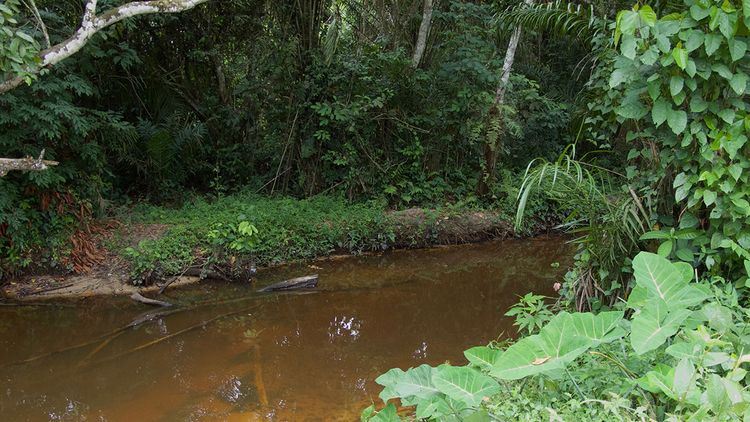

It is not only oceans that store carbon dioxide, which plays a role in global warming, but also tropical river systems. This new building block for understanding the global carbon cycle has now been discovered by an international team of researchers, in which Oldenburg marine researcher Jürgen Rullkötter was involved.
According to Prof Dr Jürgen Rullkötter, science had previously underestimated tropical rivers as a source of carbon dioxide (CO₂) in the atmosphere. Together, researchers from seven research institutions discovered that these rivers also store CO₂ in the form of organic material and release the carbon again when the climate changes.
The study published in the current issue of "Nature Geoscience" is the result of a long-standing collaboration between the Oldenburg Institute of Chemistry and Biology of the Marine Environment (ICBM), the Centre for Marine Environmental Sciences (MARUM) at the University of Bremen and the University of Newcastle in England on ocean sediments as archives for the climate in Central Africa. It focuses on a sediment core that the researchers took 14 years ago at the mouth of the Congo and have since kept frozen for further analyses.
As plants absorb a lot of CO₂ in the warm and humid conditions of the tropical rainforest, but at the same time microbial activity in the soil is very high, the scientists had not expected organic material to remain inland for long. "We had assumed rapid decomposition and were therefore surprised by the astonishing quantities of old organic material in the sediment core off the Congo estuary," emphasises Rullkötter. For example, the researchers found microscopically small pieces of wood that were already 3,000 years old when they were deposited there.
Using molecular methods, this organic material could be assigned to swamp areas. Contrary to what has long been assumed, the Congo basin is not completely covered by rainforest: In the centre, where several tributaries flow into the Congo, there is an area that is permanently covered by water like a swamp. "The area is about the size of Switzerland and was relatively unknown until recently, as it is hidden under dense forest," explains the first author of the publication, Dr Enno Schefuß from MARUM in Bremen. "Any organic material that enters the swamp is largely preserved under the oxygen-free conditions."
The analyses indicate that the swamp must have been much larger in the past and that parts of it dried out in less humid climate phases. The exposed organic material eroded and some particularly resistant components were washed into the ocean by the river - but the main amount was released into the atmosphere as CO₂. "According to this, the ocean sediments are indicators of presumably significant CO₂ emissions on the continent, which may not have been sufficiently taken into account in climate models to date," summarises Rullkötter.
However, he also sees the study as proof of the researchers' perseverance. After the sediment core was extracted almost a decade and a half ago during a cruise by the German research vessel "Meteor", the marine scientists from Oldenburg and Bremen immediately began their analyses. "However, with different objectives, hypotheses and methods - and initially with little success," recalls the former ICBM director. Only further developed methods and new findings, which were also gained by Oldenburg experts on the African continental margin, made the now published study possible.