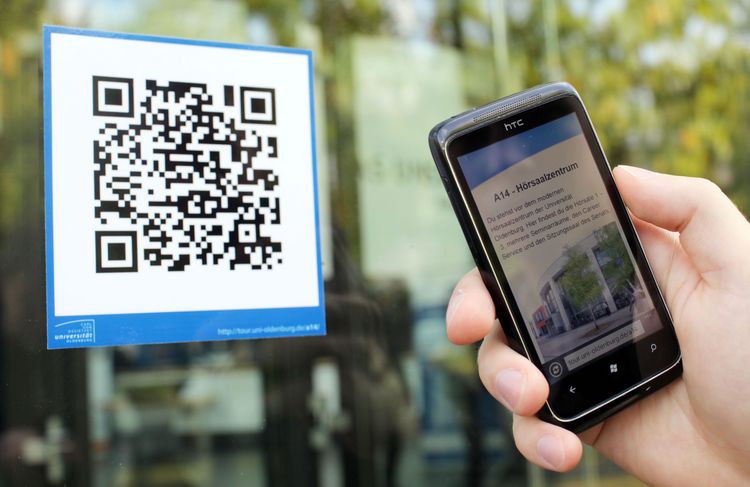
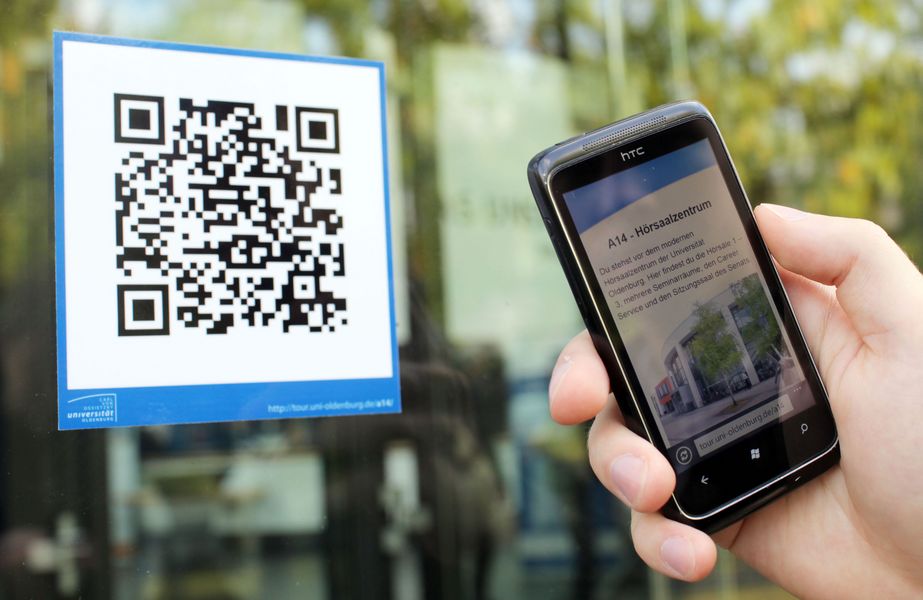
They look as though they’re in desperate need of a bit of a design overhaul: QR codes – those pixelated black squares – are becoming an increasingly common sight, whether on posters, leaflets or beneath a newspaper article. Not for the aesthetically sensitive, but strictly functional and extremely easy to use: instead of typing in a web address, you simply scan the code with your smartphone – and the information appears on your mobile phone. A student project group from the ‘Social Web for Poets’ professional development module has now demonstrated that the technology can also be used to guide people around the campus.
“We wanted to make it easier for first-year students to find their way around,” says Markus Glötzel, head of the new module, which is funded by central tuition fees; the Department of Computing Science / Very Large Business Applications (VLBA) within the Department of Computing Science is responsible for the project. The result of the ten-member project group is a virtual scavenger hunt across the Uhlhornsweg campus. It takes participants past the lecture theatre block, buildings A7, A11 and A5, and on to the library and the central area.
The students have stuck a QR code at the entrance to each building. It links to a website specifically designed for viewing on smartphones. The website contains a description of the current location – and directions to the next stop. “We taught the skills needed to create the websites in the module. For example, there was a basic course in HTML and CSS,” explains Glötzel.
QR codes originally came from the automotive industry, when Web 2.0 was still a long way off. A subsidiary of Toyota developed the first version as early as 1994, at that time for tracking parts in production. With the rise of smartphone technology, QR codes have since become part of everyday life. Now they even count towards exams: the campus tour is recognised as a partial assessment for students on the “Social Web for Poets” module.
The module also aims to examine Web 2.0 from technical, sociological and economic perspectives, says Glötzel. “We have taken a critical look at various tracking techniques – in other words, those techniques that allow user behaviour on the internet to be traced in detail.” The module is funded until the end of the summer semester 2013. “Subsequent groups can therefore update the campus tour if anything changes to the buildings, and add further buildings to it.”