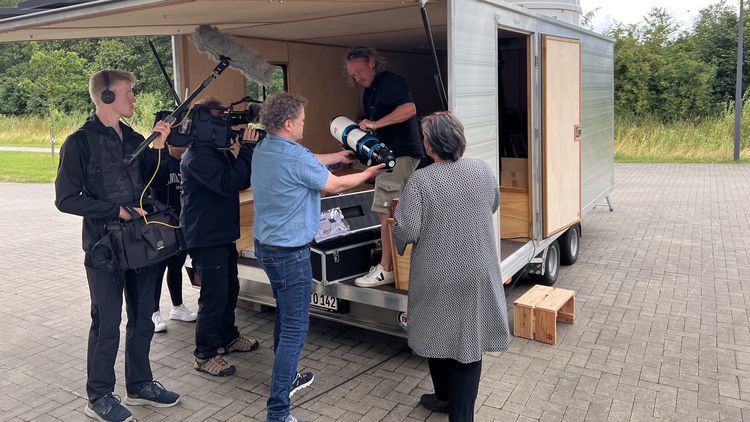


Take a look at the stars - the mobile observatory "Tiny Observatory" makes it possible. This unusual project offers do-it-yourself astronomy with the help of two telescopes and modern technology.
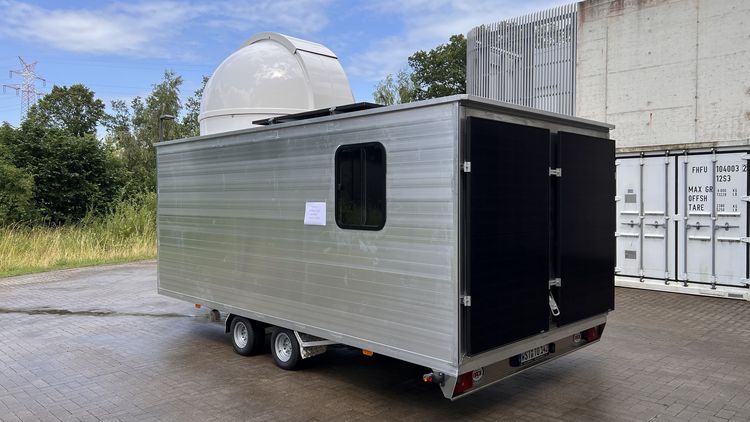
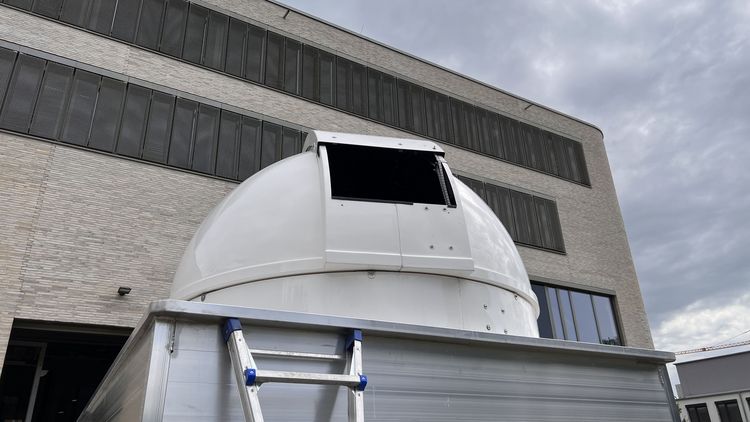
From the outside, it is immediately apparent that this is no ordinary trailer: the silver-coloured box on wheels not only has photovoltaic systems on the doors and roof, but also a striking white dome on the roof. Underneath this, inside the trailer, there is a lifting tripod on which two telescopes are mounted. There is also a projector, a large screen and benches. This equipment makes the unusual construction what it is: the "Tiny Observatory". In the mobile observatory, interested members of the public can look through the telescope themselves under expert guidance or follow what is happening in space on the screen.
The aim of the project's creators is to bring the wonder of space closer to the people. The mobile observatory was conceived, designed and built by employees of the Department of Medical Physics and Acoustics and the Institute of Physics at the University of Oldenburg as well as the LEB (Ländliche Erwachsenenbildung in Niedersachsen e.V.). "The Tiny Observatory gives us the opportunity to bring really exciting astronomy and physics to the people," says a delighted Prof Dr Björn Poppe, Head of the Department of Medical Radiation Physics. Due to light pollution from artificial light sources, it is becoming increasingly difficult to identify objects in the night sky with the naked eye. The mobile observatory is intended to remedy this situation and offer interested parties the opportunity to look into space. The project is being funded by the Federal Ministry of Education and Research as part of the Science Year 2023 - "Our Universe".
The "foundation" of the Tiny Observatory is a trailer the size of a caravan. Employees of LEB's social enterprise b-wohnen, who normally build tiny houses, worked on it for several months. For example, they fitted the trailer with the lifting stand, installed the photovoltaic system and fitted out the interior. The university's physicists were then able to install the centrepiece of the mobile observatory: the reflector telescope and the refracting telescope. "These telescopes allow interested laypeople to gain their first astronomical experience and to take pictures of objects in space," explains Poppe. The Tiny Observatory covers its power requirements with the help of the photovoltaic system, which feeds the energy generated into a battery.
With the help of a computer system and the support of experienced star guides and astronomers, interested parties can control the telescopes themselves and collect their own measurement data. In this way, the project actively involves citizens in research. Poppe and his team also collect measurement data and operate the telescopes by remote control - the development and testing of remote-controlled astronomical measuring devices is one of Poppe's main areas of work. "From the project proposal to the construction of the observatory and the design of the accompanying programme for interested people of all ages, we all worked together for more than a year. Our different areas of expertise make the project particularly exciting and diverse," says Meike Freis from LEB, project coordinator of the Tiny Observatory.
The mobile observatory has been making stops in Oldenburg (Wechloy campus of the university) since 21 July, in Carolinensiel (Gulfhof Friedrichsgroden) from 18 September, in Wiesmoor (Zwischenbergen village community centre) from 7 October and in Wilhelmshaven (Jade InnovationsZentrum) from 5 November. Further information on the background and programme can be found on the LEB website. The mobile observatory will continue to be used for research and by the public.