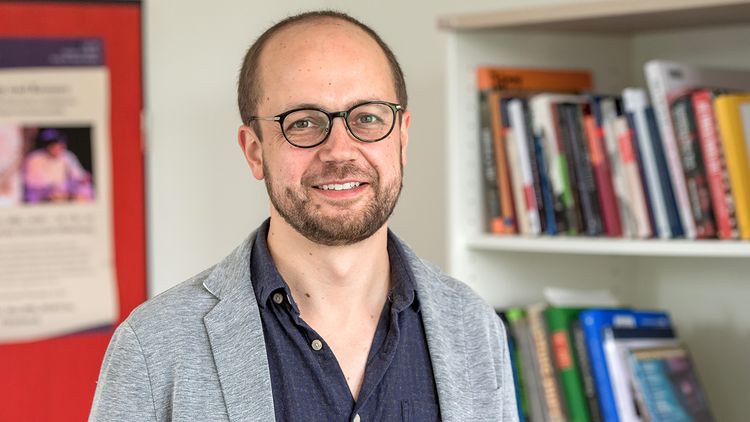

An international research group led by music educator Mario Dunkel is investigating the role that music plays in the rise of populism. The Volkswagen Foundation is supporting the project with almost one million euros.
What do the electoral successes of the AfD, the participation of tens of thousands in Pegida demonstrations or the FPÖ's entry into the Austrian parliament have to do with bands like frei.wild or the self-proclaimed folk rock'n'roller Andreas Gabalier? Quite a lot, music educator Prof Dr Mario Dunkel suspects. Together with colleagues from Hungary, Austria, Italy and the Netherlands, he is conducting a research project to investigate the extent to which commercially successful music is linked to the spread of populist ideologies. The Volkswagen Foundation is funding the project for three years with a total of almost one million euros as part of the "Challenges for Europe" programme.
The cultural dimension of populism
"For some years now, we have been observing in various European countries that, apart from Nazi or right-wing rock bands, very popular musicians are also picking up on populist ideas and thus reaching large sections of society," explains Dunkel. The researchers are analysing this phenomenon of populist, popular music in a total of three project phases, taking Germany, Hungary, Austria, Italy and Sweden as examples. Together, they are first analysing from a musicological perspective which populist elements can be found in commercially successful songs. In doing so, they will analyse the connection between song lyrics, music video and musical parameters such as form, rhythm, melody, harmony and sound.
They then look at the reception of these songs from a sociological perspective. To this end, moderated group discussions with first-time voters are planned in the five sample countries. The final phase of the project will focus on highlighting differences and similarities between the countries.
It is the cultural dimension of populism that the researchers are focussing on in their project. Although populist movements specifically utilise the emotional and identity-forming effect of popular culture, this aspect has hardly been considered in studies to date, says Dunkel. As Europe's leading branch of the cultural and creative industries, music has a central role to play.
Challenge for the European community of values
It is typical of populist ideology, for example, to differentiate between the "corrupt elites" and the "real people". A characteristic that can also be found in Gabalier's songs, says Dunkel: "In 2014, he was criticised in the press for singing an old version of the Austrian national anthem that only said 'sons' and not 'sons and daughters'. In response, he published the song 'A Meinung Haben', in which he criticises the alleged dictatorship of opinion of the elites."
According to Dunkel, anti-democratic tendencies are often closely linked to this camp thinking: "Those who claim to represent the will of the people are not dependent on democratic structures." Populist movements thus question the values on which the European Union is based - such as the democratic order or the protection of minorities. "In order to deal with these changes, we first need to understand them. We want to contribute to this with our basic research," says Dunkel, summarising the aims of the project. The results could also provide starting points for didactic methods that promote a critical awareness of populist cultures - an aspect that is particularly important to the researcher, who has held the junior professorship for music education with a focus on transcultural music education since April 2017.
For years, the 36-year-old's research has focussed on the question of how music is used politically. Among other things, he has analysed West German music diplomacy during the Cold War. The idea for the current project came about rather by chance last summer, from a conversation with his friend and colleague Dr Martin Niederauer. "Martin recommended the book 'The Authoritarian Revolt' by Volker Weiß to me, which led to a conversation about the connection between music and the new right-wing scene," says Dunkel. Shortly afterwards, the Volkswagen Foundation's call for proposals "Challenges for Europe" made it possible to realise a research project on this topic.