
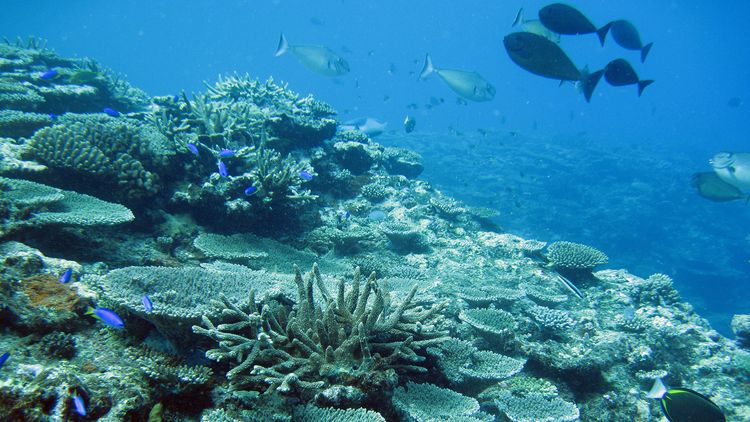
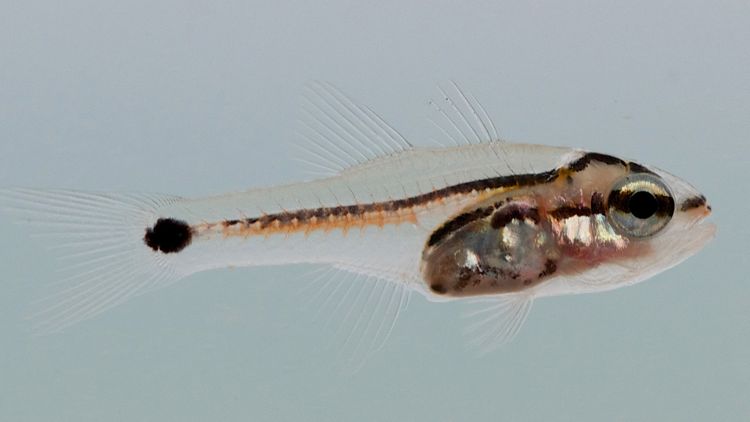
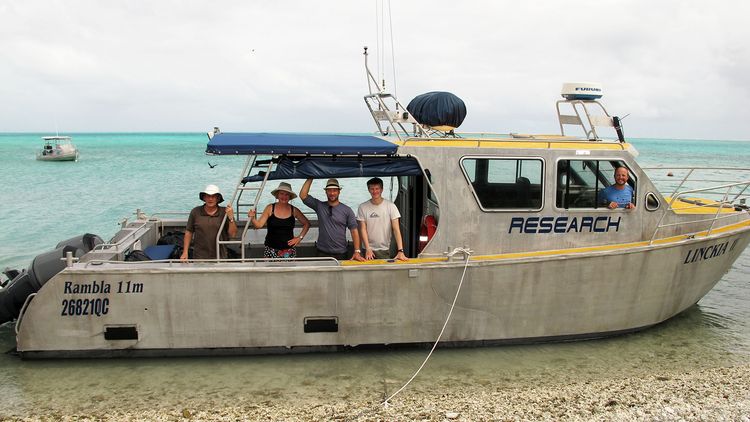


How do coral reef fish find their way to their home reef and what role does the Earth's magnetic field play in this? An international team of researchers led by Oldenburg has investigated the navigational ability of cardinalfish. The scientists showed that the animals can easily orientate themselves using only their magnetic compass. They have now published their results in the scientific journal "Current Biology". The lead authors are Michael Bottesch and Prof Dr Gabriele Gerlach from the Institute of Biology and Environmental Sciences at the University of Oldenburg. Many coral reef fish leave their birthplace as larvae because the reef offers them too little protection from predators. The young animals are not yet able to swim very well, so most of them drift with the current up to 50 kilometres out into the open ocean. However, they have to return to a reef to reproduce and, surprisingly, they very often choose their natal reef for this. Biologists at the University of Oldenburg have been studying the question of how the young fish manage this task for several years. Together with researchers from James Cook University in Townsville (Australia) and Boston University (USA), they spend a few weeks each year on "One Tree Island", a small island on the Great Barrier Reef in Australia, in order to uncover the secret of perfect navigation. In collaboration with the Oldenburg biologist Prof Dr Henrik Mouritsen, who has been researching the sense of direction of migratory birds for years, they have already discovered that the fish larvae can use the position of the sun as a compass during the day. In their recently published study, they investigated the orientation behaviour of the cardinalfish "Ostorhinchus doederleini" at night, when the sun is not available as an orientation aid. The team led by biologist Michael Bottesch used magnetic coils to influence the Earth's magnetic field. And indeed: the fish reorientated themselves when the researchers rotated the Earth's magnetic field using the coils. "This proves that the fish larvae can orientate themselves by the Earth's magnetic field on their way towards their reef - at night and without the help of other directional sensors," says Bottesch. In further studies, the researchers now want to find out exactly how this magnetic compass develops and whether it differs in fish that grow up in different current conditions. If this is the case, fish from a different area with an opposing current would orientate themselves differently. It is also conceivable that this basic orientation of the magnetic compass could be inherited. "A magnetic compass that might help coral reef fish larvae return to their natal reef", Bottesch et al., 2016. Current Biology Vol. 26, Iss. 24
More on the topic
AG Biodiversity and Evolution of Animals AG NeurosensoricsContact
Prof. Dr Gabriele Gerlach
Institute of Biology and Environmental Sciences
Tel: 0441/798-3986