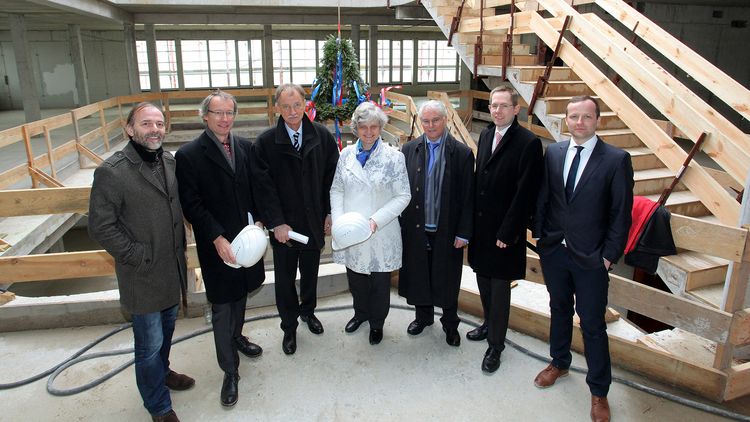

The shell of the new "WindLab" research laboratory for turbulence and wind energy systems is complete. The centrepiece of the new 2,300 square metre building is a turbulent wind tunnel. It is intended to help increase the efficiency of wind farms.
In the WindLab, scientists investigate the interaction of turbulent atmospheric flows with wind energy systems - i.e. wind farms, wind turbines and their components. The aim is to obtain precise data on the operating behaviour of wind turbines and large offshore wind farms. The new building was approved by the German Council of Science and Humanities in 2012 and categorised as particularly worthy of funding. Guests at the topping-out ceremony included Lower Saxony's Finance Minister Peter-Jürgen Schneider and Wilhelm Wickbold, Chief Building Director of the Lüneburg Heath State Building Authority.
"In the context of the energy transition, the importance of wind energy utilisation is constantly increasing. Research into the 'fuel wind' and the utilisation and further development of the existing infrastructure open up opportunities for Lower Saxony as a business and science location and for the development of the entire coastal region. The approximately 20 million euros for the new building are therefore a good investment in the future," said Finance Minister Schneider, who was impressed by the construction progress and expressed his thanks to all those involved in the construction so far.
The four-storey WindLab offers space for over 130 scientists from the fields of physics, meteorology, oceanography and engineering. The new wind tunnel will be used by researchers from the Universities of Oldenburg and Hanover, the Jade University of Applied Sciences, the Fraunhofer Institute for Wind Energy and Energy System Technology (Bremerhaven) and the Max Planck Institute for Dynamics and Self-Organisation (Göttingen).
"With the WindLab, we are expanding our research in the field of renewable energies in a future-oriented manner and at the highest technical level. We are also relying on close networking and cooperation with numerous experts who will use the Oldenburg turbulent wind tunnel," emphasised Prof. Dr Katharina Al-Shamery, Acting President of the University of Oldenburg, at the topping-out ceremony.
The Oldenburg scientists, led by wind energy expert Prof. Dr Martin Kühn, turbulence researcher Prof. Dr Joachim Peinke and energy meteorologist Dr Detlev Heinemann, were responsible for the content of the proposal for the new research building. Compared to wind tunnels, such as those used in aviation, the university's turbulent wind tunnel can simulate wind fields as they occur in nature. "Until now, experiments in the wind tunnel have always been carried out under particularly low-turbulence conditions," explained physicist and turbulence expert Peinke at the topping-out ceremony. However, this does not correspond to reality, especially in the field of wind energy. Wind turbines are exposed to up to 100 million gusts of wind over an operating period of 20 years, which poses extreme challenges for materials and technology. "With the new wind tunnel, we are now able to carry out precise tests on turbulence developments on rotor blades, individual model wind turbines or turbines in wind farm arrangements," says Peinke. The investigations should help to increase the efficiency of wind farms and avoid technical and financial risks.
The WindLab was designed by Stuttgart-based architects HammesKrauseArchitekten. The total costs of around 20 million euros are being borne equally by the federal government and the state of Lower Saxony. The WindLab should be ready for occupancy next year.