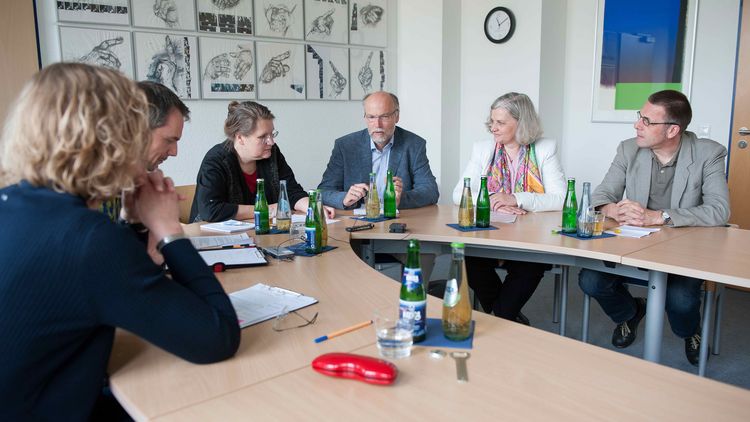


The University of Oldenburg celebrated its 40th birthday in 2014. What makes it special? What should education look like in the future, and how can students' thirst for knowledge be encouraged? An exchange of views between Katharina Al-Shamery, Sabine Doering, Birger Kollmeier and Niko Paech.
QUESTION: Mrs Al-Shamery, you came to Oldenburg in 1999 as a university lecturer in physical chemistry. How did you find the early days?
AL-SHAMERY: I was immediately involved in discussions about projects that were exciting and, above all, interdisciplinary. Biologists were discussing patina on paintings and sculptures with archaeologists, historians, philosophers - and even chemists like me, for example. Something like that was completely new to me. The discussion with the didactics departments was also completely different here. At other universities, they always had a wallflower existence and were somewhat ridiculed. And here they were right in the middle of it. To this day, I value precisely this different culture at the University of Oldenburg - it makes it special. And it is probably also the reason why many colleagues are happy to stay, even when they receive high-calibre appointments.
QUESTION: Mr Kollmeier, what was it like for you?
KOLLMEIER: I remember exactly when I started. At 33, I was the youngest professor in the department when I was appointed to the University of Oldenburg in 1992. In Göttingen, I was on first-name terms with all the students and the students were on first-name terms with me. Then I came to Oldenburg, addressed everyone as "du" - and everyone addressed me as "du". That was a bit of a culture shock. Overall, the first few years were not so easy as the youngest with the largest group of 16 people, with a lot of equipment and the corresponding space requirements, but they shaped me, for sure.
QUESTION: Ms Doering, did you also experience a culture shock when you came to the Institute for German Studies in 2001?
DOERING: Yes, you could say that, in a positive sense. I particularly remember the spirit of optimism at the Institute and the department at the time, but it was also accompanied by uncertainty. I was just under 40, there were a handful of colleagues under 50, the rest were approaching retirement. It was an exciting time in which we younger people were given responsibility very quickly. I had a very different experience in Bavaria. Here, in Oldenburg, I suddenly had the chance to help shape the Institute and its working conditions. Back then, I encountered a strong and, at first glance, seemingly homogeneous generation of founders who vacillated between nostalgia, perseverance and a wonderful self-confidence.
QUESTION: Mr Paech, you came from the city council in 2001 ...
PAECH: That's right, I was Agenda 21 officer in Oldenburg for three years. Then a position was advertised: A project from the Federal Ministry of Education and Research, it was about sustainability research with a view to markets and companies. Of course, I knew the university beforehand and it had a good reputation. I quickly realised that it was not only good at sustainability research, but also had a very good standing due to its openness to problems affecting society as a whole. Later, after my habilitation, I naturally had many more opportunities to actively shape research projects. But there is another important point for me: what I really like is that this university has an interdisciplinary character that is otherwise only known from Sunday speeches. It's something that's always talked about - especially by university and science policy-makers - but is rarely put into practice.
QUESTION: Mr Kollmeier, you are considered one of the university's scientific figureheads and are responsible for the Hearing4all cluster of excellence, among other things. If you had to put it in a nutshell: what is important to you in your research?
KOLLMEIER: Advancing basic scientific knowledge. In the cluster, we are dedicated to hearing, an extremely complex system that we want to understand better - and that is not possible without constant learning, and in an absolutely interdisciplinary field, as it is set up here in Oldenburg, I completely agree with Mr Paech. And for me, that's the essence of it: looking at something from different angles and gaining more knowledge about the underlying structure and the system.
"Excellent research in the humanities can sometimes do without third-party funding. Above all, it needs what is hardly available anymore: time."
Sabine Doering
QUESTION: Mrs Doering, as a humanities scholar, you probably have other priorities?
DOERING: Well, what we all have in common is that we are committed to scientific principles. And that we strive to get closer to the truth. Nevertheless, I often experience a certain alienation towards what we literary scholars deal with - also because I can't say so quickly: Society is directly improved by what I do. But literary studies is very important. I am convinced that art, in its various media of expression, is an anthropological constant and a deep human need. We have to look at what the arts produce if we want to understand who we are and the big questions we have to deal with.
QUESTION: Can you give us an example?
DOERING: When I deal intensively with literature and thinking around 1800 in my work - one of the most important periods in recent literary and intellectual history - I help to understand how ways of thinking and decisions came about that we are still dealing with today. And I am not directly concerned with usability. Rather, it's about the historical depth of our present, which must be the subject of sound academic reflection. Appreciating this requires a different perspective. Because academic appreciation is often measured in terms of third-party funding and staff numbers. And that is wrong. Excellent research in the humanities sometimes manages without third-party funding. And above all, it needs what is hardly available in my School due to the increasing number of supervisory tasks: time.
PAECH: That's right, we economists also lack the time to develop creative and problem-orientated theoretical content. Because we are rushed. We constantly have to show how many projects we have and how much they weigh. It's a kind of physical, sometimes meaningless process of evaluation: we say that the project doesn't weigh anything because only 350,000 euros have been approved. Another is more important because it has brought in twice as much. But the question must be asked first and foremost: What is the benefit to this company of carrying out a particular research project or developing a particular corpus consisting of many employees and responsibilities?
"Personality development must play a major role
"
Katharina Al-Shamery
QUESTION: Have universities ultimately become blind to the problems of society?
PAECH: They often seem to me like the cocktail bar on the Titanic. Where the bartender wonders how he can optimise the cocktails while the ship is already leaning. To name just one example: The 2008 financial crisis has not been dealt with socially. No consequences were drawn from it. In view of the many instabilities in the monetary and financial system, we really are on the Titanic. Where are the economic alternatives? We need to reflect more on the changes that need to be made in order to make a society more crisis-proof. And the resilience mentioned here would be predestined for interdisciplinary collaboration.
KOLLMEIER: To stay with the metaphor: I feel more like the professor in the cocktail bar. Ultimately, we have two currencies: one is money, the other is time. It is a question of efficiency as to how much time we can spend on acquisition, which we are forced to do in order to be able to realise research under certain conditions. Accordingly, I don't think that reducing it to money is so crucial. I don't have the impression that our university is primarily dominated by money or the use of third-party funding. And the status of a person can certainly not be measured by the use of third-party funding.
AL-SHAMERY: I do find it problematic to see where universities are heading today. The demands that society is increasingly placing on us are: I research a project for three years and the product comes out immediately. I don't think that's enough. The university is not just a place where research is carried out. It is also a place where young people are trained who will later take on responsibility in their academic appointments. Personality development must therefore play a very important role. In reality, students rush from one exam to the next. The question must be: How can we further develop the university so that people can take on responsibility later on, so that they learn to think in a connective and strategic way and are able to develop visions? Including and especially visions for the future of our society? So we need to take countermeasures and rethink what a university is. And this is where the University of Oldenburg can make an important contribution.
QUESTION: Mr Paech, you are regarded as a lateral thinker, and "Die Zeit" once described you as a "radical critic of growth". How important is it to you to be "unconventional" and to position yourself as such in science?
PAECH: Of course, anyone who argues against economic growth today and even claims to do so with a scientific approach is probably considered a lateral thinker. But for me, the exciting question is how you position yourself as a lateral thinker within a structure of colleagues and also within a School. And I maintain my positive impression of this university, because I am not only tolerated, but sometimes even supported.
QUESTION: In what way?
PAECH: My colleagues often hold different views. But they do so in the context of their work and also their networking across the chairs, but they also allow other views. It applies to all of us in general: lateral thinking in itself must not distract from the criteria of good research and good teaching. For me, it's very important to be good at what you do.
DOERING: I agree. Being lateral is not a value in itself. As Mr Paech said: We need a good foundation of craftsmanship. And I see our great strength as being that we promote independence over specialised traditions. At the same time, we have to be careful not to petrify certain cross-cutting issues. Not everything that was lateral and innovative the day before yesterday has to be relevant or good today. And I am experiencing a lot of new energy among my colleagues in particular, which is fuelling the question: What are the important topics today - and much more importantly - what will they be tomorrow?
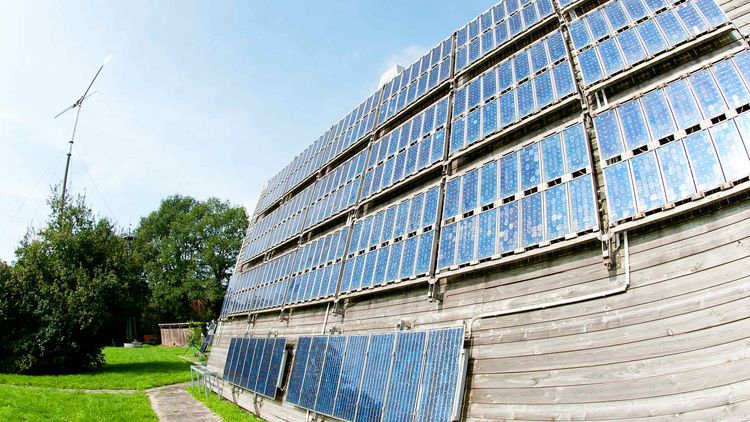
AL-SHAMERY: But this question has always been a driving force at the University of Oldenburg. Just take the research on renewable energies. It emerged from the anti-nuclear movement, and if you were involved with "renewables" back then, as Joachim Luther was, you were immediately labelled in a certain corner. If you think about how this line of research into renewable energies has now become influential worldwide, then we have to say that it has more than paid off. I also think it's important not to focus purely on major priorities and to downplay everything else. It is very important to also promote projects that would be categorised as exotic elsewhere. Henrik Mouritsen's research into the navigation of migratory birds is a good example of this. We are interested in a certain diversity, and there has to be room for new things, and this room can only be created if we also admit unusual projects.
"It's a question of efficiency, how much time we spend on acquisition in order to realise research under certain conditions."
Birger Kollmeier
QUESTION: Oldenburg's hearing research also began in an unusual way - with a noise protection project. Mr Kollmeier, how important is lateral thinking in your research?
KOLLMEIER: Definitely a lot, at least it starts with me, as I don't really fit into any one category. I am neither a pure physicist nor a doctor, but even during my training I saw the better methodology in physics and the more interesting questions in medicine. In the end, I tried to bring the two together - which is now also reflected in medical training at our university. We all benefit from the fact that this university is not an old-structured and venerable one, but is very dynamic and you can easily find yourself in non-classical areas - and lateral thinking is one of its strengths.
DOERING: For me, lateral thinking means not chasing after every fashion. That's very often the case in the humanities. One "turn" after another is proclaimed. And there are universities that are very quick to adapt to the latest trend, only to be left behind again. That's why I think it's important that we also have places here where we experience trust. And, for example, to pursue things that are not the most fashionable, but that have lasting substance. Our responsibility as academics in a good sense, regardless of whether the topics are fashionable or more traditional, is to be a role model and show perseverance and say: these are the topics we are working on.
PAECH: The question is: how can we encourage young people to leave the beaten track, regardless of the discipline? This is only possible at universities where a productive debate takes place. It doesn't hurt if things are a little less cosy. One aspect that we argue about in economics is this: Do we want to preserve this expansive model of prosperity that emerged after the Second World War by hook or by crook? Or do we really have to ask ourselves, even at universities, whether a different economy that breaks with traditional ideas should be developed? A lot can be learnt from such controversies. And I think that's what captivates students: an honest and fair debate of points of view.
DOERING: Another problem for us in German Studies is that we have to supervise more and more students. A few years ago, we had around 150 students in the first-semester German Studies course. Now there are 300, and we have to provide them with good teaching. We have the money from the Higher Education Pact - but a lot of the work is done by doctoral candidates and postdocs, who have less time for research as a result. And I would like to see us do an even better job of creating a research- and performance-friendly climate right from the initial study phase. The consequence of a misunderstood Bachelor's system is the attitude of trying to obtain the greatest possible number of credit points and certificates with the least possible effort. Unfortunately, I sometimes find that particularly committed students have a hard time and prefer to keep their mouths shut so that they are not seen as nerds. We have to show this right from the start: University and studying doesn't just mean getting a Bachelor's degree, but being enthusiastic about important problems and substantive issues and mastering them together.
QUESTION: Education that inspires: Ms Al-Shamery, does the university need to do more to achieve this?
AL-SHAMERY: We need to use this time to think about university education again. We are all a bit older and know what university was like when we were students. There was a massive culture of debate, some things were terrible, some things were not, but the atmosphere was always very lively and people consciously engaged with society. Today, I feel less and less enthusiasm for a subject. Eyes have to be glowing again - and people should come to the University of Oldenburg because they want to gain knowledge. To achieve this, university education must be brought back into the discussion, and we can spearhead this topic together with other universities. At the same time, I hope that we will continue to promote young talent - we are already leading the way in Lower Saxony with 18 programmes alongside Göttingen.
QUESTION: Mr Paech, what do you wish for the future of the university?
PAECH: As an economist, I hope that different sustainable economic concepts will be treated impartially on an equal footing. As you said, Ms Al-Shamery, it's about getting young people excited about what they are studying - and not just thinking about their career after graduation. Unfortunately, universities are currently not pacemakers for sustainable development because they are too uncritical of a modern society that is based on unbounded, completely illusory lifestyles.
QUESTION: What does this mean in concrete terms for the university?
PAECH: Many young people go to university in order to have a justification for no longer having to get their hands dirty with what we used to call production, labour or supply. People who attend university today expect to be able to lead a socially recognised, comfortable and globally unlimited life later on - anything else is considered out of the question. While the material downside of our existence is outsourced to India and China. The belief in progress, that matter can be replaced by knowledge and symbols, is one of the greatest shortcomings of our education system. And I expect universities, especially economists, to finally develop sustainable counter-designs.
QUESTION: Mr Kollmeier, where do you see the most important tasks of the university - what would you like to see?
KOLLMEIER: For me, the most important thing is the battle for the best minds. They don't necessarily have to be people from all over the world, people from Germany are enough. The quality of the people doesn't improve the further away they are. We already have a lot in the region that we can build on. My wish would be that we get better and better and realise this - to get the best minds.
"Unfortunately, universities are not currently setting the pace for sustainable
development."
Niko Paech
QUESTION: And you, Mrs Doering?
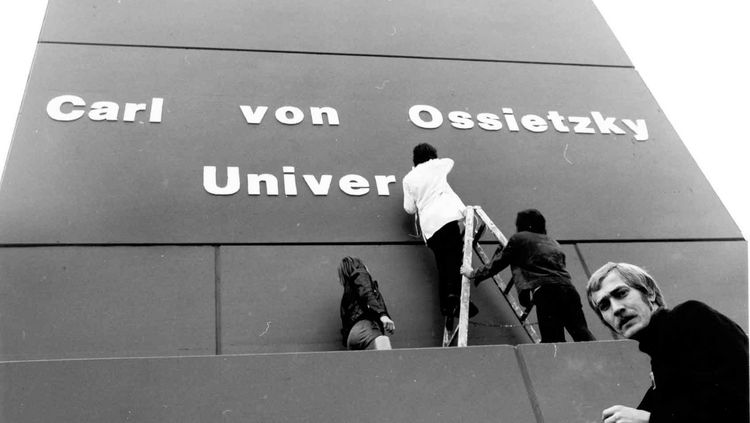
DOERING: We are lucky that the generation before us fought to have a wonderful namesake. Carl von Ossietzky was a lateral thinker who used his personality to stand up for what was most important to him: freedom, justice and peace. And I would like to see a discussion throughout the university about how much this person obliges us as a namesake. It is also important to me to reach out to the students. After all, it wasn't some unworldly cranks who campaigned for the name back then. Instead, they saw in the person of Carl von Ossietzky a programme that every new generation has to think about anew.
-------
-------
THE DIALOGUE PARTNERS
Prof Dr Katharina Al-Shamery
Katharina Al-Shamery is Acting President of the University of Oldenburg. The chemist is a member of the University Senate of the German Research Foundation (DFG). She is a member of the German Academy of Sciences Leopoldina. Al-Shamery was honoured with the Federal Cross of Merit for her special services to science and research. From 2011 to 2014, she was a member of the independent body "Ombudsman for Science".
Prof. Dr Sabine Doering
Sabine Doering is a university lecturer in Modern German Literature in Oldenburg. She is currently a Fellow of the Notre Dame Institute for Advanced Study (NDIAS) at the University of Notre Dame (Indiana, USA). Doering is President of the International Hölderlin Society based in Tübingen and a member of the Scientific Advisory Board of the Federal Institute for Culture and History of Germans in Eastern Europe (BKGE).
Prof. Dr Birger Kollmeier
Birger Kollmeier, physicist and medical doctor, is spokesperson for the "Hearing4all" cluster of excellence. He also heads the Department of Medical Physics, Hörzentrum Oldenburg GmbH and the Fraunhofer Project Group for Hearing, Speech and Audio Technology. The Oldenburg scientist has received prestigious awards, such as the International Award of the American Academy of Audiology and the German Future Prize.
Prof. Dr Niko Paech
Niko Paech is an adjunct professor of "Production and Environment" at the University of Oldenburg and a board member of the Association for Ecological Economy (VÖÖ). Paech is regarded as a radical critic of growth - and has received the "Zeit Wissen" sustainability prize for his ideas on a "post-growth economy", among others. Paech is involved in institutions such as the Oldenburg Energy Cooperative (OLEGENO), KoBE (Centre of Excellence for Building and Energy) and the Polygenos cooperative.