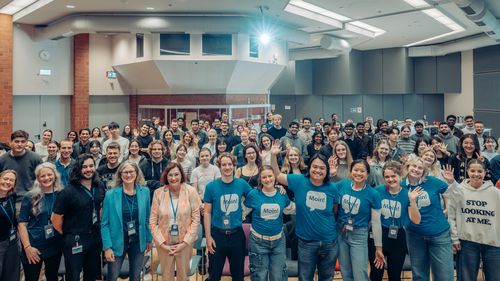


Multi-resistant germs pose major challenges for hospitals worldwide. As part of the 1st Spring School Oldenburg-Groningen, 14 students and seven experts from Germany and the Netherlands are tackling the topic.
How can we prevent the emergence and spread of multi-resistant germs in our hospitals? Prof Dr Alex Friedrich stands next to the flipchart with this question and looks around the room expectantly. The professor of Medical Microbiology and Hospital Hygiene at the Rijksuniversiteit Groningen knows that there is no simple answer to this question. Nor does he expect there to be. But after a few hours at the 1st Spring School Oldenburg-Groningen, he also knows that it is very important for the 14 German and Dutch medical students to talk about the topic of "multi-resistant germs in hospitals". They discuss ways of protecting susceptible patients from the germs so animatedly that lunch threatens to go cold. Even in the cafeteria, the conversations - mostly in English - revolve around hygiene and antibiotics.
"It's really great how the students are getting involved," says Prof Dr Dr Klaus Peter Kohse, Chair of the doctorate committee at the University's School of Medicine. He finds it particularly remarkable that the budding doctors organised the three-day conference in Oldenburg's PFL cultural centre largely independently. "All we had to do was tick them off and everything was up and running," says the university lecturer. He is involved in organising the conference together with three German and four Dutch lecturers. The students also impressed him professionally. "They brought a whole host of ideas to the table. They simply bring a different perspective to us lecturers, who already have decades of experience." He sees formats such as the Spring School as a successful addition to medical training at the university and a sensible investment in the future. "The topic is a burning issue for us doctors. The next generations of doctors and scientists can be important multipliers in practices, clinics and laboratories," says Kohse.
Mathilde Ruis (26) and Philipp Siemer (29) are already very interested in the topic, which is why they helped organise the Spring School. They are studying medicine on the Oldenburg model degree programme at the European Medical School (EMS) and have already dealt intensively with the problems of multi-resistant germs. "The resistant germs are difficult to recognise and usually spread quickly, especially in patients who have been weakened by an operation or illness," says Siemer. Studies assume that by 2050, infectious diseases will have increased so drastically that they will claim more victims than cancer. It is incredibly important to discuss the topic - especially with fellow students from the Netherlands, as experience has shown that the healthcare system there is better able to cope with the challenge of multi-resistant germs.
"The standards in the Netherlands are much better," says Mathilde Ruis. For example, there is a fixed GP system there, so that doctors have a good overview of the medication prescribed to their patients. There are also fewer clinics in the neighbouring countries, which means that there are experts in almost every hospital - for example for hygiene, antibiotics or intensive care medicine. However, the students from Germany and the Netherlands are not only exchanging expertise. Each of the seven Oldenburg participants is hosting a fellow Dutch student. "This is how we forge an important bond for later," says Ruis. The EMS students spend at least one year of their degree programme in Groningen.
At the end of the three-day conference, the participants want to draw up an agenda with concrete proposals for an omnipresent system that could curb multi-resistant germs. "The whole thing should have the character of an appeal. Communication must finally be improved, we want to shake up all those responsible," says Ruis. The next Spring School is already being planned. It will take place in Groningen next year.