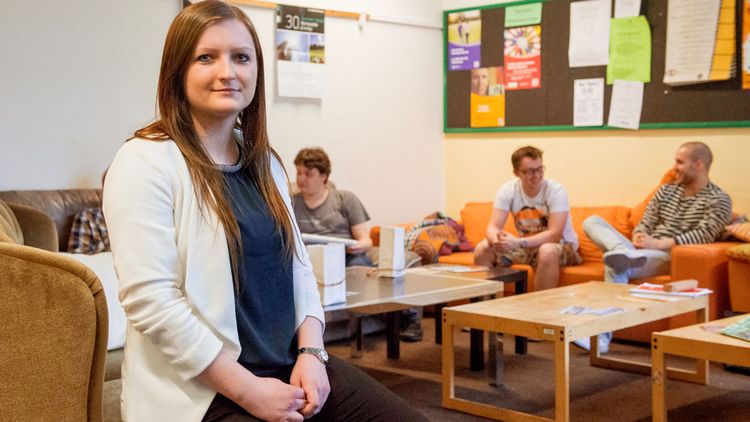

For the first time in more than 40 years of university history, the RCDS, which is considered conservative, is the strongest parliamentary group in the student parliament. However, the new AStA remains "at the back left" in the cafeteria foyer - a visit.
"The AStA is at the back left in the corner," explains the ServicePoint employee in the cafeteria foyer - and unintentionally mentions the right keyword. As a former reform university, the University of Oldenburg is still said to have a left-wing political orientation. Until recently, the same was therefore also true of the university's General Students' Committee (AStA).
However, the election to the student parliament (StuPa) saw the first "change of government" at the top of the legally constituted student union in its 40-year history: for the first time, the Ring Christlich-Demokratischer Studenten (RCDS), which is considered conservative, was elected as the strongest faction in the StuPa and thus also moved into the AStA.
So a conservative AStA is now in charge at the left-wing university? Its new spokesperson Nicole Sikora takes a more relaxed view. "In my opinion, there's not much sign of a left-wing university today," she says. "It was much more pronounced when it was founded. And I don't consider the RCDS to be very conservative either. We are said to be, but that hardly applies to our Oldenburg group."
What's the story behind the change of government, was it deliberately wanted by the students? "I don't think the students are as politically minded as they used to be. I can't imagine that our election was primarily about wanting to vote out the left-wing AStA. They voted for us because they liked our plans and we were already very present for them during the election campaign. That worked, not this left-wing versus conservative thinking."
Sikora is studying biology in her sixth semester and says that she has always been very committed. For this reason, she joined the student body right at the beginning of her studies. "That's when I realised that the AStA itself was barely present for us," she recalls, adding: "What was it like for all the other students?" So she decided to become active in the AStA herself and "do a lot of things differently", as Sikora says.
Joining the RCDS was not a purely political decision for Nicole Sikora: "I looked at the programmes of all the university groups. I saw the greatest opportunities to change something at the university with the RCDS. They had the most concrete points," she says.
These concrete points include, for example, a structured AStA. The twelve officers and 20 employees of the AStA have already realised this goal. Instead of one project department, there are now nine departments that take on individual tasks. "This means that students know more quickly who they can contact and we can work in a more organised way," says Sikora.
Members of both the RCDS and the Juso university group are represented in the departments. This is because the RCDS formed a coalition with the Jusos (student organisation of the SPD) after the elections in January. "We needed the coalition to be able to form a majority in the StuPa," explains Daniel Kaszanics from the RCDS board and officer in the AStA.
"We were prepared to talk to all other political university groups," adds Sikora. "We had days of coalition negotiations and realised that the Jusos were simply the best fit for us - both in human and political terms."
As a result of the merger, students from 17 different degree programmes are represented among the AStA members. "We are also almost all student representatives. This is a good prerequisite for being very close to many students and getting their feedback on life and work at the university," says Kaszanics.
As a result, the negotiations have brought together many points that the RCDS and Jusos have written on their banners and which primarily include student issues. Sikora says that she often used to wonder what some of the projects had to do with students.
"Our most important projects are therefore to create more study spaces, provide better Wi-Fi coverage and introduce a Uni-Card, which is to be a library card, semester public transport pass and canteen card at the same time," says Sikora's colleague Kaszanics. "Outside of social counselling, these are the issues that most students approach us with," he adds. "For example, we have already suggested that more benches be installed on campus," he reports.
René Behrens from the Public Relations Department is responsible for ensuring that the AStA's projects are more widely recognised among students. "We have just created a Facebook page and are updating our homepage," he says. Job adverts from the departments can already be found there, which all students can apply for. "Even people who are not active in the university's political groups can help to change things," says Behrens, "but we have to teach them that first."
The StuPa's term of office is one year. Nicole, Daniel, René and their colleagues have that long to work on their goals. "We know that we can't achieve everything in one year. But we want to get as many projects off the ground as possible," says Sikora.
"There is also the opportunity to stand for election again next year. We will of course try to become the strongest parliamentary group again next year." As the three explain, they all invest a lot of time and can only devote a limited amount of time to their studies. "That's why new students are also welcome to represent the RCDS and Jusos next year," says Sikora.