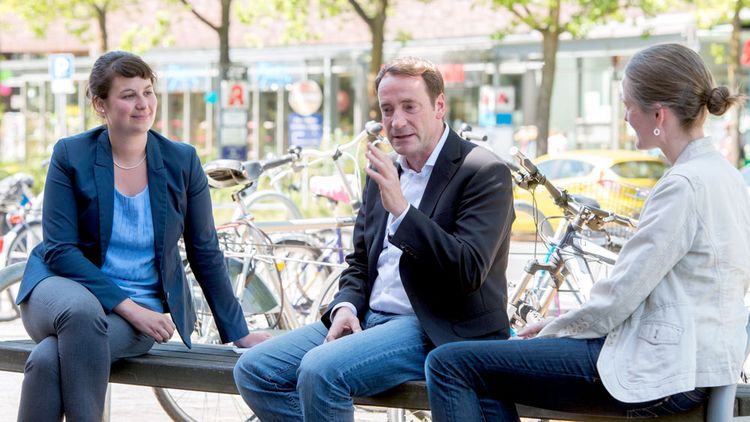
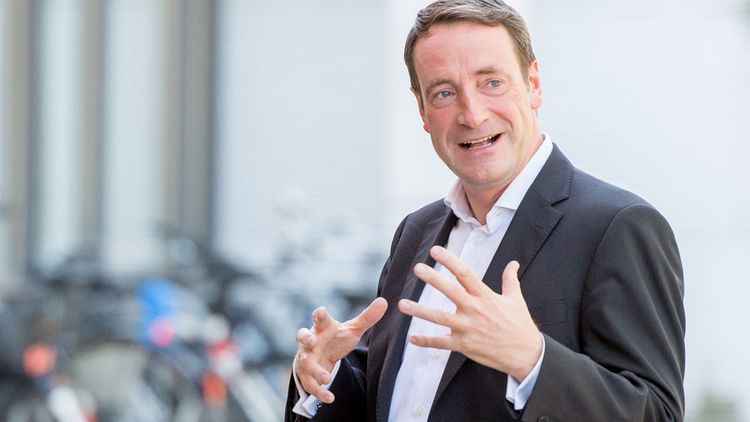
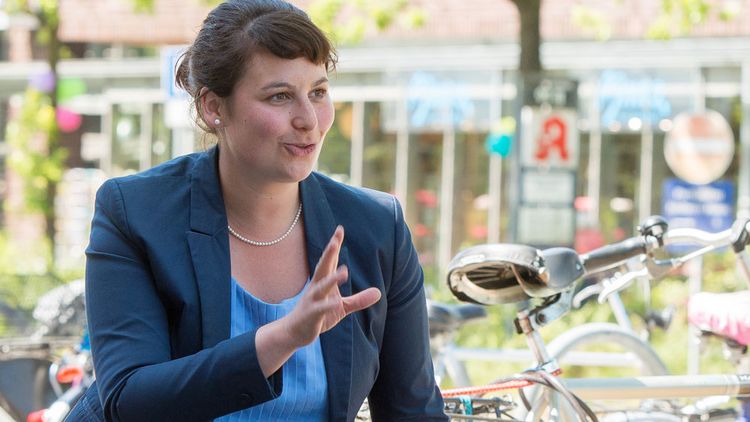


Whether someone is doing a doctorate in chemistry or social sciences: "Many phases between euphoria and a deep valley are similar," says the Managing Director of the Graduate Academy, Linda Jauch. In this interview, she and Vice President Bernd Siebenhüner talk about the interdisciplinary promotion of young talent at the university - even after the doctorate.
QUESTION: Mr Siebenhüner, what is your personal experience of supporting early career researchers - how were you supported?
SIEBENHÜNER: I grew up in the old German university system, with a doctoral position at my former university. My doctoral supervisor mentored me very intensively, but there were few programmes on methods or transferable skills. Later, I had a junior professorship here in Oldenburg - combined with the management of a junior research group. I would have liked to have had the kind of support in leadership and doctoral supervisor that we offer today.
QUESTION: Mrs Jauch, you have been in charge of promoting early career researchers at the university for six months now. What was your first stage?
JAUCH: The most visible thing is certainly the Graduate Academy's new website. Coming from outside, I didn't find it easy to get an overview of the programmes on offer in Oldenburg. This is due to the structures that have grown up.
QUESTION: How do you explain the structures in Oldenburg to someone who doesn't know what's going on? 3GO, OLTECH - how do they all fit together under one roof?
SIEBENHÜNER: We have always had doctoral programmes that offer subject-related support. There are currently 18, and we are very successful here as a university. In 2009, the OLTECH Graduate School was founded with scientific and technical qualification programmes. This also takes the pressure off the individual programmes, so things are not offered more than once. It is similar with the 3GO Graduate School for Social Sciences and Humanities.
QUESTION: And the Graduate Academy bundles interdisciplinary programmes.
JAUCH: Yes, anyone can take part, whether they are doing an individual or structured doctorate, whether they are a postdoc or junior professor, and simply register for courses via the website. We have recently restructured the programme somewhat in light of the current debate: German universities train a large number of doctoral candidates and also have a responsibility to ensure that the transition to a further career - whether within or outside academia - is successful. Of course, the same also applies to postdocs.
QUESTION: Career promotion and development as a new focus?
JAUCH: Exactly. There are courses on acquiring third-party funding as well as basic business courses and job application training. Of course, it makes a difference whether I'm doing a doctorate in chemistry or in social sciences. But I believe that many phases between euphoria and a deep trough are similar, regardless of the subject culture - it is similar when preparing for further career steps.
QUESTION: Is it a balancing act between preparing for an academic career or a career outside academia?
SIEBENHÜNER: The latter is becoming increasingly important, as the higher education system in Germany offers very narrowly defined career opportunities. Many doctoral students do not stay in academia. We must therefore also recognise and support other functions of the doctorate - something the higher education system has long avoided.
JAUCH: The figures speak for themselves: not everyone can enter the academic system, and that's fine - but for a very long time there was a lack of training and information on alternative career options.
QUESTION: Perhaps it has been seen elsewhere, whether at the Federal Employment Agencies or in the individual responsibility of the people concerned...
JAUCH: But it was often not communicated so openly. I think this is also the responsibility of the universities.
SIEBENHÜNER: Absolutely. It also has a moral component. We like to attract young talent to universities, we need them: they have great ideas and are motivated to do research and teach. We hold out the carrot to them that they could become something in the academic system - and for many, the experience is that, often after their doctorate, the carrot is gone and is held out to someone else. That is of course a problematic thing.
QUESTION: The often uncertain career prospects for mid-level academic staff - the vast majority of academic staff in Germany have temporary contracts - are currently a hot topic of discussion. Where can the university still do something, and what demands do you have of politicians?
SIEBENHÜNER: It would be wrong to say that it's just a matter for big politics, but it can't just be a matter for the universities either. The number of professorships is rising very slowly because the universities' basic budgets are hardly increasing at all - and most of the additional funding is channelled into short-term employment contracts. The political logic behind this: attractive programmes that always offer new opportunities to raise one's profile - but are designed for the short term. In this case, the universities cannot do much more than award contracts for the duration of the project at most.
QUESTION: The Graduate Academy has been around for a few years now. How do you envisage the next steps?
JAUCH: Our new six-month interdisciplinary postdoc coaching programme starts in February. For those who completed their doctorate less than three years ago, the programme will focus primarily on career development and planning, while for more experienced postdocs - including junior professors, junior research group leaders and first appointments - the focus will be on leadership and supervision. Ultimately, they also supervise new doctoral candidates.
QUESTION: So it directly benefits your original target group.
SIEBENHÜNER: If we take seriously the idea that the doctorate is a research phase in which you work on your masterpiece in the academic landscape, so to speak, then supervision by a doctoral supervisor is central and remains irreplaceable. I think it's important to support this and it should be reliably organised.