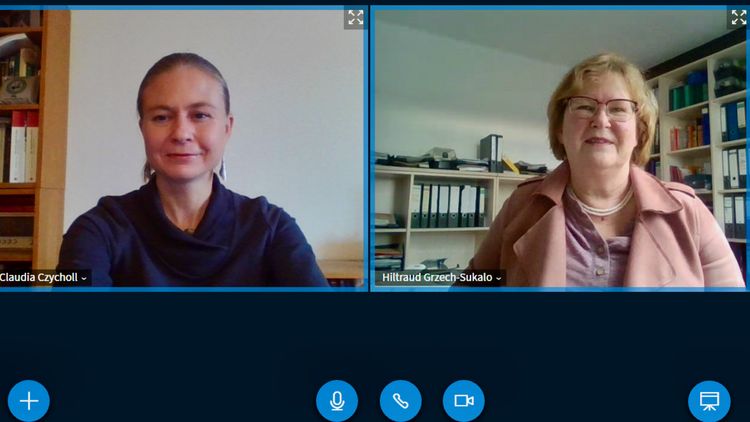


How to work from home and manage from a distance is a topic that is currently on many people's minds - and is also occupying a project team at the university. Two experts, currently working from home themselves, in an interview.
You were already researching mobile working before the pandemic and have been working from home yourself for a few months now. Has this changed your perspective on the topic?
Hiltraud Grzech-Sukalo: Before I joined the "prentimo" research project in 2016, I had actually worked remotely for 20 years as a self-employed management consultant and no longer felt like travelling all over the place. The work at the end of the project was mainly done from home, with occasional meetings in Frankfurt with the project participants from Munich, Cologne, Berlin or Stuttgart. In this respect, I am familiar with working from home. The past few months have now changed my perspective to the extent that I am grateful for the many online meetings and don't always have to travel for an exchange. Even if I do miss the odd conversation "on the side".
Claudia Czycholl: I was already familiar with working from home before the pandemic, but now I've been working from home continuously for almost a year. What I miss most is the direct contact and dialogue with colleagues. I'm also constantly experiencing how difficult it can be to draw the line between work and private life.
Working from home, teleworking and mobile working: many people use these terms interchangeably. Can you briefly explain what the difference is?
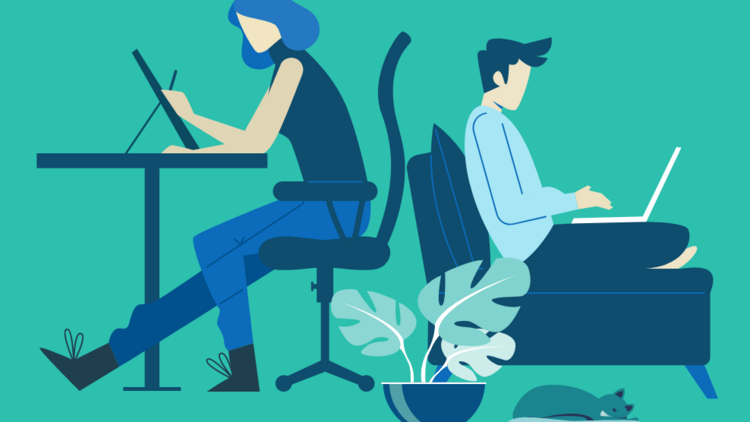
Grzech-Sukalo: Mobile working refers to working outside the company premises, it is flexible in terms of time and location and often results from the tasks. The spectrum of mobile work ranges from providing a service to customers to typing at home at your desk. Working from home is a form of mobile work.
Czycholl: Teleworking or telecommuting, on the other hand, refers to a workstation set up by the employer for a fixed period of time in the employee's private space. Unlike working from home, teleworking requires clear framework conditions between employer and employee.
Grzech-Sukalo: This brings us straight to a core problem: when working from home, without clear regulations in a company or service agreement, there is no guarantee that I have an ergonomically favourable and technically well-equipped workplace. This also applies to the financing of home office workplaces.
In recent years, you have been looking at how working in different locations can be organised in a way that promotes health. What is your most important tip - for employees and companies?
Czycholl: Supervisors often expect employees to be permanently available, even if they rarely express this directly. As a result, employees may lack sufficient rest periods. It is therefore crucial that working hours and availability are clearly regulated and adhered to. Ideally, line managers should set an example in this respect and ensure that their employees do so in a friendly manner. After all, if I finish work at 5 p.m. but still receive emails from my line manager late into the evening, this can put me under pressure and make it harder to switch off.
Grzech-Sukalo: If there is no clear regulation, some employees believe they have to be permanently available. We know that from the prentimo study. This can lead to sleep disorders and a high level of stress. When it comes to working hours, employees often don't know enough about the legal basis: if Sunday or night work is not authorised, a company can't expect it either - and in my opinion, it has a duty to clearly inform its employees about this.
"Working well from home can only be successful if there are no children to look after at the same time."
(Claudia Czycholl)
What other challenges do you see when it comes to working from home?
Czycholl: Against the backdrop of the coronavirus pandemic, we are seeing a partial relapse into traditional patterns of gender-specific division of labour. For example, during the school and daycare centre closures during the first lockdown in spring, women took on the main burden of childcare work and home schooling. Many have cut back on their academic appointments to do this. However, working from home can also have advantages in terms of work-life balance: Working hours can be adjusted or distributed so that you can take your child to daycare at a certain time, for example, or make it easier to integrate caring for relatives. The important thing is that working from home can only be successful if there are no children to look after at the same time.
Grzech-Sukalo: Another sticking point is that many companies were still not well prepared for the topic of remote leadership during the second wave of coronavirus. In my experience, many managers are not yet sufficiently trained in motivating teams at a distance, making clear agreements and giving feedback. In addition, managers often lack the skills to organise work in a way that promotes health. Managers still focus too much on controlling employees. However, leadership at a distance can only succeed with a good culture of trust.
Is this where the topic of further education comes into play? part of the project team in the newly approved project "Working between home and office"? Leadership at a distance is "not for control freaks", according to the final report of the predecessor project "Digital - Mobile"...
Grzech-Sukalo: Exactly, it's about getting the control impulse out of people's heads and seeing what skills managers need for remote leadership. We want to help company management to develop solutions in dialogue with employees.
Czycholl: According to our findings, there is also a need for further training programmes for line managers when it comes to working from home. To put it bluntly, the management task cannot be to call my employees every half hour to make sure that they are productive. There has to be trust, results-orientated work without constant monitoring during the work process. Further education and training is rarely a preventative measure, but rather a response to specific challenges. Whether it is about leadership skills at a distance, additional IT skills or strategies to reduce stress, it is necessary to offer appropriate further education and training for everyone involved. This also applies to programmes for works councils and Staff Councils on the following questions: How can employees at different work locations be addressed effectively, and what does remote consulting mean in terms of data protection, for example? There is a need at all levels.
In the "Working between home and office" project, you assume that a large proportion of employees will continue to work from home at least part of the time in the future. So you think the effect will be sustainable?
Grzech-Sukalo: Yes. The desire to work from home already existed before the pandemic. In the years before coronavirus, the proportion of employees working from home was fairly stable at around 12 per cent, with around 60 per cent interested in occasionally working from home. It was theoretically possible for 40 per cent. However, there are also many activities in industry or catering, for example, that simply cannot be transferred to the home office. So there is a certain limit, and it is difficult to estimate the order of magnitude. In the future, many employees would like to work from home, but not exclusively.
"We like to stick to the tried and tested and defend the workplace as our territory."
(Hiltraud Grzech-Sukalo)
Over the next year and a half, the new project will focus not only on further education but also on company regulations. Why are these so important - and why have they apparently been neglected so far?
Czycholl: A key point is that there should be transparent and comprehensible rules on who can and cannot work from home. Not every workplace in a company or institution is suitable for this. Employees can perceive individual arrangements, for example within individual departments - whether rightly or wrongly - as inequality, which sometimes leads to conflicts. A company agreement that both sides can refer to is therefore important.
Grzech-Sukalo: However, companies often shy away from company regulations so as not to restrict themselves. We would like to use best practice examples to show the benefits and positive effects that company agreements and guidelines can have for everyone.
In your research, you bring together various stakeholders. This is also the case in the project "Working between home and office", which is primarily concerned with practice.
Grzech-Sukalo: That's right. We will again engage in intensive dialogue with interested employees, companies, interest groups, chambers of trade and industry and chambers of commerce. As the service sector is strongly represented in the north-west region around Oldenburg, the project is particularly focussed on this.
Czycholl: It is incredibly important to bring these different groups of people into a dialogue so that employees, staff and works councils and managers can exchange ideas, contribute their experiences and develop something together.
In the past, digitalisation and globalisation were the main drivers of mobile working. Recently, the pandemic has been the strongest catalyst in your view?
Czycholl: A space for experimentation has emerged - in which we are also realising which framework conditions still need to change in the future. The pandemic is certainly the driving factor at the moment. I'm interested in the extent to which climate and environmental protection will play a greater role in the future, alongside digitalisation and globalisation.
Finally, would you dare to make a small prediction: when could the stationary workplace - an office with a desk - become the exception rather than the rule?
Grzech-Sukalo: Not in my lifetime, I suspect, but who knows. I don't see much chance of that in the next 20 years. On the one hand, we like to stick to the tried and tested and defend the workplace as our territory. On the other hand, for the time being at least, there are still many tasks that are not exclusively suitable for working from home or mobile working - even if the world of work is changing.
Czycholl: There will certainly be more home office workplaces in the future. Working in co-working spaces will also increase. I assume that different forms of work will increasingly be practised side by side and in combination.
Interview: Deike Stolz