
Master Social Sciences
Master Social Sciences
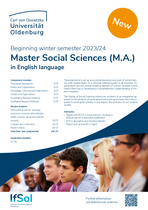
The subject Master's degree course in Social Sciences has a broad social science profile with a common focus on organisations. The consecutive Master's degree programme builds on a Bachelor's degree in social sciences or a related subject.
Organisations are central building blocks of modern societies. They structure life courses, distribute resources and shape the social areas of education, health, culture, politics and the economy. An understanding of modern societies therefore always requires an understanding of how modern organisations function and the social processes and inequalities that arise in and through them. This special orientation of the degree programmes taught in German makes it possible to impart in-depth and consistent knowledge of political science and sociology in equal measure.
In the modern knowledge society, skills in dealing with knowledge are more important than encyclopaedic specialist knowledge, especially for the social sciences. The Master's degree programme in Social Sciences offers scope for students to set their own priorities in terms of content and aims to introduce students to an integrative approach to analysing social phenomena. Graduates should be able to actively shape modern organisational structures.
By using English as the language of instruction, students learn to find their way in a multicultural environment and develop intercultural competences. As a result, graduates have improved competitiveness in the business environment and in science.
Focal points
The Master's degree programme in Social Sciences provides students with the skills to theoretically analyse social science issues in an organisational society, to conduct empirical research using quantitative and qualitative methods and to reflect on them from a normative perspective. Social scientists must be able to think through scientific or practical problems from different perspectives, categorise them in a wider context and work on them using appropriate instruments. The starting point of the curriculum is therefore the interweaving of subject-related and practical research skills with comprehensive theoretical and broad methodological knowledge.
The curriculum includes compulsory modules on the theoretical foundations of organisational research, organisations in politics and society as well as knowledge and learning in organisations. In addition, a broad knowledge of qualitative and quantitative methods is taught. Students have the opportunity to set their own individual priorities through the selection of their elective modules. There is a selection of advanced courses from Political Science and Sociology, Economics, Business Administration, Health Sciences and advanced methods courses.
Access regulation
Admission to the Master Social Science programme is governed by the admission regulations which can be downloaded here. The admission requirements are set out in §2 in particular:
- Completion of a relevant Bachelor's degree programme or an equivalent qualification;
- a previous course of study is considered subject-relevant if the degree programme leading to a Bachelor's degree or an equivalent degree has provided competencies in one of the areas of social sciences, sociology, and/or political sciences with a minimum of 60 credit points,
- descriptive and inductive statistical skills, knowledge of data management and data analysis using common statistical software and introductory knowledge of linear regression analysis including its assumptions amounting to at least 9 credit points have been acquired;
- Sufficient knowledge of the English language at level B2 of the Common European Framework of Reference for Languages (CEFR) must be demonstrated for the programm.
- Applications must be submitted electronically via the online portal of the Carl von Ossietzky University of Oldenburg. The application must be submitted by 30 September. For applicants with a foreign university degree from a third country, the deadline for applications is 31 August.
- The Master's degree programme in Social Sciences begins in the winter semester.
The Admissions Committee is responsible for admissions (Kommissionen und Ausschüsse // Universität Oldenburg (uol.de)).
Language requirements
In order to study this course at the University of Oldenburg as a student from outside of Germany, you need an adequate knowledge of English.
English Language Proficiency see admissions regulations
- Common European Framework of Reference for Languages (CEFR) Level B2 or
- if applicants are native speaker or they have university entrance qualification or a university degree obtained in English (within the last two years)
The proof of language proficiency must be presented for the enrolment. Applicants who need a preparatory German course before commencing their studies must present their knowledge of English with their application. Language skills can also be proven by Abitur certificates showing that English has been completed as a continued foreign language for at least five years with sufficient performance, or by proof of a semester abroad with English as the teaching language; this proof must not be older than 5 years.
Career opportunities
By taking the M.A. "Social Sciences", Graduates will acquire a wide range of skills transferable to a number of career opportunities, including:
- (International) Organisational development and consulting
- Public administration and political organisations
- Media production and development, including e.g. opinion research
- University research and teaching
- Teaching in other education institutions
- Science management at universities or research institutions