
Non-classical light and photonics


Non-classical light and photonics
What is non-classical light, what is it used for and how can it be generated?
Photons are the quanta of the electromagnetic field. They open up an understanding of light as a stream of particles, the photonswhich is complementary to the classical description of waves.

In contrast to thermal light, as emitted by a light bulb, or the coherent emission of a laser, there are also states of light with decidedly quantum mechanical properties. A description of these states is not possible within the framework of classical physics. Non-classical light is characterised, for example, by so-called anti-bunching: photons emitted from a source always have a certain minimum time interval, so that two photons are never emitted simultaneously. Single photons are an elementary component of many quantum applications, and light sources that emit single photons by pressing a button. Such a device is the central building block of a truly secure quantum-based communication network such as BB84, where encryption is based on the intrinsic properties of light quanta. Any potential eavesdropping attempt would be unmasked, as the measurement process irreversibly changes the state of the photon.
However, it is also possible to use an emission cascade to specifically generate pairs of photons that are entangled with each other in terms of their intrinsic properties, such as the direction of polarisation. There are various possible applications for this quantum light in the field of quantum technologies by using photons as flying qubits. For example, pairs of entangled photons can be used for quantum key transmission, such as in the well-known E91 protocol. Intensive research is also being conducted into photonic quantum computers, in which photons are manipulated with quantum gates consisting of linear optical elements. Photonic computing is of particular interest due to its cost efficiency compared to our digital, transistor-based technologies. While reliable anti-bunching is desirable for the former application, the latter requires above all a high indistinguishability of the photons in order to ensure optimum quantum interference.
There are many more or less established material platforms for the realisation of quantum light sources. Epitaxially grown semiconductor quantum dots from compounds of elements of the III and V main groups in the periodic table, as well as defects in silicon crystals, should be emphasised here. Recently, single photon sources based on two-dimensional semiconductor materials have also been researched, with a focus on mono- and bilayers of so-called transition metal dichacogenides: Here, it is possible to generate spatially localised electronic states through targeted deformation of the atomically thin layers, from which the emission of individual photons then takes place.
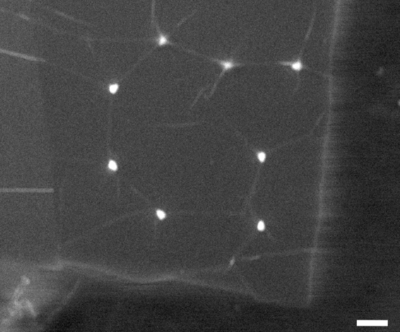
Scanning electron micrograph of deterministically generated wrinkles in a WSe₂ monolayer nanosheet containing linearly polarised single photon sources. The scale is 1 µm.
Even more sophisticated are so-called moiré systems, in which a periodic (moiré) potential is generated by deliberately twisting two monolayers against each other, in which individual electron-hole pairs can be localised. When electron and hole recombine, a single light quantum, or photon, is emitted.

At the CvO University of Oldenburg we are actively researching the generation of non-classical light. Here we concentrate our activities on
the development of a bright single photon source based on low-cost 2D semiconductors,
the implementation of the BB84 quantum communication protocol using these quantum emitters,
improving the indistinguishability of single photons by integrating a quantum emitter into an optical microcavity that strongly modifies the light-matter interaction."

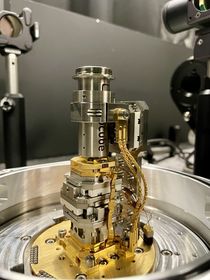
Another true quantum phenomenon is a condensation of identical particles into a single quantum state. The idea was developed by Einstein and Bose already in the very beginning of quantum era, and the current studies are aimed to observe such effect in novel quantum materials. Polariton condensation in TMDC in Oldenburg.
Would you like to know more? The physics degree programme offers the lecture Quantum Optics .
Contact person:
Quantum Theory Group
Prof. Dr Christopher Gies
AG Quantum Materials
Prof. Dr Christian Schneider