
Quantum control of ultrafast dynamics
Contact

Prof Dr Matthias Wollenhaupt
Carl von Ossietzky University of Oldenburg
School V - Institute of Physics
Carl-Von-Ossietzky-Str. 9-11
D-26129 Oldenburg
Germany
Research Group
Ultrafast Coherent Dynamics
https://uol.de/ukd
Phone: +49-441-798-3482
Room: W2-1-101
matthias.wollenhaupt@uol.de
Quantum control of ultrafast dynamics
Motivation
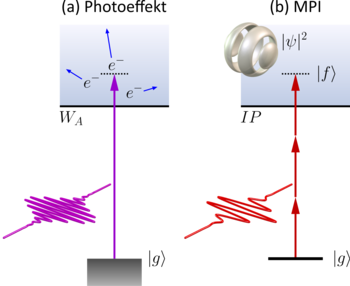
The interaction of light with matter is a central research topic in physics, as it provides fundamental insights into atomic and molecular structures and their dynamics. The photoelectric effect, i.e. the release of an electron from a material through the absorption of light, is an important experiment for the physical understanding of light-matter interaction. Its theoretical interpretation with the help of light quanta (photons) by Albert Einstein in 1905 contributed significantly to the foundation of quantum physics. In addition to its fundamental significance, the photoelectric effect is an essential tool in modern basic research with a wide range of applications, for example in photovoltaics for power generation and in light detection and imaging using highly sensitive sensors. Photoelectron spectroscopy, whose development was honoured in 1981 with the Nobel Prize in Physics awarded to Kai Siegbahn, enables high-resolution analysis of electronic states in atoms, molecules and solids. The development of coherent light sources, in particular lasers, has enabled the targeted control of quantum mechanical dynamics on ultrashort time scales and opened up new applications in solid-state physics, plasma physics, medicine and quantum information.
In recent decades, groundbreaking advances in ultrafast spectroscopy have been recognised by several Nobel Prizes, including for femtochemistry (Zewail, 1999), the development of the optical frequency comb (Hänsch, 2005), chirped pulse amplification (Mourou & Strickland, 2018) and attosecond physics (Krausz, Agostini & L'Huillier, 2023). The interaction of intense laser pulses with matter leads to non-linear optical multiphoton processes, which play a central role in ultrafast spectroscopy. Their theoretical description goes back to Maria Göppert Mayer, who predicted the simultaneous absorption of several photons to excite atomic states as early as 1931, thus laying the foundation for modern non-linear optics. One such non-linear optical process is multiphoton ionisation (MPI), in which electrons are released from atoms or molecules by absorbing several photons.
In our research group ULTRA (ultrafast coherent dynamics) we investigate the laser control of atomic and molecular MPI dynamics induced by temporally structured femto- and attosecond laser pulses. In the experiment, we reconstruct the released three-dimensional photoelectron wave packets using tomographic methods.
Quantum control
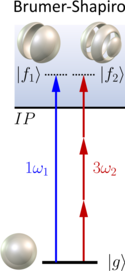
Ultrashort laser pulses not only enable the time-resolved observation of ultrafast quantum phenomena, they are also the key to the active control of quantum mechanical processes. The aim of quantum control is to selectively and efficiently steer a quantum system from its ground state to a desired target state with the help of shaped femtosecond laser pulses . According to Louis de Broglie, quantum particles such as the electron also have the character of waves and are described by matter waves. The physical mechanism of quantum control is based on the targeted manipulation of constructive or destructive interference of these matter waves using specially customised laser pulses.
A prominent implementation of this principle is the Brumer-Shapiro scheme, in which the quantum system is excited with two pulses of different colours and a specially tuned frequency ratio. The quantum system is simultaneously steered via two different paths into the target state in which the matter waves interfere. The type of interference, i.e. whether the matter waves are amplified or cancelled out, is precisely controlled by the optical phase of the pulses.
The control of MPI with polarisation-shaped femtosecond laser pulses is particularly fascinating. This generally opens up a multitude of excitation paths. The excitation dynamics and inter-distance phenomena are correspondingly rich, which makes MPI highly interesting for research into fundamental mechanisms of quantum control.
High-intensity laser fields not only offer significantly higher excitation efficiency, but also open up completely new control mechanisms as they manipulate the structure of the quantum system itself. Coupled light-matter states arise, which are referred to as "states dressed by the light field". One research focus of our group is the development of novel strong-field control mechanisms for the selective excitation of these dressed states, known as SPODS (from "Selective Population of Dressed States").
Experimental techniques
State-of-the-art technologies are used in our laboratories to explore the world of quantum physics. Three key tools are the formation of femtosecond laser pulses, imaging photoelectron spectroscopy and photoelectron tomography. Combined, they enable us to visualise ultra-fast processes on atomic time scales - and even to control them in a targeted manner. We present these two techniques below.
(a) Polarisation shaped femtosecond laser pulses
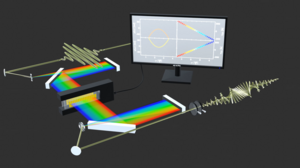
Femtosecond laser pulses are shaped using a process called spectral phase modulation. A laser pulse is first broken down into its different colours (or frequencies) - similar to a rainbow. This is done using an optical grating that diffracts the light at different angles depending on the colour.
The colour components separated in this way are directed into a so-called Fourier plane. There is a special display - a transparent liquid crystal display (LCD) - whose individual pixels can be specifically controlled. By changing the refractive index of individual pixels, we influence the phase of each colour component of the pulse.
After this manipulation, the frequency components are recombined - and the laser pulse now has a new, customised shape.
With such a "pulse shaper", which consists of two liquid crystal displays, not only the phase and polarisation can be modulated, but also the amplitude via additional polarisation filters. This gives us full control over the shape of the light pulse - a crucial step for many experiments in modern quantum physics.
The following gallery shows some examples of shaped laser pulses:
(b) Photoelectron tomography and photoelectron holography
What is measured?
For the investigation of ultrafast quantum dynamics, we measure the reaction of the quantum system to our irradiated shaped laser fields. To do this, we measure the distribution of electrons that have been released from the atom or molecule by the laser pulse through the process of multiphoton ionisation: the so-called photoelectrons.
These electrons carry information about the light-induced processes in the quantum system. Their direction and speed after the interaction tell us what has happened in the quantum system. They are therefore our "observation tools" - our observables.
The technique: Velocity Map Imaging (VMI)
To detect the photoelectrons, we use a method called velocity map imaging (VMI). This involves directing the photoelectrons onto a detector with the help of electric fields - in such a way that their direction and speed (more precisely: their momentum vector) are mapped.
Electrons travelling in the same direction with the same momentum hit the same point on the detector screen. From a mathematical point of view, the tangential components of the momentum vector distribution are projected onto the detector screen.
The detector makes these electrons visible by converting them into small flashes of light, which are then recorded by a camera. In other words, something like an "X-ray image" is recorded by the momentum distribution of the photoelectrons.
From 2D to 3D: tomographic methods
This 2D projection is already very informative - but in our laboratory we go one step further: we reconstruct the complete three-dimensional momentum distribution of the electrons - similar to computer tomography in medicine.
The trick: while the detector rotates around the patient in a CT scan, we rotate the quantum system itself instead. To be more precise, we rotate the polarisation of the laser pulse that excites the system. This is made possible by a so-called half-wave plate, with which we can control the direction of the polarisation.
In this way, we record many different "viewing angles" - and then use these to calculate a complete 3D pulse distribution of the photoelectrons.
Even more depth: holography
We also utilise a concept from optics: holography. Here, we superimpose a known reference distribution on the electron distribution that interests us. The resulting interference patterns not only contain information about the position of the electrons, but also about their phase.
With this combination of tomography and holography, we gain a particularly deep understanding of how quantum systems behave under the influence of light.
Further reading
You can find out more about our work in the following overview articles:
- "Multichromatic polarisation-controlled pulse sequences for coherent control of multiphoton ionization" in
Frontiers in Physics 9, 675258 (2021)
DOI: Frontiers in Physics - "Bichromatic Control of Free Electron Wave Packets" in
"Progress in Ultrafast Intense Laser Science XV (Topics in Applied Physics, Volume 136)"
Eds: K. Yamanouchi and D. Charalambidis, Springer, Chapter 3 (2020)
DOI: Springer - "Control of free electron wave packets by polarisation-tailored ultrashort bichromatic laser fields" in
Advances in Physics: X 4, 1672583 (2019)
DOI: Advances in Physics: X - "Ultrafast and Efficient Control of Coherent Electron Dynamics via SPODS" in
Advances in Chemical Physics 159, 235 (2016)
DOI: Advances in Chemical Physics
Popular science articles can be found here:
- "Femtosecond laser pulses generate electron vortices" in
Physik in unserer Zeit 48, 162 (2017)
DOI: Physik in unserer Zeit - "Electron waves made to measure" in
Physik Journal 11, 37 (2012)
DOI: Physik Journal