
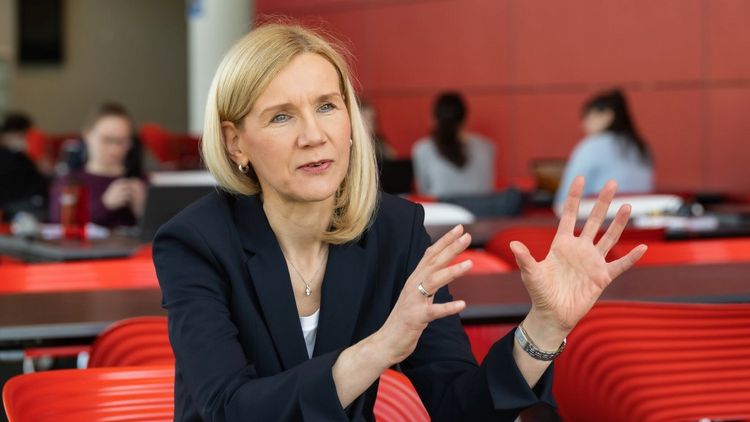

In this interview, economist Jutta Günther explains why non-linear career paths are nothing to be ashamed of, why further education is essential, and why it pays to be curious.
Professor Günther, how does one build a career that takes you from being a pharmacy assistant to a university vice-chancellor?
I’ve always been curious to see what else was possible in my career. After completing two apprenticeships in the pharmaceutical sector, I gained my first insights into the world of science as a technical assistant at the Free University of Berlin. A project in Colombia, which involved the manual production of medicines, sparked my interest in development economics. That’s why I wanted to study social and economic sciences. At the University of Oldenburg, this was possible after a year of preparation via the so-called ‘Z-exam’. After holding various positions in research and academia, I was appointed to my professorship in Economics at the University of Bremen, where I have been Vice-Chancellor for almost four years. My journey has been marked by many ups and downs and, without an academic background in my family, was not a foregone conclusion.
You’re open about the fact that your career path hasn’t been a straight one – why is that?
Some people view non-linear careers as a flaw. By emphasising that I studied via adult education, I want to encourage people, for example, to reorient themselves professionally or to catch up on their university entrance qualifications. Starting a degree straight after school or later on is neither better nor worse. But of course, someone with a wide range of professional experience brings different skills to the table. So what initially appears to be a detour can actually lead to success.
A question for the economist: How important is it to be able to change career direction and undertake further education?
Without a flexible education system, an enormous number of opportunities would be missed. Discovering new skills over the course of a career is incredibly valuable, not only from an individual perspective but also for the economy as a whole. We live in very dynamic times, and not just in terms of technological development. That is why continuous further education and upskilling are so important. We should encourage people to develop themselves through lifelong learning – and to push themselves to their limits in the process.
If further education is so important for upcoming transformations – should universities place greater emphasis on lifelong learning?
The University of Oldenburg has always been a leader in further education, as I noticed even during my time as a student. The capacity and opportunities are significantly greater than here in Bremen, for example. It is a strategic question as to what extent universities should meet the existing demand for further education. If the answer is yes, the federal states would need to provide their universities with the necessary resources.
The Universities of Bremen and Oldenburg are pursuing a joint path in the race for excellence. Some 30 years after you first entered higher education, this path occasionally brings you back to Oldenburg …
The Haarentor campus, where we Z-exam candidates suffered and celebrated together, brings back many fond memories. The fact that I am now able to help shape the Northwest Alliance alongside the University of Oldenburg – the institution that opened the door to the academic world for me – is simply fantastic.
About
Jutta Günther, Rector of the University of Bremen since September 2022, has led an international research team in the field of innovation economics there since 2014 as a professor of Economics. Prior to her time at the University of Bremen, Jutta Günther held senior positions at the Leibniz Institute for Economic Research in Halle. Other stages in her academic career included the universities of Jena (habilitation), Osnabrück (PhD) and Oldenburg (undergraduate studies), with study and research stays in, amongst others, the USA (Fulbright), Japan, Norway and Russia (DAAD).
University without AbiturThe so-called entrance examination, or ‘Z-exam’ for short, has enabled more than 5,000 students to gain entry to the University of Oldenburg since the 1970s. The process, which involves written and oral examinations, is organised by the C3L. In recent years, this route into higher education has been used less frequently, as individuals with vocational qualifications can now undertake a degree programme in a related subject. Today, the Z-exam is primarily used by those seeking a career change.