

JEOL JNM-ECZL500R
JEOL JNM-ECZL500R
in operation since May 2023

Two probes are available for this NMR spectrometer. The Supercool probe is fitted as standard.
Supercool probe: NM-83020SCO5TH5 500 MHz 5 mm FG/SCOTH
Liquid nitrogen cooling
Configuration: ¹H/¹⁹F coil
X-coil
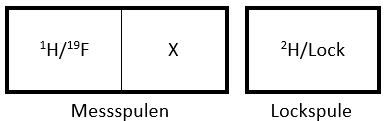
- ¹H and ¹⁹F are on the same coil:
- Heteronuclei (X) can be measuredwith ¹H decoupling OR ¹⁹F decoupling.
- ¹H heteronucleus 2D measurements are possible. (e.g. ¹H¹³C HMQC)
- ¹⁹F heteronucleus 2D measurements are possible. (e.g. ¹⁹F¹³C HMQC)
- ¹⁹F CANNOT be measured in ¹H-decoupled mode.
- ¹H CANNOT be measured in ¹⁹F-decoupled mode.
The Supercool probe is cooled to -196°C using liquid nitrogen. This reduces the noise generated by the electronics. This electronic noise is temperature-dependent. Consequently, better sensitivity is achieved and measurement time can be reduced. The reduction in measurement time depends on the atomic nucleus and the experiment. The sample chamber remains at room temperature or the desired measurement temperature.
Temperature experiments are possible from room temperature up to +150°C. Care must be taken to select a suitable solvent.
ROYAL HFX probe: NM-80010HFXSS 500 MHz FG/ROHFX
Features: ¹H/¹⁹F coil with DUAL MODE
X-coil
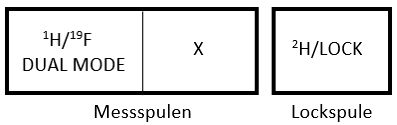
This probe is equipped with an additional Dual Tune mode for ¹H and ¹⁹F. Although the two nuclei are on the same coil, they can be measured simultaneously. This means
- ¹H can be measured ¹⁹F-decoupled AND vice versa.
- Heteronuclei can be measured SIMULTANEOUSLY with ¹H and ¹⁹F decoupling, or either with ¹H decoupling only or with ¹⁹F decoupling only.
- ¹⁹F heteronucleus 2D measurements are possible (e.g. ¹⁹F¹³C HMQC) with or without additional ¹H decoupling.
¹H heteronucleus 2D measurements are possible (e.g. ¹H¹³C HMQC) with or without additional ¹⁹F decoupling.
Temperature experiments are possible from -100°C to +150°C. Care must be taken to select a suitable solvent.
__________________________________________________________________________________
For temperature measurements and experiments not carried out automatically, please make an appointment.
Experiments – The following have been set up so far:
Further experiments are in progress or available on request.
| ¹H: | ¹H | |
| ¹H_para | ||
| ¹H¹H COSY | H–H correlation within a spin system | |
| ¹H¹H NOESY | ||
| NOE difference | Differential measurement | |
| ¹H{¹⁹F} | HFX probe only | |
| ¹H{³¹P} | Decoupling also possible with 2 offsets | |
| ¹H{X} | Decoupling from other heteronuclei is possible; also possible with 2 offsets | |
| PSYCHE | ¹H{¹H} | |
| DOSY | Diffusion | |
| EXSY | Chemical exchange | |
| Water suppression | ||
| Solvent suppression | For non-deuterated solvents / Measurement without a lock | |
| ²H | Deuterium | Measurement on the lock channel |
| ⁷Li: | 7Li{1H} | |
| ¹¹B: | 11B | with and without background suppression |
| 11B{1H} | with and without background suppression | |
| 1H11B HMQC | ||
| 1H11B HMBC | ||
| ¹³C: | ¹³C{¹H} | |
| ¹³C{¹H} dept135 | CH₃/CH positive – CH₂ negative | |
| ¹³C{¹H} apt | CH₃/CH positive – CH₂/C negative | |
| ¹H¹³C HMQC | not phase-sensitive | |
| ¹H¹³C HMBC | ||
| ¹⁵N: | ¹H¹⁵N HMQC | Coupling constant and measurement range must be specified |
| ¹H¹⁵N HMBC | Coupling constant + measurement range must be specified | |
| ¹⁹F: | ¹⁹F | |
| ¹⁹F{¹H} | HFX probe only | |
| ²⁷Al: | ²⁷Al | with and without background suppression |
| ²⁷Al{¹H} | with and without background suppression | |
| ²⁹Si: | ²⁹Si | |
| ²⁹Si{¹H} | ||
| ²⁹Si{¹H} – inapt | Polarisation transfer | |
| ²⁹Si-inept | Polarisation transfer | |
| ¹H²⁹Si HMQC | ||
| ¹H²⁹Si HMBC | ||
| ³¹P: | ³¹P | |
| ³¹P{¹H} | ||
| ¹H³¹P HMQC | ||
| ¹H³¹P HMBC | ||
| ⁷¹Ga: | ⁷¹Ga{¹H} | |
| ⁷⁷Se: | ⁷⁷Se | |
| ⁷⁷Se{¹H} | ||
| ¹H⁷⁷Se HMQC | ||
| ¹H⁷⁷Se HMBC | ||
| ¹¹⁹Sn: | ¹¹⁹Sn{¹H} | |
| ¹H119Sn HMBC | ||
| ¹²⁵Te: | ¹²⁵Te{¹H} | |
| ¹H¹²⁵Te HMBC | ||
| ¹⁹⁵Pt | ¹⁹⁵Pt{¹H} | |
| ²⁰⁷Pb: | ²⁰⁷Pb{¹H} | |