
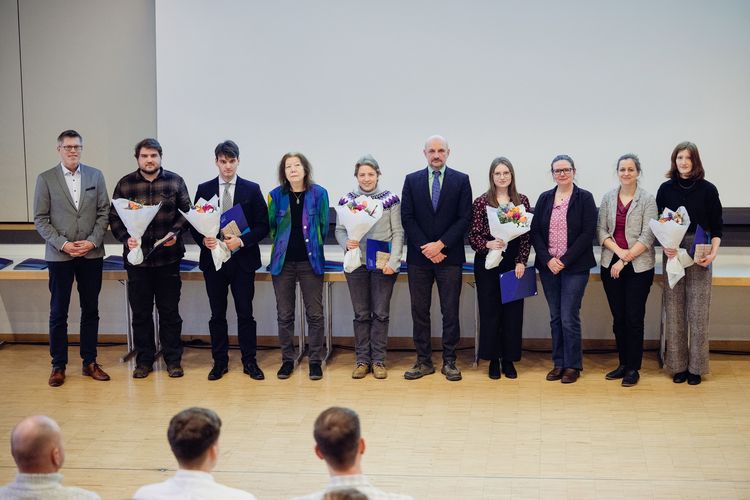
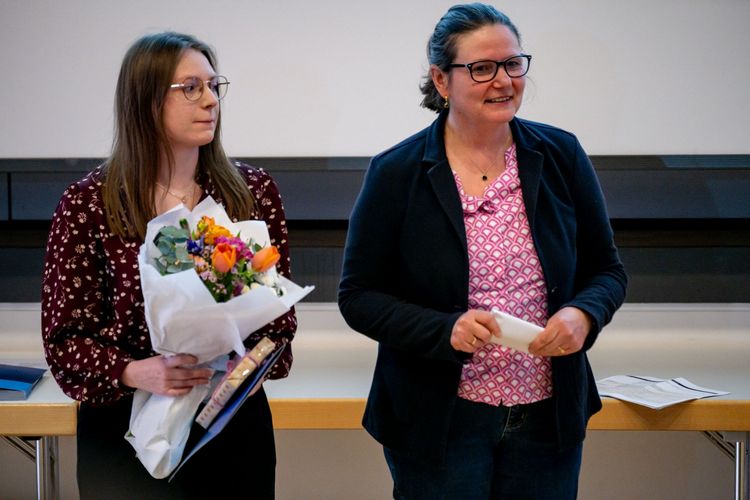
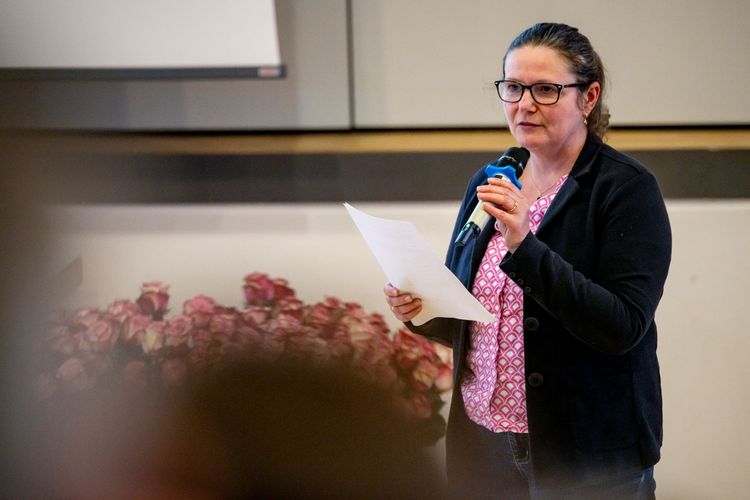


At a graduation ceremony held on 26 February 2026, Faculty V – Mathematics and Natural Sciences at the Carl von Ossietzky University of Oldenburg bid farewell to over 650 graduates. A total of 365 Bachelor’s and 241 Master’s students graduated during the past academic year. The faculty also awarded 52 doctoral degrees. Around 180 graduates collected their certificates in person. Prof. Dr Andrea Strübind, the University’s Vice-President for Studies and Teaching, gave a welcoming address. Prof. Dr Helmut Hillebrand entertained the attendees with a lecture on the topic ‘You ain’t seen nothing yet: Changes in marine biodiversity’. The programme was accompanied by music from the student soul and funk band of the Institute of Music, conducted by Stephan Schomaker.
During the ceremony, the Faculty also honoured five Master’s students for their outstanding final theses. The recipients were Marit Büsing (Institute of Chemistry), Lars Burnus (Institute of Biology and Environmental Sciences), Kristian Gjorgjieski (Institute of Physics), Noah Körner (Institute of Mathematics) and Helena Post (Institute of Marine Chemistry and Biology).
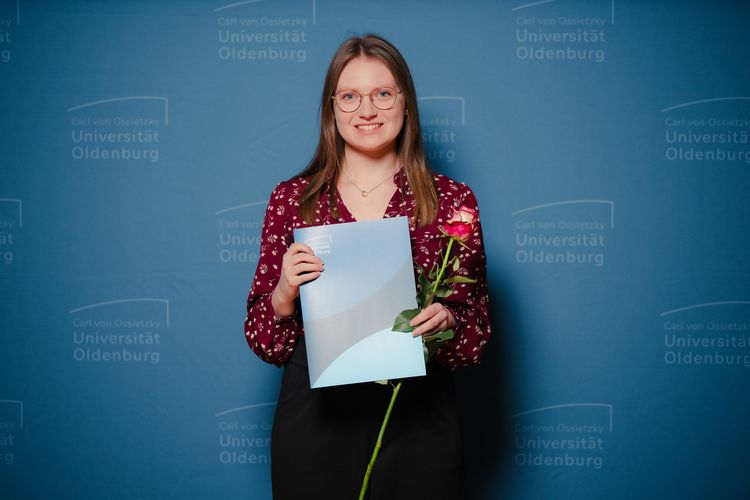
The Institute of Chemistry extends its warmest congratulations to all the honourees, but especially to Marit Büsing
Marit Büsing, M.Sc.:
Following her Bachelor’s degree on the topic of ‘Biocatalytic synthesis of benzylamines using amine dehydrogenase’, which she completed in Prof. Haralf Gröger’s research group, Marit Büsing went on to undertake a Master’s degree. Under the title “Adsorption and Distribution of Magnetosomes on Solid Surfaces”, she completed her Master’s thesis at the Carl von Ossietzky University of Oldenburg in the “Electrochemistry and Interfaces of Condensed Systems” research group (Prof. Gunther Wittstock). As part of her thesis, she investigated the adsorption, opening and distribution of magnetosomes on solid surfaces. More specifically, she studied organelles from magnetotactic bacteria, which consist of a magnetic nanocrystal core surrounded by the bacteria’s inner protein-rich lipid membrane. Thanks to these magnetosomes, magnetotactic bacteria have the ability to align themselves along the Earth’s magnetic field. In her work, Marit Büsing adsorbed the magnetosomes onto gold surfaces modified with thioglucose and thiocytosine monolayers. The distribution of the magnetosomes was then investigated over several days using electrochemical methods, as well as quartz crystal microbalance and atomic force and magnetic force microscopy.
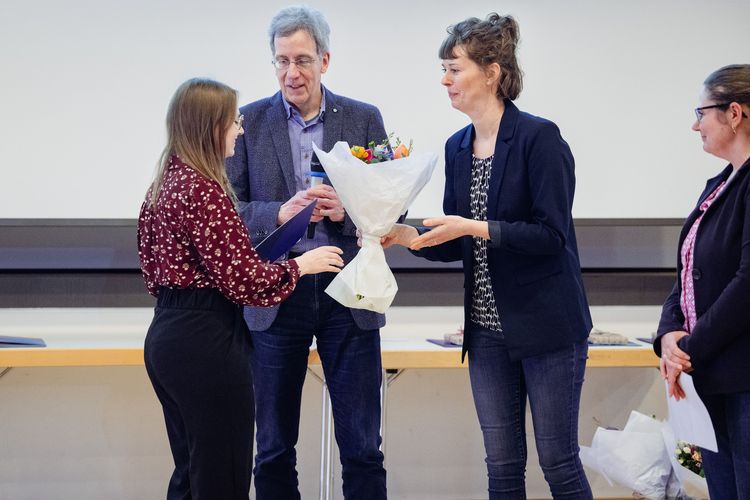
Her work, the results and the summary thereof were rated as outstanding: Marit Büsing received an award from Faculty V – Mathematics and Natural Sciences at the C.v.O. UOL, which was presented to her by the Dean of the Faculty during the ceremony. The laudatory address for Marit Büsing was delivered by PD Dr Izabella Brand.
Marit Büsing will continue her career within the NaviSense Cluster of Excellence at our university and as a colleague and member of Prof. Wittstock’s research group, where she intends to tackle the challenges and work on the production of model membrane systems to elucidate the intermolecular interaction pathways that play a role in the perception of the Earth’s magnetic field.