
The registration procedure for the courses: What do I have to do when and how?
The registration procedure for the courses: What do I have to do when and how?
Prioritised lottery procedure instead of 'first come, first served'
Places in the courses are no longer allocated on a 'first come, first served' basis (whoever is quickest gets a place), but according to a prioritised lottery procedure, which gives you much more opportunity to create a timetable that makes sense.
Do I have to sit in front of my PC again at a specific time to log in?
No. There are registration periods for modules during which you can register for the lottery procedure in Stud.IP for eligible courses of a module and prioritise them; the time of registration does not affect your chances. After the respective lottery date, you will be notified whether you have been admitted to the courses.
How do I use the option to specify priorities?
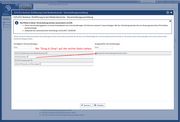
Select the course of a module in which you would most like to participate and put it at the top of your priority list in Stud.IP (priority 1).
Then select the course you would like to attend in case you do not get into the course with the highest priority in the draw and move it to the second place on your priority list.
Proceed in the same way with the remaining events until you have prioritised all the events offered in the module.
You should only leave out those courses that overlap with courses in your other subject or the PB or courses already taken in German Studies. Otherwise, you risk not getting a place on the module at all.
Priorities in master modules
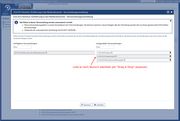
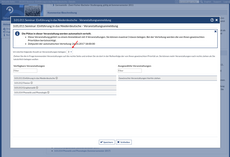
In the Master's modules (e.g. ger790/890 or ger 780/880), you must take several courses and can usually combine them as you wish. In Stud.IP, it is possible to specify how many courses you would like to select in the current registration procedure when assigning priorities. The following screenshot shows how to do this:
What is the best way to proceed during the registration period from 24 February to 2 March 2026?
- Look in the table of registration dates (see the top right-hand column when viewing on a PC) for the modules you wish to register for. On the first relevant day, select as many alternative modules as possible, as described above, and assign priorities to them.
- After the allocation, note down in your timetable which courses you have been allocated to, and use this as a basis for planning which other modules are suitable for you. Please note that Stud.IP is not able to automatically detect timetable clashes during the allocation process. You must check this yourself!
- Over the following days, use this plan to select courses from other suitable modules and, for each one, note in your timetable which time slots are now occupied and which remain free.
- Fill in your timetable step by step in this way until 2 March 26.
- You MUST deregister from courses if you have been allocated a place but are unable to attend after all.
Note for first-year students (only valid in the winter semester): Registration for the core modules ‘Language and Culture’ and ‘Literature and Culture’ takes place on 9 October 2025/10 October 2025, i.e. after the German Studies information session during orientation week.
Example of procedure during the registration period
Example:
(from one of the previous semesters)
The student Gisela would like to complete ger221, ger231 and ger246; if she cannot get into ger221, she could also attend ger211. She selects the following preferences for ger221 in Stud.IP on Monday shortly before 11 pm:
1. 3.01.055 (Henzel)
2. 3.01.051 (Stiemer)
3. 3.01.053 (Huber)
At 11 pm she is assigned to Mr Stiemer's course (her 2nd preference) (Tue, 18-20 and Wed 12-14).
On Tuesday, she sleeps late and only registers for ger246 at 11 a.m.; because she already knows that she does not have time for Mr Tröster-Mutz's ger246 (3.01.075, Wed, 12-14), she only chooses the following courses (the third course offered would have overlapped with 3.01.051 Stiemer):
1. 3.01.071 Wichers
2. 3.01.073 Tröster-Mutz
This time she is drawn to her first preference at 11 pm and is delighted. In the meantime, her timetable is already quite full, partly because of her second subject, and she can only enter two preferences on the registration day (Thursday) because she has no time for the other dates (3.01.062, for example, overlaps with 3.01.052, the exercise associated with 3.01.051, which she has to attend):
1. 3.01.061 Bußmann
2. 3.01.063 Bußmann
She is now assigned to her second preference.
So now she has 15 CPs spread over 10 SWS in German Studies this semester - completely sufficient!
How can I increase my chances of getting a place on a course?
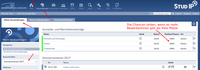
You can see for which courses the 'pressure' is particularly high. Stud.IP shows how high the chance is of getting into a particular course that you have prioritised. If, for example, "Chance 50%" is displayed there, this means that 80 people are interested in the selected AM seminar with 40 places and have prioritised it in the Stud.IP list. Choose courses that are not yet overbooked if possible!
What happens if I don't get in during the lottery procedure?
Don’t panic! It is true that you might be unlucky in the allocation process. But firstly, there are often alternatives: for example, if you haven’t secured a place on any ger221 modules, most students can choose ger211 instead.
Secondly, depending on the module, you can still enrol in courses that haven’t filled up through the lottery system until 21 April 2026.
Thirdly, if you’re facing seemingly insurmountable timetable issues, please contact the by email.
General organisational queries regarding timetable planning are also welcome at any time.
Note for first-year students (applies only to the winter semester): Please contact the by email if you have any questions regarding the clearing process. Please include a telephone number in your email so that we can call you if necessary. Some matters are best discussed over the phone. General organisational enquiries regarding timetable planning are also welcome by email at any time.
Can I submit a hardship application?
Yes, but only during the period from 14 July 2025 to 22 August 2025. After that, no further hardship applications will be accepted, without exception. Information on who can submit a hardship application and how to do so can be found here (top left if viewing on a PC; on a tablet or smartphone, the page is displayed in a single column).
The exact date on which the hardship proposal is submitted within the above-mentioned deadline does not affect the allocation of places. All proposals received between 14 July 2025 and 22 August 2025 will be treated equally.
Note for first-year students (applies only to the winter semester): First-year students may submit hardship applications until 8 October 2025 at 12 noon. You must enclose a current enrolment certificate confirming that you are in your first semester of the Bachelor’s degree in German Studies!
Do I have better chances if I am in my final semester?
Yes, the enrolment procedure is set up so that students in the higher semester are given special consideration.
Information on the hardship case 'last semester' can also be found here.
What are not grounds for hardship provisions? For example:
- I have to work
If you would like to work alongside (!) your studies, please fit your working hours around your studies, not the other way round. An academic appointment is not considered a case of hardship (exceptions for part-time study approved by the I-Amt and therefore verifiable). - I have a long journey tothe university
A long journey to the university is not considered a case of hardship.
The registration deadlines

You will find the exact registration deadlines for each course in Stud.IP in the registration sets.
The SoSe 2026 course catalogue has already been made visible.
Tips
- ALWAYS try to specify several alternatives (prioritise!). This will significantly increase your chances!
- If possible, register for courses with a 75-100% chance of being accepted. The higher the chance, the more likely you are to get a place!
- ALWAYS deregister immediately from courses to which you have been allocated but which you will not be attending! Please check for overlaps, as Stud.IP does not take overlaps into account when drawing lots!
- Please be open to alternatives if you are unable to attend your chosen module.
- You do not have to sit in front of your PC immediately at the beginning of the enrolment period. You can register up until the lottery procedure. Please refer to the table of registration deadlines for the time window from the activation of registration until the start of the lottery procedure.
- Do not register for too many modules ("have a look ..."). You will take away important places from others!