

Rethinking working time
Project implementers
University of Oldenburg
Chair of Human Resources and Organisation
Prof. Dr Thomas Breisig
Hiltraud Grzech-Sukalo
Office for University and Trade Union Co-operation
Dr Uwe Kröcher
Dr Claudia Czycholl
Rethinking working time
Project duration: April 2024 - August 2025
"Saturday is my dad's day." This was the slogan used by trade unions in Germany in the mid-1950s to call for a five-day or forty-hour week. Almost seventy years later, the debate about working hours has flared up again. Shorter, but also longer working weeks are seen as solutions to counteract existing shortages of skilled labour. In addition to various working time models, the possibilities of flexible working time organisation are also being discussed, including with regard to life-phase orientation.
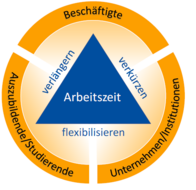
We want to discuss the sometimes conflicting demands on working hours with key stakeholder groups in the future discourse. The aim is to explore the opportunities, risks and challenges of different working time models against the backdrop of a shortage of skilled labour and different lifestyles and employment plans. A particular focus will be on the north-west region around Oldenburg. The latest research findings on the demand for skilled labour in specific occupational groups and the effects of working time models will be contrasted with the interests of employees and their representatives, companies/institutions and their associations, apprentices/students and their representatives.
The various interests are discussed in face-to-face and online events and common areas of overlap and different views on the organisation of working time are examined. The events are aimed at companies, managers, employees, apprentices, students, interest groups, company health officers, trade unions, employers' associations and chambers of industry, commerce and crafts.
Impulse paper of the project
The impulse paper presents the key results of the future discourse "Rethinking working time - in times of skilled labour shortages". A special focus is placed on various models of a 4-day week and their potential advantages and disadvantages for employees.

How do employees want to work? Focus on the 4-day week
The short report deals with employees' perceptions of working hours in general and the 4-day week in particular.

Working hours: focus on apprentices, students and young workers
This short report takes a look at the working time wishes of the younger generation. It is part of the results of a workshop that was organised as part of the future discourse "Rethinking working time".
The 4-day week: option or utopia?
Closing event | Thu, 14.08.2025, 16:30 - approx. 18:45 | BIS-Saal, University of Oldenburg

There are currently many debates about the future of work. Fuelled by discussions about the economic situation and shortages of skilled workers, working hours play a central role. In the run-up to his first government statement on 14 May 2025, Friedrich Merz emphasised: "We need to work more and, above all, more efficiently in this country. We will not be able to maintain this country's prosperity with a four-day week and work-life balance." The four-day week is attracting both supporters and critics. Business organisations, for example, are calling for longer working hours and rejecting a 4-day week. At the same time, more and more companies and institutions are offering a 4-day week in order to increase their attractiveness on the labour market. And the majority of full-time employees would like a shorter working week.
As part of the final event of the future discourse "Rethinking working hours - in times of skilled labour shortages", we took another look at the 4-day week. Is the four-day week a model for the future? What are the potential advantages and disadvantages of different 4-day week models for employees and employers? What operational requirements are needed to implement a 4-day week? Prof Dr Julia Backmann from the University of Münster presented key findings from Germany's largest pilot project on the 4-day week on these and other questions. Following the presentation, we discussed the pros and cons of the working time model with various stakeholders from academia and the world of work. Julia Backmann (University of Münster), Heiko Henke (Oldenburg Chamber of Crafts), Dorothee Koch (Regional Managing Director, DGB Oldenburg-Ostfriesland) and Sofia Heuser (Young People's Secretary, ver.di Weser-Ems district) contributed their specific perspectives and experiences.
The local radio station oldenburg eins recorded the event: https://youtu.be/2GQNLjBqGXc
The event took place as part of the future discourse "Rethinking working hours - in times of skilled labour shortages" and was sponsored by the Lower Saxony Ministry of Science and Culture.
Four-day week - What does it look like in practice?
Lecture | Thu, 06.02.2025, 17:00-18:30 | online
In recent years, the debate surrounding the four-day week has gathered momentum and is becoming increasingly important in the world of work. Employees are often interested in a shorter working week to achieve a better balance between academic appointments and private life. Employers, on the other hand, see a four-day week as an opportunity to better attract and retain skilled workers.
But what does it look like in practice? What four-day week models do companies and organisations offer? What should be considered when introducing a four-day week? What experiences have employees and employers had with the working time models?
These and other questions were discussed in the online event on the basis of two practical reports on two different models of a four-day week. Sabine Reger, Head of the Main Office at Mengen City Council, and Works Council Chairwoman Christina Kreft from DRK KV Sangerhausen e.V. reported on their specific experiences of implementing a four-day week and the new daily routine in the areas of city administration and care.
The event took place as part of the future discourse "Rethinking working hours - in times of skilled labour shortages" and is sponsored by the Lower Saxony Ministry of Science and Culture.
Shorter, longer, more flexible - How do we want to work?
A workshop for employees and Works and Staff Councils
Workshop | Wed, 20.11.2024, 14.00 - 17.00 | University of Oldenburg, Ökocentrum
There are currently many debates about the future of work. Working hours play a central role in this: business associations, for example, are calling for longer working hours in order to cover labour requirements. At the same time, more and more companies and institutions are introducing a four-day week to counteract shortages of skilled workers and increase their attractiveness on the labour market. And more and more employees do not want to work full-time in order to have more free time for themselves.
The aim of the workshop was to explore the opportunities, challenges and implementation possibilities of various working time models. To this end, knowledge of legal regulations on the topic of working hours was imparted and different working time models and their advantages and disadvantages (workload, effects on health, work-life balance, etc.) were discussed. The workshop also focussed on the wishes, suggestions and design issues of employees and interest groups with regard to a 4-day week, shorter working hours and/or flexible working hours.
Advisor: Margareta Steinrücke is a labour and gender sociologist and coordinator of the Bremen Working Time Initiative. She has also been active for many years at ver.di, particularly in women's and educational work, in the attac federal working group ArbeitFairTeilen and in the European Work-Time Network.
The workshop took place as part of the future discourse "Rethinking working time - in times of skilled labour shortages" and was sponsored by the Lower Saxony Ministry of Science and Culture.
Four-day week - a model for the future?
Lecture | Thu, 19.09.2024, 17:30-19:00 | online
with Dr Anna Arlinghaus, Managing Director of XIMES GmbH (research and consulting)
More time - that's what many employees want. More and more companies and organisations are looking into the four-day working week model in order to offer skilled workers the most attractive working conditions possible. But is the four-day week a model for the future for all sectors? What are the potential advantages and disadvantages for employees and employers? How can a four-day week be implemented? What operational requirements are needed?
The Austrian research and consulting company XIMES GmbH has advised many companies on these and other questions relating to the four-day week, supported them during implementation and evaluated the process as well as the working time models in several companies. In her presentation, Dr Anna Arlinghaus presented different variants of the four-day week as well as results from the accompanying studies and discussed both the opportunities and challenges of implementation with the participants.
Lecture
The four-day week in practice
Dr Anna Arlinghaus, Managing Director of XIMES GmbH

The event took place as part of the future discourse "Rethinking working hours - in times of skilled labour shortages" and was sponsored by the Ministry of Science and Culture of Lower Saxony.
Generation Z - How do we want to work?
A workshop for apprentices, students and JAVs
Workshop | Wed, 14.08.2024, 9.00 - 13.00 | University of Oldenburg - A01 0-006
The labour market is changing. On the one hand, many business associations are calling for longer working hours in order to cover labour requirements in companies. On the other hand, many employees want to work less and have more free time. As future employees, apprentices in particular are confronted with the new working time debate: should and do we want to work more or less in the future? Is the 4-day week a model for the future? How can working hours be organised flexibly? What do we want from future employers with regard to working hours?
These questions were discussed in the workshop with students, apprentices and apprentice representatives. Various working time models and their advantages and disadvantages were presented and the participants worked together to identify their suggestions, wishes and ideas for employers when it comes to working hours. The workshop also provided an opportunity to share their own experiences on the topic of working hours in a training company or part-time job.
The workshop took place as part of the future discourse "Rethinking working time - in times of skilled labour shortages" and is funded by the Lower Saxony Ministry of Science and Culture. More information about the project can be found here: https: //uol.de/kooperationsstelle/projekte/arbeitszeit-neu-denken
More or less work? Rethinking working time
Debate | Mon, 10 June 2024, 6.15 pm | online
with Verena Albrecht (Oldenburg Employers' Association)
and Prof. Dr Beate Zimpelmann (Bremen Working Time Initiative)
There are currently many debates about the future of work. Fuelled by discussions on possible solutions to the need for skilled workers, working time plays a key role. Should we work more or less in the future? Is the 4-day week a model for the future? And how can working hours be organised flexibly in order to meet the interests of employees and employers?
These and other questions were the focus of the event on the future organisation of working hours. In two short inputs, Beate Zimpelmann from the Bremen Working Time Initiative and Verena Albrecht from the Oldenburg Employers' Association shed light on the pros and cons of more or fewer working hours. This was followed by a debate on the different ideas for the future organisation of working time with active participation from the audience.
The event took place online and was aimed at companies, interest groups, trade unions and associations as well as interested employees, apprentices and students.
The evening event took place as the kick-off event of the future discourse "Rethinking working time - in times of skilled labour shortages", which is funded by the Lower Saxony Ministry of Science and Culture. You can find more information about the project here: https: //uol.de/kooperationsstelle/projekte/arbeitszeit-neu-denken

