
events
events
On this page we provide an overview of the current event dates of the cooperation centre. Information on past conferences, lectures and workshops can be found here.
Firewall? Bans? Democracy education?
How do we protect our democracy from the extreme right?
Lecture | Thu, 10.09.2026, 19:00 h | BBS Haarentor
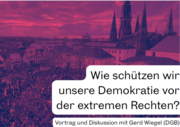
An authoritarian and in many cases anti-democratic far right is on the rise. Not just in Germany, but worldwide. What are the reasons for the rise of this authoritarian right? Who does it reach and what can help to counter the acute threat to democracy and human rights? What role do trade unions play in this and what can we contribute?
We want to discuss these and other questions with Gerd Wiegel, Head of the Democracy, Migration and Anti-Racism Policy Department at the DGB Federal Executive Board.
Participation in the event is free of charge and will take place in the auditorium of the BBS Haarentor (Ammerländer Heerstr. 33 - 39, 26129 Oldenburg). Registration is not required.

Fair pension distribution
Lecture | Tue, 22.09.2026, 18:30 | Library Hall University of Oldenburg
with Prof Dr Jutta Schmitz-Kießler (Bielefeld University of Applied Sciences, Pension Commission of the DGB)

For many people, pensions are a distant reality and only become an issue when the end of their working life is in sight. Because the complicated system of pensions and pension funding often attracts little interest, many cuts to pension benefits have been implemented relatively quietly in the past. Yet pensions affect almost everyone. This year, the federal government intends to implement a large-scale reform of the pension insurance system, which was drawn up by the so-called ‘Commission on Old-Age Provision’ and which will result, for many, in a lower pension in old age and an increase in the state pension age. As an alternative, the DGB has commissioned its own pensions commission to draw up key points for the future of pensions, with a view to securing socially just and adequate pensions in the future. For it is not demographic change that is putting pressure on the pay-as-you-go pension system, but the polarised distribution of income and wealth.
Pensions expert Prof. Dr Jutta Schmitz-Kießler will present key aspects of the pensions debate and explain the proposals put forward by the DGB’s Pensions Commission. In doing so, she will also subject the main key points of the Federal Government’s reform plans to critical scrutiny.
Speaker:
Jutta Schmitz-Kießler, Prof. Dr. rer. pol., is a professor of political science, specialising in social policy, at Bielefeld University of Applied Sciences; her research focus is on old-age provision systems, poverty in old age and employment in later life, as well as labour market and employment structures. She was a member of the DGB’s Pension Commission, which presented its recommendations in June 2026.
Attendance at the event is free of charge. Please register by 18 September 2026 using the online registration form on the website of the Office for University and Trade Union Co-operation.
Event series: ‘Social Inequality and Distributive Justice’.


The MAGA movement and the global right - networks, dynamics and counter-strategies
Lecture | Thu, 24.09.2026, 18:00 | Cultural Centre PFL

In recent years, far-right actors around the world have been increasingly forming networks. In media reports, conference announcements and even transnational partnerships, they promote the same recurring themes amidst a sometimes bewildering array of issues: anti-immigration, anti-feminism, climate change denial and the fight against a supposed ‘global left’. But who exactly are these far-right figures? How are they organised and what international goals do they pursue? And what can be done to counter them?
These and other questions form the focus of Ulli Jentsch’s talk. As a member of the ‘Research against Global Authoritarianism’ (ReGA) initiative, his aim is to understand the alliances and demands of the global far right so that local resistance can be effectively organised. For it is the same authoritarian forces, both locally and globally, that seek to hinder the protection and defence of human rights whilst also criminalising the pursuit of humanitarian goals. A practice of resistance against the far right should keep both these levels in mind.
Speaker:
Ulli Jentsch is a freelance journalist from Berlin who has been active for decades in various anti-fascist initiatives and international networks, including ‘Research against Global Authoritarianism’. He has been researching the far right in Germany for over twenty years. His work focuses on exposing the structures and ideologies of right-wing terrorism, Christian fundamentalism and the ‘pro-life’ movement.
The lecture is part of the series ‘Right-wing Networks: Manifestations, Explanatory Approaches and Counterstrategies’. The event is organised in collaboration with Arbeit und Leben Niedersachsen, the DGB Weser-Ems region and the Cooperation Centre for Universities and Trade Unions in Osnabrück.
Attendance at the event is free of charge. Please register by 20 September 2026 using the online registration form on the website of the Office for University and Trade Union Co-operation.
The organisers reserve the right to exercise their right to admit or exclude persons and to refuse entry to the event or exclude anyone from it who belongs to far-right parties or organisations, is associated with the far-right scene, or has previously made racist, nationalist, anti-Semitic or other inhuman remarks.
A world order in flux – the end of international law?
Lecture | Tue 6 Oct 2026, 6.30 pm | Hybrid | Library Hall, University of Oldenburg
with Kai Ambos (University of Göttingen)

Worldwide, international law is coming under severe pressure due to the erosion of the prohibition on the use of force, the rise of anti-liberal alliances and accusations of double standards – and not only as a result of the recent military interventions and threats by Russia, the US and China. Multilateral regulatory systems and their foundations in international law are at risk of being further undermined. The law of the strongest seems increasingly to be gaining the upper hand over the rule of law. Germany, too, stands at a crossroads, not least with regard to its assessment of the Gaza war. How should these shifts be assessed from the perspective of international law? Is international law in danger of degenerating into a mere instrument of power if breaches of the law are assessed differently depending on which alliance a state belongs to? How can Germany, as an advocate of a ‘rules-based order’, regain credibility? These questions will be discussed with the renowned criminal and international law expert Prof. Dr Kai Ambos.
Speaker:
Kai Ambos is Professor of Criminal Law, Criminal Procedure, Comparative Law, International Criminal Law and International Law at the University of Göttingen, and a judge at the Kosovo Specialist Chambers in The Hague.
Attendance at the event is free of charge. Please register by 1 October 2026 using the online registration form on the website of the Office for University and Trade Union Co-operation.
Event series: ‘Between authoritarian libertarianism and democratic fascism – the world order in flux’.
Kai Ambos’s latest publication:
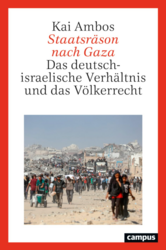
Reason of State in Gaza: German-Israeli Relations and International Law, Campus Verlag, 360 pages
Kai Ambos analyses the concept of ‘reason of state’ and clarifies its relationship to international law and the constitution; he demonstrates that the use of the term in German-Israeli relations raises many unresolved questions and that its application leads to problems concerning the rule of law. The book examines the Gaza War from the perspective of international law and investigates whether war crimes, crimes against humanity and even genocide may have been committed. It also considers Germany’s responsibility. Finally, it addresses the key question of how to deal with the concept of raison d’état in the light of the Gaza War.
Searching for historical traces: city tour on National Socialism in Oldenburg
City tour | Wed, 07.10.2026, 16:00 - approx. 18:15 | Oldenburg city centre
Experiencing the city as a learning space and bringing history to life in various locations. This is possible with the help of a city walking tour. With our walking tour on National Socialism in Oldenburg, we aim to provide an opportunity to explore an important part of the region’s history.
The tour on National Socialism in Oldenburg covers just under four kilometres, taking in ten stops from the Pferdemarkt through the city centre to the former Oldenburg State Parliament building, and finally ending at the memorial wall for the Jewish victims of the Holocaust. At these memorial sites, topics such as the possible reasons for the NSDAP’s early successes in Oldenburg, the wartime experiences of the city’s residents, and the rising anti-Semitism that ultimately led to the Holocaust are explored.
At each stop, participants can explore the information at their own pace. The stops are designed to appeal to people with and without prior knowledge of the subject.
Participation in the event is free of charge. The exact meeting point will be announced by email a few days before the event begins. Please register by 2 October 2026 using the online registration form on the website of the Office for University and Trade Union Co-operation. The number of participants is limited to 20.
Speaker
Kevin Mennenga, education coordinator at Arbeit und Leben Niedersachsen
The city tour is part of the series of events entitled ‘Right-wing networks: manifestations, explanatory approaches and counter-strategies’. The event is being organised in collaboration with Arbeit und Leben Niedersachsen, the DGB Weser-Ems regional branch and the University-Trade Union Cooperation Office in Osnabrück.
Wealth inequality - why is wealth so unequally distributed?
Lecture | Tue, 20.10.2026, 18:30 | Library Hall University of Oldenburg
with Dr Markus M. Grabka (German Institute for Economic Research DIW)
An event as part of the event series "Social Inequality and Distributive Justice".
The event is sponsored by the Hans Böckler Foundation.
Who is still thinking here?
AI, knowledge transfer and the future of schools and universities
FRITZSCHE FORUM | Thu, 29 October 2026, 18:00 | BIS Hall, University of Oldenburg

Generative AI systems such as ChatGPT are currently fundamentally changing the way knowledge is produced and used. Texts, arguments and summaries can be generated in a matter of seconds – with significant implications for schools and universities. Traditional examination formats are coming under pressure, teachers are facing new challenges in assessing performance, and at the same time, fundamental practices of learning and writing are shifting.
Kira Baresel and Benjamin Möbus examine these developments from a critical education policy perspective. The centre of their attention is not so much the specific didactic applications of AI, but rather what these technologies fundamentally mean for the transmission of knowledge and education. As machine-based systems become increasingly involved in the production of knowledge, the question arises anew as to what role independent thinking, judgement and critical reflection will play in educational processes in the future.
The lecture thus views AI as a challenge to the self-image of schools and higher education institutions and invites discussion on the consequences this will have for teachers, higher education institutions and education policy.
Speakers:
Kira Baresel is a research assistant at the Centre for Media Literacy at the University of Vechta. Her work focuses on artificial intelligence in higher education and its impact on teaching, learning and assessment.
Benjamin Möbus is a research assistant in the Department of Education at the University of Vechta, specialising in inclusive education. His research focuses on artificial intelligence in an educational context and its impact on learning, knowledge production and performance assessment.
Attendance at the event is free of charge. Please register by 25 October 2026 using the online registration form on the website of the Office for University and Trade Union Co-operation.
The FRITZSCHE-FORUM is a joint event organised by Arbeit und Leben Niedersachsen, the DGB Weser-Ems regional branch, the GEW Weser-Ems district association and the Office for University and Trade Union Co-operation. The event is being organised in co-operation with the Centre for Teacher Training – Didactic Centre (DiZ) at the University of Oldenburg.
Authoritarian rebellion - How anti-modern reflexes are gripping broad sections of society and moving further to the right
Lecture | Tue, 17.11.2026, 18:00 | online via BigBlueButton
They are family members, friends, acquaintances, club members, double header players, tennis partners or members of the volunteer fire brigade. They have made up their minds: This Federal Republic is no longer their republic. We know them, they don't just sit in parliaments or talk shows, they also sit at kitchen tables or regulars' tables. They come from the so-called centre of society. Their revolt tends towards the authoritarian. The various spectrums of authoritarians from the Reich to alternative movements have a deep-seated longing for a pre-modern harmony in common. They are concerned about freedom and yet are afraid of it. This ambivalence exacerbates current crises and has a long tradition - in the Enlightenment and in fairy tales. In his lecture, Andreas Speit shows why anti-modern ideas dominate in broad sections of society and the consequences of their accompanying radicalisation: Doubting reality, rejecting the rule of law, delegitimising democracy.
Speaker:
Andreas Speit is a freelance journalist, author and editor of numerous books on right-wing extremism and neo-Nazism in Europe. He has been the author of the taz-nord column "Der Rechte Rand" since 2005 and regularly contributes to zeit-online, Deutschlandfunk Kultur and WDR. He has received several awards for his work, including from the German Journalism Association.
The lecture is part of the event series "Rechte Netzwerke: Erscheinungsformen, Erklärungsansätze und Gegenstrategien". The event is being organised in cooperation with Arbeit und Leben Niedersachsen, the DGB Weser-Ems region and the Cooperation Centre for Universities and Trade Unions in Osnabrück.
Participation in the event is free of charge and takes place online via BigBlueButton. Please register by 13 November 2026 using the online registration form on the homepage of the Office for University and Trade Union Co-operation.
The organisers reserve the right to exercise their domiciliary rights and to deny access to or exclude from the event persons who belong to right-wing extremist parties or organisations, are associated with the right-wing extremist scene or have already made racist, nationalist, anti-Semitic or other inhuman statements in the past.
The dawn of a new era of imperialism?
Lecture | Tue 24 Nov 2026, 6.30 pm | Library Lecture Theatre, University of Oldenburg

In historical studies, the period from 1885 to 1914 is referred to as the ‘Age of Imperialism’, which had its main theatres of action in sub-Saharan Africa and China and culminated in the First World War. Despite the establishment of the League of Nations as an international framework for order, this trend continued in East Asia and Central Europe right up until the Second World War. With the post-war order established by the victorious powers and the founding of the UN – and certainly by the end of the East-West conflict – it seemed that a ‘New World Order’ based on rules and international law was beginning to take shape.
Are we now witnessing, with Putin’s attempt to forcibly restore Tsarist Russia, Trump’s military interventions and his ambitions to expand US territory through acquisition, as well as Xi Jinping’s strategy of creating new dependencies along the New Silk Road routes through loans and infrastructure projects, are we witnessing the dawn of a new imperialist era aimed at partitioning the world? Are we heading towards a new global conflict? The lecture will examine the parallels and differences between the three actors’ imperialist policies and those of earlier periods.
Speaker:
Ulrich Menzel, Professor Emeritus at the Technical University of Braunschweig, where he held the chair for International Relations and Comparative Government. His research focuses on the theory and history of the international system, development theory and North–South relations, international political economy, and peace and conflict studies.
Attendance at the event is free of charge. Please register by 20 November 2026 using the online registration form on the website of the Office for University and Trade Union Co-operation.
The event is taking place as part of the series ‘Between Authoritarian Libertarianism and Democratic Fascism – A World Order in Flux’, which is being organised in collaboration with the Comparative Political Science Working Group (Prof. Dr Torsten J. Selck), the ‘Arbeit und Leben’ Educational Association of Lower Saxony and the DGB Weser-Ems Regional Branch.
Income inequality - Social division in Germany
Lecture | Thu, 21.01.2027, 18:30 | Library Hall University of Oldenburg
with Dr Dorothee Spannagel (Institute of Economic and Social Sciences WSI)
An event as part of the event series "Social Inequality and Distributive Justice".
The event is sponsored by the Hans Böckler Foundation.
Social inequality and distributive justice
Series of events 2026-2027
18:30 in the Library Hall, University of Oldenburg, Uhlhornsweg 49-55
The polarisation in society between rich and poor is becoming ever greater. This applies both to income trends in recent decades, but even more so to the distribution of wealth. The richest 10 % own a good two thirds of total wealth, while the bottom half only have 1.5 %. The wealth of billionaires grew by 30 % to USD 840 billion in 2025. At the same time, wages are lagging behind other types of income, such as capital income. Recipients of social transfer payments are one of the poorest groups in Germany and are the most severely affected. Despite this, employers and conservative politicians are calling for ever deeper cuts to social security and pension benefits while at the same time rejecting higher taxes on wealth and for the rich. The result would be a further increase in social inequality.
This series of events aims to take a closer look at the development of social inequality in Germany. What are the various causes of the growing gap between rich and poor? How could social polarisation be mitigated?
16 June 2026
Rich and poor: two sides of the same coin - social inequality in Germany
with Prof Dr Christoph Butterwegge (University of Cologne, expert on the Federal Government's Poverty and Wealth Report)
22 September 2026
Fair pension distribution
with Prof Dr Jutta Schmitz-Kießler (Bielefeld University of Applied Sciences, member of the DGB Pension Commission)
20 October 2026
Wealth inequality - Why is wealth so unequally distributed?
with Dr Markus M. Grabka (German Institute for Economic Research DIW, Socio-Economic Panel)
27 January 2027
Income inequality - social division in Germany
with Dr Dorothee Spannagel (Institute of Economic and Social Sciences WSI, Hans Böckler Foundation)
The events will take place at 18:30 in the library hall of the University of Oldenburg, Uhlhornsweg 49-55, Oldenburg.