
Publications (2021-2025)
Publications (2021-2025)
2025: Impulse paper of the future discourse "Rethinking working time - in times of skilled labour shortages"
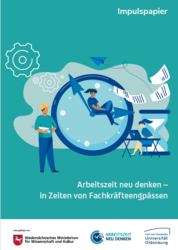
The impulse paper presents the key results of the future discourse "Rethinking working time - in times of skilled labour shortages". A special focus is placed on various models of a 4-day week and their potential advantages and disadvantages for employees.
The future discourse, which ran from April 2024 to August 2025, was funded by the Lower Saxony Ministry of Science and Culture. The University of Oldenburg's Chair of Business Administration (Organisation and Human Resources) and the Office for University and Trade Union Co-operation were involved in the implementation.
The impact paper is available here available online.
2025: How do employees want to work? Focus on the 4-day week

Breisig, Thomas/Czycholl, Claudia/Grzech-Sukalo, Hiltraud/Kröcher, Uwe (2025): How do employees want to work? Focus on the 4-day week; in brief, 06/2025
"Dad's mine on Saturdays." With this slogan, the trade unions demanded a 5-day or 40-hour week in the mid-1950s. Almost seventy years later, the debate about working hours has flared up again. Many employees want a shorter working week and a flexible organisation of their working hours. This is often driven by the desire for a better balance between academic appointments and private life. Employers, on the other hand, are increasingly offering a 4-day week in order to better attract and retain employees against the backdrop of a shortage of skilled labour.
What ideas do employees have when it comes to working hours? What role does the 4-day week play in this? What different variants of the 4-day week can be found in practice? And what are the possible advantages and disadvantages of working time models for employees? These are the questions addressed in the 06/2025 issue of kurz & knapp.
The short report was published as part of the future discourse "Rethinking working hours - in times of skilled labour shortages" sponsored by the Lower Saxony Ministry of Science and Culture.
Issue 06/2025 of kurz & knapp is available online here.
2025: Working hours: focus on apprentices, students and young workers

Breisig, Thomas/Czycholl, Claudia/Grzech-Sukalo, Hiltraud/Kröcher, Uwe (2025): Gainful employment: focus on apprentices, students and young workers, in brief, 01/2025
The labour market is changing. Working hours play a central role in this. In order to counteract skills shortages and increase their attractiveness on the labour market, more and more companies and institutions are introducing a 4-day week and/or offering flexible working hours. This trend is not least due to the working attitudes of the so-called Generation Z (born around 1996-2010), which are the subject of controversial discussions with many attributions.
What ideas do future employees and young workers have about working hours? What is important to them in their job? What do they expect from employers? These questions are addressed in the 1/2025 issue of kurz & knapp. The short report was published as part of the future discourse "Rethinking working time - in times of skilled labour shortages" sponsored by the Lower Saxony Ministry of Science and Culture.
Issue 01/2025 of kurz & knapp is available online here.
2025: Skilled labour shortages in the northwest. Extent, causes, strategies
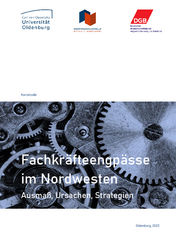
Bernshausen, Felix/Kröcher, Uwe (2025): Brief study on skilled labour shortages in the northwest. Extent, causes, strategies
The Office for University and Trade Union Co-operation, together with the DGB Oldenburg-Ostfriesland, has produced the study "Skilled Labour Shortages in the Northwest: Extent, Causes, Strategies", funded by the Hans Böckler Foundation.
In the study, authors Felix Bernshausen and Dr Uwe Kröcher examine the skills shortages in East Frisia, Emsland and Oldenburg. To do this, they selected twelve occupational groups of particular importance, such as agriculture, catering and nursing. They then analysed these with regard to six indicators such as the unemployment rate and pay trends. This was based on regionalised data from the Federal Employment Agency's skilled labour shortage analysis.
The most important result: there is currently no general labour shortage in the north-west, but there are specific shortages of skilled workers in some occupational groups.
Click here for the short and long versions of the study, which was published in March 2025.
2024: Trust is good, recording is better. Working hours and time recording in the home office

Grzech-Sukalo, Hiltraud/Czycholl, Claudia (2024): Trust is good, recording is better. Working time and working time recording in the home office, in: Zeitschrift für Arbeitswissenschaft, p. 78, 78-86.
Hiltraud Grzech-Sukalo and Claudia Czycholl contributed an article to the February issue of the Zeitschrift für Arbeitswissenschaft. In the article, they first present the development of home office use in Germany and selected regulations of the Working Hours Act with possible effects on the health and work-life balance of employees due to violations of the legal requirements. They then look at the obligation to record working hours when working from home and discuss the draft bill presented by the German government to amend the Working Hours Act in this context. Finally, the authors provide insights into the practice of working from home and its regulation on the basis of company and service agreements on the aspects of working time, availability requirements and working time recording.
The article is available as an open access version: https://link.springer.com/article/10.1007/s41449-023-00403-4
2024: University and trade unions. 50 years of co-operation between two worlds

Uwe Kröcher, Manfred Klöpper, Claudia Czycholl (2024): University and trade unions. 50 years of co-operation between two worlds. In: Jürgen Lüthje, Dietmar Schütz (eds.): 50 years of the University of Oldenburg: a stroke of luck for the city and region, Oldenburg, Isensee Verlag, pp. 321-330
This article summarises the co-operation from its beginnings to the present in the necessary brevity. The conceptual background of the co-operation is presented and the development from the idea to the institutionalisation of the co-operation centre is traced. In addition, the claim and real benefits for the university and trade unions as well as society are summarised and finally the current and future significance of co-operation is discussed.
The article can be found in the printed book and can be ordered in bookshops or from the publisher.
2023: Study on the socio-ecological transformation of the energy industry in the north-west region

Scheele, Ulrich in collaboration with Kröcher, Uwe (2023): Study on the socio-ecological transformation of the energy industry in the north-west region
The study by Prof. Dr Ulrich Scheele in collaboration with Dr Uwe Kröcher sheds light on the status quo of the industry in the region and its prospects in the transformation. A particular focus was placed on the employment effects of the energy transition. The work is thus one of the few publications that is dedicated to this issue with a concrete view of a region and summarises the essential state of research. Partners of the study are the Lower Saxony Alliance for Sustainability, the DGB region Oldenburg-Ostfriesland, the Office for University and Trade Union Co-operation at the University of Oldenburg and Arbeit und Leben Niedersachsen.
The study file can be downloaded here free of charge.
2023: Designing hybrid work. Analyses - concepts - practical reports

Breisig, Thomas/Czycholl, Claudia/Grzech-Sukalo, Hiltraud/ Kröcher, Uwe (2023) Gestaltung hybrider Arbeit: Analysen - Konzepte - Praxisberichte. University of Oldenburg Press (UOLP), Oldenburg
The practice-oriented future discourse Hybrid Work - the Normality of Tomorrow explored the opportunities, risks and design possibilities of hybrid workplaces. To this end, the perspectives of various stakeholder groups on the opportunities and risks of combining home office and on-site work in the company/institution were included. A particular focus was placed on the mutually dependent topics identified as central: "workplace concepts", "work organisation" and "digitalisation". In our practice-oriented book publication Gestaltung hybrider Arbeit (Designing hybrid work), we document the central results of the future discourse with contributions on analyses, concepts and design approaches to hybrid work.
The PDF file can be downloaded here free of charge.
2023: Hybrid working - the normality of tomorrow

Breisig, Thomas/Czycholl, Claudia/Grzech-Sukalo, Hiltraud/Kröcher, Uwe (2023): Hybrid work - the normality of tomorrow
The impulse paper presents the key results of the project "Hybrid workplaces - the normality of tomorrow" . The future discourse focussed on various forms and possibilities for designing hybrid work. The associated new requirements for companies, interest groups and employees as well as the opportunities and risks of hybrid work were explored together with the stakeholder groups. A particular focus was placed on the interdependent topics: Workplace concepts, work organisation and digitalisation.
The future discourse, which ran from August 2022 to December, was funded by the Lower Saxony Ministry of Science and Culture. The University of Oldenburg's Chair of Business Administration (Organisation and Human Resources) and the Office for University and Trade Union Co-operation were involved in its implementation.
The impact paper is available here available online.
2022: Impulse paper of the future discourse "Working between home and office"

Breisig, Thomas/Czycholl, Claudia/Grzech-Sukalo, Hiltraud/Kröcher, Uwe (2022): Impulse paper: Working between home and office
The impulse paper presents key results of the project "Working between home and office". A particular focus is on the online surveys conducted on experiences with working from home. In addition, we would like to use this impulse paper to provide suggestions for health-orientated, socially acceptable, good working from home. The Future Discourse, which ran from March 2021 to July 2022, was funded by the Lower Saxony Ministry of Science and Culture. The University of Oldenburg's Chair of Business Administration (Organisation and Human Resources) and the Office for University and Trade Union Co-operation were involved in its implementation.
The impact paper is available here available online.
2022: Annotated excerpts from works and service agreements on home office, teleworking and mobile working

Czycholl, Claudia/Grzech-Sukalo, Hiltraud/Kröcher, Uwe (2022):Annotated excerpts from company and service agreements on home office, teleworking and mobile work
The annotated compilation of excerpts from existing agreements from various sectors on mobile working, home office and teleworking serves as asuggestion or assupport for the drafting of company and service agreements. The contents of the handout are divided into annotated subject areas, from "Preamble" to "Accessibility" and "Co-determination". These each contain specific example formulations from works and service agreements.
The PDF is available here available online.
2022: Working between home and office - what about compliance with the Working Hours Act?

Grzech-Sukalo, Hiltraud/ Czycholl, Claudia (2022): Arbeiten zwischen Home und Office - wie ist es um die Einhaltung des Arbeitszeitgeseztes bestellt?, in: Gesellschaft für Arbeitswissenschaft e.V., Sankt Augustin (ed.), Spring Congress 2022, Magdeburg, Technologie und Bildungin hybriden Arbeitswelten, contribution C.1.1.
The coronavirus pandemic has led to a sharp increase in working from home. In the future, a large proportion of employees will continue to work partly or entirely from home. This often leads to a dissolution of the boundaries of work in terms of time. Results from three projects at the University of Oldenburg show that working from home often does not comply with the Working Hours Act. Daily and weekly working hours are exceeded and breaks and rest periods are not observed, not least due to permanent availability requirements and/or (interested) self-endangerment. In order to counteract any resulting negative effects on health, company or institutional regulations on working hours are important.
2021: Impulse paper of the future discourse "Digital - Mobile"

Breisig, Thomas/Czycholl, Claudia/Grzech-Sukalo, Hiltraud/Kröcher, Uwe (2021): Impulse paper: Future discourse on digital mobility. Opportunities, risks and design approaches of mobile work and home office
The impulse paper presents key results of the "Digital - Mobile" project and provides suggestions for health-orientated, socially acceptable working from home. The future discourse, which ran from August 2019 to December 2020, was funded by the Lower Saxony Ministry of Science and Culture. The University of Oldenburg's Chair of Business Administration (Organisation and Human Resources) and the Office for University and Trade Union Co-operation were involved in its implementation.
The impact paper is available here available online.
2021: Mobile in time and space? Results of the practical project "Digital - Mobile"

Grzech-Sukalo, Hiltraud/Czycholl, Claudia (2021): Mobile in time and space? Results of the practical project "Digital - Mobil", in: Gesellschaft für Arbeitswissenschaft e.V., Dortmund (ed.), Spring Congress 2021 in Bochum: Arbeit HUMAINE gestalten, contribution C.2.4.
Abstract: Mobile working is on everyone's lips in times of the coronavirus crisis. However, mobile work is by no means new and has been the subject of scientific research for some time, including the study "prentimo - prevention-oriented design of mobile work". The practical project "Digital - Mobile" builds on this. In so-called future workshops in the north-west region around Oldenburg, central fields of action for mobile work were discussed with employees, interest groups, managers and trade associations. Due to coronavirus, the focus was on working from home. It became clear that both the design and implementation of company agreements and specific training and further education programmes are required to ensure that working from home is successful and socially and health-friendly.
2021: Working from home in times of the pandemic

Czycholl, Claudia/Grzech-Sukalo, Hiltraud (2021): Home office in times of the pandemic. In: Arens, U. (ed.): Operational infection protection, Hanser-Verlag. S. 83-97.
With the outbreak of the coronavirus pandemic, companies have had to deal with hygiene plans and infection prevention concepts more than ever before. The book edited by Uwe Arens provides a cross-industry overview of the current state of occupational health and safety on topics such as mental stress and company pandemic management. Hiltraud Grzech-Sukalo and Claudia Czycholl have written an introductory article on "Working from home in times of the pandemic". Based on the latest studies and project results, they discuss the potential and benefits as well as the risks and negative effects of working from home for employees. This is followed by recommendations for action for socially and health-compatible and effective working from home.
The anthology is available as an open URL: https://www.hanser-elibrary.com/doi/10.3139/9783446469976
2021: On the road to new mobility. Prospects for transport, the environment and labour

Manfred Flore, Claudia Czycholl, Uwe Kröcher (eds.) (2021): On the way to new mobility. Perspectives for transport, environment and labour. Oekom publishing house.
Verkehrswende sozial gedacht: The Oldenburg and Osnabrück cooperation centres have published a book on the mobility transition, in which the necessary radical changes to the transport system are discussed from the perspectives of science, the climate and environmental protection movement and the trade unions. The contributions to the book make it clear that sustainable prospects for employment and "good work" are only possible in harmony with sustainable mobility - and vice versa.
The printed version can be ordered in bookshops or from the publisher (Oekom), the digital version is available in open access from the publisher.
2021: Economic democratic elements in structural policy?

Uwe Kröcher (2021): Economic democratic elements in structural policy? Theses based on the socio-ecological transformation of the automotive industry. In: Joachim Lange and Rainer Danielyzk (eds.): Präventive Strukturpolitik revisited: Wie können sich Regionen auf den (durch Klimaschutz bedingten) Strukturwandel einstellen?, Loccumer Protokolle Volume 57/2020, Rehburg-Loccum 2021, pp. 125-138.
The article, which was presented during a conference at the Evangelische Akademie Loccum on 7 October 2020, uses the example of the transformation of the automotive industry to argue that the classic structural policy instruments must be expanded to include economic democratic elements if the sustainability revolution is to succeed with decarbonisation. Furthermore, it is argued that structural and industrial policy goals require socio-political flanking if ecological sustainability goals are to be integrated.
The conference proceedings with further contributions can be ordered in printed form from the Evangelische Akademie Loccum. The text version is available as a PDF document.