
Event archive
Event archive
Documentation and materials from past events
We document the majority of our organised events here. As a rule, you will find the invitation flyers as well as the presentation slides of the speakers who have made their presentations available for publication.
2026
The MAGA Movement and the Global Right – Networks, Dynamics and Counterstrategies
Lecture | Thu 24 Sept 2026, 6.00 pm | PFL Cultural Centre

In recent years, far-right actors around the world have been increasingly forming networks. In media reports, conference announcements and even transnational partnerships, they promote the same recurring themes amidst a sometimes bewildering array of issues: anti-immigration, anti-feminism, climate change denial and the fight against a supposed ‘global left’. But who exactly are these far-right figures? How are they organised and what international goals do they pursue? And what can be done to counter them?
These and other questions were the focus of Ulli Jentsch’s lecture. As a member of the ‘Research against Global Authoritarianism’ (ReGA) initiative, his aim is to understand the alliances and demands of the global far right so that local resistance can be effective. For it is the same authoritarian forces, both locally and globally, that seek to hinder the protection and defence of human rights whilst also criminalising the pursuit of humanitarian goals. Any practice of resistance against the far right should keep both these levels in mind.
Speaker:
Ulli Jentsch is a freelance journalist from Berlin who has been active for decades in various anti-fascist initiatives and international networks, including ‘Research against Global Authoritarianism’. He has been researching the far right in Germany for over twenty years. His work focuses, amongst other things, on exposing the structures and ideologies of right-wing terrorism, Christian fundamentalism and the ‘pro-life’ movement.
The lecture took place as part of the series of events entitled ‘Right-wing Networks: Manifestations, Explanatory Approaches and Counterstrategies’. The event was organised in collaboration with Arbeit und Leben Niedersachsen, the DGB Weser-Ems region and the Office for University and Trade Union Co-operation in Osnabrück.
A pension that is fair in terms of distribution
Lecture | Tue 22 September 2026, 6.30 pm | Library Lecture Theatre, University of Oldenburg
with Prof. Dr Jutta Schmitz-Kießler (Bielefeld University of Applied Sciences, DGB Pensions Commission)
For many people, pensions are a distant reality and only become an issue when the end of their working life is in sight. Because the complicated system of pensions and pension funding often attracts little interest, many cuts to pension benefits have been implemented relatively quietly in the past. Yet pensions affect almost everyone. This year, the federal government intends to implement a large-scale reform of the pension insurance system, which was drawn up by the so-called ‘Commission on Old-Age Provision’ and which will result in lower pensions in old age and a rise in the state pension age for many. As an alternative, the DGB has commissioned its own pensions commission to draw up key points for the future of pensions, with a view to securing socially just and adequate pensions in the future. For it is not demographic change that is putting pressure on pay-as-you-go pensions, but the polarised distribution of income and wealth.
Pensions expert Prof. Dr Jutta Schmitz-Kießler presented key aspects of the pensions debate and explained the proposals put forward by the DGB Pensions Commission. In doing so, she also subjected the main key points of the Federal Government’s reform plans to critical scrutiny.
Speaker:
Jutta Schmitz-Kießler, Prof. Dr. rer. pol., is a professor of political science, specialising in social policy, at Bielefeld University of Applied Sciences; her research focus is on old-age provision systems, poverty in old age and labour force participation in old age, as well as labour market and employment structures. She was a member of the DGB’s Pension Commission, which presented its recommendations in June 2026.
Event series ‘Social Inequality and Distributive Justice’.
Firewall? Bans? Democracy education?
How do we protect our democracy from the far right?
Lecture | Thu 10 Sept 2026, 7.00 pm | BBS Haarentor
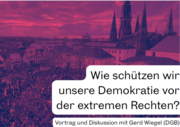
An authoritarian and, in many cases, anti-democratic far right is on the rise. Not only in Germany, but worldwide. What are the reasons behind the rise of this authoritarian far right? Who does it appeal to, and what can be done to counter this acute threat to democracy and human rights? What role do trade unions play in this, and how can we contribute?
These and other questions were discussed with Gerd Wiegel, Head of the Department for Democracy, Migration and Anti-Racism Policy on the DGB Federal Executive Board.
Israel/Palestine and the German Left – on the debate about anti-Semitism following 7 October
Reading and discussion | Wed 24 June 2026, 6.30 pm – approx. 8.30 pm | BIS Hall, University of Oldenburg

The catastrophe in Israel/Palestine and how it is assessed appear to be increasingly tearing the ideological Left in Germany apart. When assessing the massacre on 7 October and the subsequent war in Gaza, the crux of the debate lies in drawing the line between anti-Semitism and legitimate criticism of Israel’s policies. At present, open discourse is virtually impossible; calls for, and the practice of, authoritarian exclusion of the opposing side are becoming ever more frequent. Given the global resurgence of new fascist movements, this deep division within the Left is dramatically disastrous.
In his lecture, Dietrich Schulze-Marmeling highlighted the continuities of anti-Semitism within the Left, which reached a preliminary peak after 7 October, and discussed its potential exploitation to fuel anti-Muslim racism. The basis for this was his book *Anti-Semitism Reloaded: The Left, the State and 7 October* from 2024. This highly readable book, written in clear language, provides an important guide to understanding the background to a highly charged discourse and to setting the record straight on certain moral contortions. It is a plea to the Left to be guided by empathy and the universality of human rights.
The Office for University and Trade Union Co-operation had organised this event to foster a constructive debate and had responded to the call by Uffa Jensen from the Centre for Research on Anti-Semitism at the Technical University of Berlin: “To make the problems of the Middle East conflict understandable and tangible, we need free debate and exchange.”
Book: Dietrich Schulze-Marmeling: Anti-Semitism Reloaded. The Left, the State and 7 October. Rastede 2024, edition einwurf
Rich and poor: two sides of the same coin – Social inequality in Germany
Lecture | Tue 16 June 2026, 6.30 pm | Library Hall, University of Oldenburg
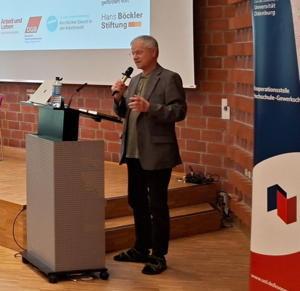
The polarisation in society between rich and poor is particularly pronounced. This applies both to the distribution of income and, to an even greater extent, to the distribution of wealth. The richest 10 per cent in Germany own a good two-thirds of total wealth, whilst the bottom half hold just 1.5 per cent. At the same time, wages and earned income are lagging behind investment income and other forms of income. Christoph Butterwegge is one of Germany’s most renowned researchers on poverty. In his lecture, he highlighted how the gap between rich and poor arises and why it has widened recently. In his view, this is the result of a politically deliberate redistribution from the bottom to the top. The event also discussed why political leaders are barely responding to social inequality and what really needs to be done to curb it.
Speaker:
Christoph Butterwegge, Prof. Dr. rer. pol., was a lecturer in political science at the University of Cologne from 1998 to 2016. Main areas of research: the development of the welfare state and poverty; right-wing extremism, racism and (youth) violence; migration, integration and minority policy. He was a member of the expert panel for the German Federal Government’s Report on Poverty and Wealth.
Searching for historical traces: city tour on National Socialism in Oldenburg
City tour | Thu, 11.06.2026, 16:00 - approx. 18:15 | Oldenburg city centre
Experience the city as a learning space and make history tangible at various locations. This is possible with the help of a city tour. With the city tour on National Socialism in Oldenburg, we would like to offer the opportunity to explore an important part of regional history.
The tour of National Socialism in Oldenburg covers almost four kilometres and includes ten stops from the Pferdemarkt through the city centre to the old Oldenburg State Parliament and ends at the memorial wall for the Jewish victims of the Holocaust. Aspects such as possible reasons for the early successes of the NSDAP in Oldenburg, the war experiences of the city's inhabitants and the increasing anti-Semitism that ultimately led to the Holocaust were addressed at the memorial sites.
Information could be acquired independently at each station. The stations were designed to appeal to people with and without prior knowledge.
Speaker
Kevin Mennenga, Education Coordinator at Arbeit und Leben Niedersachsen
The city tour took place as part of the event series "Right-wing networks: manifestations, explanatory approaches and counter-strategies". The event was organised in cooperation with Arbeit und Leben Niedersachsen, the DGB Weser-Ems region and the Office for University and Trade Union Co-operation in Osnabrück.
The 999 Penal Division
Film + discussion| Mon, 18.05.2026, 19:00 | BIS-Saal, University of Oldenburg
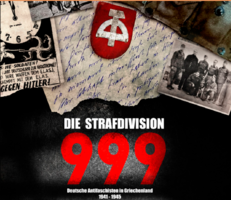
From 1942, the Nazis recruited criminals and political opponents into punitive units in order to use them as cannon fodder in various theatres of war. They experienced an increasingly strong resistance movement in Greece. Many of the forced recruits defected to the Greek Liberation Army. The best-known example is the "partisan professor" Wolfgang Abendroth, who worked with the Greek resistance and eventually switched sides completely.
From a Greek perspective, the film recalls the anti-fascists among the German soldiers who risked their lives in occupied Greece during the Second World War and deserted to fight on the side of the Greek resistance. The film screening was followed by a discussion with the historian Dr Gregor Kritidis (Rosa Luxemburg Foundation).
The event was organised by the Antimilitarist Alliance Oldenburg and the Office for University and Trade Union Co-operation in cooperation with Bildung und Solidarität - Stiftung der GEW Oldenburg-Stadt and the Rosa-Luxemburg-Stiftung Niedersachsen.
A world without cars - a VW worker, an activist and a mobility expert in dialogue
Panel discussion | Tue, 12.05.2026, 18:00 | Online event
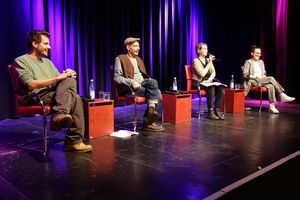
with: Katja Diehl (mobility expert and bestselling author), Thorsten Donnermeier (long-time VW worker and member of IG Metall), Tobi Rosswog (activist and co-initiator of various social movements)
Moderation: Kikan Nelle
In Germany, dependence on the car is threefold: in rural areas, because there are no alternatives for everyday journeys. In local authorities, because public budgets depend on trade tax revenue. And in car industry locations, because jobs mean long-term financial security for workers and their families.
But at the same time, a move away from cars seems unavoidable if we are to sufficiently mitigate the climate crisis.
So how do we get out of the automotive impasse? On this evening, Thorsten Donnermeier, Tobi Rosswog and Katja Diehl discussed solutions based on their very different positions. This was a meeting of worlds that are often played off against each other: Factory hall vs. climate camp. Blue overalls vs. cycle helmets. Shift plan vs. system change. But what if something common could emerge from precisely these differences?
And it turned out that it wasn't about hating cars or celebrating jobs. It was about asking ourselves honestly: What do we really need? And who actually decides that? A conversation that gave hope - because it wasn't smooth, but angular, genuine and full of contradictions. Just like reality. And just like change.
The discussion was an invitation to question capitalist constraints and to fight together for socio-ecological transformation. The aim was to create space for discussion, but also to provide orientation and hope through concrete impulses. Out of the automotive impasse and towards a world in which we think about the ecological and social issues together.
The event was organised by the network of the Office for University and Trade Union Co-operation in Lower Saxony and Bremen and Arbeit und Leben Niedersachsen and was based on a book published in December 2025, more information: nwdlwsidh.de
Deserters - The story of conscience, resistance and escape
Reading | Mon, 11.05.2026, 19:00 | BIS-Saal, University of Oldenburg
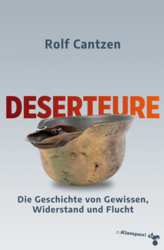
Desertion - a courageous act of resistance or a betrayal of the community? What drives people to refuse to serve in the armed forces, to renounce their loyalty to the state and the army and to flee? What religious convictions and political or humanist ideals are decisive for this, and what role does spontaneous self-empowerment play in simply no longer taking part?
The consequences that deserters have to expect for their decision are usually drastic: social ostracism, but also prison sentences and death sentences are on the cards. In his book, author Rolf Cantzen examines the decisions behind desertion and the reactions of the authorities, covering a broad historical arc from the Roman Empire to the Nazi era and the Ukraine war.
Speaker:
Rolf Cantzen studied political science, philosophy, German studies and sociology in Hanover and Berlin. He has published several non-fiction books, novels and short stories and has written numerous radio features. In 2024, he received the Alternative Media Award in the history category for the "Long Night of the Deserters".
The event was organised by the Antimilitarist Alliance Oldenburg, GEW, the Ecumenical Centre, Pax Christi and the Office for University and Trade Union Co-operation.
Hidden racism - right-wing codes and symbols
Workshop | Tue, 05.05.2026, 12:00 - 15:00 | V03 0-D001, University of Oldenburg
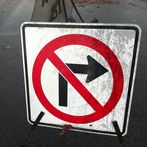
What is the meaning behind certain symbols on clothing, stickers or graffiti in public spaces? The symbols often appear inconspicuous - and yet they stand for explicit socio-political messages. This is exactly where the workshop came in: It sensitised participants to the existence and function of racist codes and symbols in everyday life and showed how subtly discriminatory ideologies are conveyed.
The event provided background knowledge on the historical development of right-wing symbolism and at the same time made a link to the present day. Illustrative examples were used to explain how codes change, the strategies behind their use and the effect they can have on those affected and on the social climate. The aim was to gain confidence in recognising such signs and to develop a reflected understanding of their meaning.
In addition, the workshop developed possible courses of action for the following questions: How can you react when you notice racist and right-wing symbols? What professional strategies are there in an educational, social or public context? The workshop invited participants to deepen their knowledge, sharpen their own awareness and strengthen their skills in dealing with discriminatory symbols.
Advisor:
Julia Gede is head of the Lüneburg office of Arbeit und Leben Niedersachsen.
The event was organised by Students at Work | Campus Office of the Office for University and Trade Union Co-operation in cooperation with ver.di jugend Bezirk Weser-Ems and GEW Bezirksverband Weser-Ems. The workshop took place as part of the event series "Right-wing networks: manifestations, explanatory approaches and counter-strategies" , which is organised in cooperation with Arbeit und Leben Niedersachsen, the DGB region Weser-Ems, the Office for University and Trade Union Co-operation
at the University of Oldenburg and the Office for University and Trade Union Co-operation in Osnabrück.
Female rebels? Of tradwives and other right-wing influencers
Lecture | Tue, 31.03.2026, 18:00 | online via BigBlueButton
Whether as a "tradwife", lifestyle influencer or self-proclaimed rebel against the "zeitgeist", right-wing women are present on social media in a variety of ways. With aesthetically perfected stagings of femininity, naturalness and domesticity, but also with representations of non-conformity and (intellectual) resistance, they embody right-wing ideologies.
In her lecture, Viktoria Rösch showed how these actors combine traditional and modern role models to convey the political messages of the extreme right. She not only focussed on the classic, submissive female figures, but also on strategies of self-empowerment. It became clear how right-wing influencers develop a "feminine right-wing counterculture" through various image and narrative politics - integrating exaggerated femininity, protest, intellectuality and right-wing ideology.
Speaker:
Viktoria Rösch is a sociologist at the Frankfurt University of Applied Sciences and works from various perspectives on the interrelationship between gender and the extreme right. Her work focuses on the image politics of right-wing female influencers. She is also a member of the network feminist perspectives and interventions against the extreme right (femPi).
The lecture took place as part of the event series "Right-wing networks: manifestations, explanatory approaches and counter-strategies" . The event was organised in cooperation with Arbeit und Leben Niedersachsen, the DGB region Weser-Ems and the Office for University and Trade Union Co-operation in Osnabrück.
The myth of the neutrality requirement in the educational context
Lecture | Thu, 26.03.2026, 18:00 | Cultural Centre PFL
Right-wing actors such as the AfD are questioning democratically positioned educational practices with increasing vigour. They repeatedly refer to compliance with a supposed "neutrality requirement": Teachers at schools or civil society actors are accused of violations and threatened with sanctions - usually with the aim of restricting political positioning and practices of political education.
In her presentation, Jana Sämann shed light on the strategic functions with which a "neutrality requirement" is popularly postulated and what consequences this can have for educational work. Afterwards, there was room to discuss personal experiences, challenges and counter-strategies.
Speaker:
Jana Sämann is a research assistant in the Department of Political Science - Didactics of Social Science at the University of Siegen. Her work and research focuses on political education in the fields of action of youth work as well as invocations, interventions and demands for neutrality in youth education work.
The lecture took place as part of the Oldenburg Weeks against Racism (18.03.2026 - 27.03.2026) took place. The event was organised in cooperation with Arbeit und Leben Niedersachsen and the DGB Weser-Ems region.
International Women's Day: Comedy and poetry special with Anna Bartling
Event | Friday, 06.03.2026, 17:30 | Cultural Centre PFL

The DGB Weser-Ems region, the individual trade unions, Arbeit und Leben Niedersachsen and the Office for University and Trade Union Co-operation cordially invited us to celebrate International Women's Day together - with humour and attitude.
We started the evening at 5.30 pm with a small champagne reception and nibbles . At 18:00, we continued with an exclusive programme by Anna Bartling (comedienne and poetry artist). This was followed by a get-together to talk to each other, share impressions and discuss existing challenges in the areas of gender equality and gender justice.
Organisers:

Better working conditions in the care sector - relief through a collective agreement
Lecture | Wed, 25.02.2026, 17:00 | online via BigBlueButton

The ongoing nursing crisis in Germany poses major challenges for hospitals and employees. High workloads and work intensification, too few staff and a lack of relief are leading to nursing staff becoming exhausted, reducing their working hours or leaving the academic appointment. Against this backdrop, the question arises as to what urgently needs to change in order to ensure good care and good work? And to what extent can collective agreements help to relieve the burden on employees so that working conditions in hospital care improve in the long term?
These questions were the focus of the presentation by Thorsten Wurlitz, nursing educator at Hannover Medical School (MHH). As a participant (ver.di bargaining committee) in the negotiations for the MHH's 2024 collective labour agreement, he also provided insights into the process and gave an initial assessment after one year.
Thorsten Wurlitz's presentation slides are available available here.
Speaker:
Thorsten Wurlitz studied political science and history and is a qualified healthcare professional and nurse. He is a nursing educator and works at the Nursing Education Academy at Hannover Medical School (MHH). He has also been actively involved in ver.di for many years.
Hydrogen - engine for employment in Lower Saxony?
Workshop | Wed, 18.02.2026, 14:00 - 17:00 | University of Oldenburg | BIS-Saal
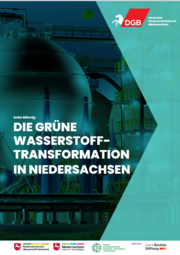
Hydrogen is seen as the key to the climate-neutral future of industry. No other Federal State is as central to this as Lower Saxony. The current GWS study "The Green Hydrogen Transformation in Lower Saxony" shows: If the hydrogen ramp-up succeeds, up to 60,000 additional jobs can be created by 2040, value added totalling 200 billion euros can be generated and energy-intensive industries can be secured in the state. Lower Saxony's ports, storage facilities and electrolysis projects make the state a potential hub for the German H₂ economy - provided that infrastructure, qualifications and sales markets grow at the right pace.
But what does this mean in concrete terms for employees, companies and regions in Lower Saxony? Which sectors are facing the greatest upheaval? Where will new jobs be created - and where will forward-looking training be needed to ensure that change does not fail due to a shortage of skilled labour?
Following a presentation by study author Anke Mönnig, we discussed regional challenges and options for shaping a fair and sustainable hydrogen transformation in the region in small groups.
The presentation slides by Anke Mönnig are available available here.



Right-wing mobilisation in the world of work: actors, strategies and structures
Lecture | Thu, 12.02.2026, 18:00 | online via BigBlueButton
For many years, right-wing networks have been increasingly trying to gain influence in the workplace context - be it through targeted political campaigns, right-wing lists in works council elections or the establishment of supposed employee representations such as the right-wing pseudo trade union "Centre". In doing so, right-wing actors specifically seize on workplace conflicts, concerns about transformation, fears of status and decline or general dissatisfaction with political and economic developments and instrumentalise them for their own political agenda. As a result, right-wing narratives are increasingly spreading in the world of work and dividing the workforce.
Dr Björn Allmendinger took a closer look at these worrying developments in his presentation: What strategies are right-wing networks pursuing in the world of work? Which players are currently particularly active? What role do organisations such as "Centre" play in right-wing mobilisation? And what options for action do works councils, trade unions and employees, for example, have to effectively counter right-wing influence?
Speaker:
Dr Björn Allmendinger is deputy managing director of Arbeit und Leben Niedersachsen and a lecturer at the Institute for Vocational Education and Adult Education at Leibniz Universität Hannover.
The lecture was part of the event series "Right-wing networks: manifestations, explanatory approaches and counter-strategies". The event was organised in cooperation with Arbeit und Leben Niedersachsen, the DGB region Weser-Ems and the Office for University and Trade Union Co-operation in Osnabrück.
2025
5 years apart - long-term consequences of the COVID-19 pandemic for work and society
Conference | Thu, 04.12.2025, 10:00 - 16:15 | University of Oldenburg | BIS-Saal
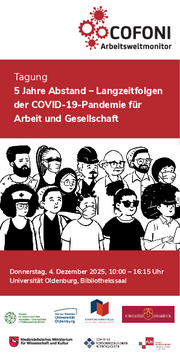
The outbreak of the coronavirus pandemic in March 2020 has fundamentally changed life in Germany. Following the containment measures and the effects in the acute phase of the pandemic, the focus is now shifting to the long-term consequences. Working from home, digital communication and flexible working hours characterise the everyday working lives of many employees and interest groups. Long COVID is a new type of illness. For those affected, this often means a massive impairment of their quality of life and social participation. This raises questions about how to deal with Long COVID in the world of work and the consequences for occupational health policy. The consequences of the pandemic are also clearly noticeable in the social professions, for example in schools. Many pupils have severe learning deficits and psychological stress has increased significantly among children and young people.
The long-term consequences of the COVID-19 pandemic for work and society are manifold. The aim of the conference was to take a closer look at these and discuss the associated challenges, recommendations for action and coping strategies from different perspectives. The annual conference of the cooperation centres of the network of universities and trade unions in Lower Saxony and Bremen offered insights into current research results and a practical exchange of experiences.
Programme
10:00 a.m. Opening
Dr Claudia Czycholl (Office for University and Trade Union Co-operation, University of Oldenburg)
10:15 a.m. Lecture
Clapping was yesterday - working after the pandemic
Sylvia Bühler (ver.di Federal Head of Health, Social Services, Education and Science)
11:00 a.m. Lecture
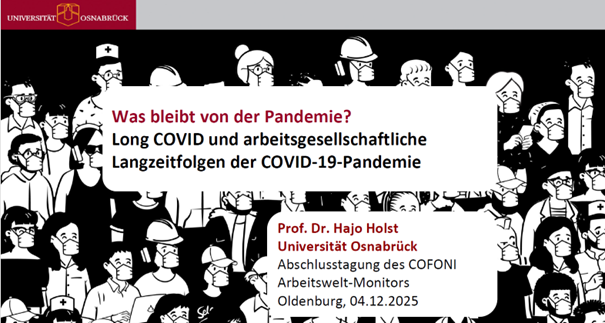
What remains of the pandemic? Long COVID and long-term consequences for labour society
Prof Dr Hajo Holst (Economic Sociology, University of Osnabrück)
11:45 a.m. Coffee break
12:00 p.m. Lecture
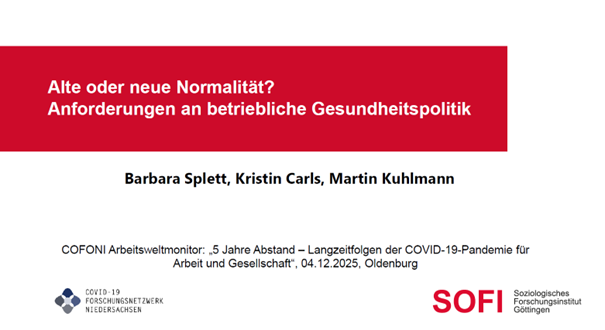
Old or new normality? Requirements for corporate health policy
Dr Barbara Splett, Dr Kristin Carls & Dr Martin Kuhlmann
(Sociological Research Institute Göttingen, SOFI)
12:45 p.m. Lecture
Social burdens and stress: Unequal impact of Long COVID
Nicolai Gröpler (Institute of Social Sciences, Oldenburg)
13:30 Lunch break
14:15 Workshops
A: Home office employees and the practice of works councils and Staff Councils
Since the coronavirus pandemic, many employees have been working partly or entirely from home. What does this mean for the work of employee representatives? What challenges are associated with this? How can works councils and Staff Councils deal with the changes? And what innovative practices have emerged from the experiences during the pandemic?
Prof. Dr Carsten Wirth (HS Darmstadt)
B: Pacing-appropriate workplace design for Long COVID
People with Long COVID are confronted with many challenges and restrictions - including at work. Pacing is an important approach to energy management in order to enable those affected to continue to participate in working life. But what exactly is pacing? And how can pacing be implemented and financed in everyday working life?
Natascha Lüsgo (Long COVID Germany)
C: Consequences of the coronavirus pandemic in schools - challenges and solutions
Children and young people were particularly affected by the lockdown during the pandemic. The loss of important social contacts, enormous learning deficits and missed opportunities in social and emotional development have left deep scars on many pupils. How can the resulting deficits be identified and counteracted? Which factors are central to overcoming the various challenges? What role do schools, teachers, parents and others play in this?
Dr Ulrike Sanders (teacher from Oldenburg) & Dr Alexander Tilgner (teacher and researcher)
15:45 Results panorama of the workshops
16:15 End of the event
Conference documentation (presentation slides)
Lecture: "What remains of the pandemic? Long COVID and long-term consequences for labour society"
Prof Dr Hajo Holst (Economic Sociology, University of Osnabrück)
Lecture: "Old or new normality? Requirements for corporate health policy"
Dr Barbara Splett and Dr Kristin Carls
(Sociological Research Institute Göttingen, SOFI)
Lecture: "Social burdens and stress: unequal impact of Long COVID"
Nicolai Gröpler (Institute of Social Sciences, Oldenburg)

Conference documentation (video recordings)
Dr Barbara Splett and Dr Kristin Carls
(Sociological Research Institute Göttingen, SOFI)
Nicolai Gröpler (Institute of Social Sciences, Oldenburg)
Organisers & cooperation partners
COFONI Working World Monitor - Long-term consequences of the pandemic, Long/Post COVID and occupational inequalities, Network of Cooperation Centres for Universities and Trade Unions in Lower Saxony and Bremen, Office for University and Trade Union Co-operation at the University of Oldenburg, University of Osnabrück, Peter L. Reichertz Institute for Medical Computing Science




Promotion
The conference was funded by the COVID-19 Research Network Lower Saxony (COFONI) with funds from the Ministry of Science and Culture of Lower Saxony (14-76403-184).


Network of cooperation centres

The network of co-operation offices for universities and trade unions in Lower Saxony and Bremen
www.kooperation-hochschule-gewerkschaft.de
Office for University and Trade Union Co-operation
SON at the TU Braunschweig
Dr Britta Wittner
Tel.: 0531 391-4280
koop-son@tu-braunschweig.de
www.koop-son.de
Institute of Labour and Economics, University of Bremen
Dr André Holtrup
Tel.: 0421 218617-29
holtrup@iaw.uni-bremen.de
www.iaw.uni-bremen.de
Office for University and Trade Union Co-operation
Georg-August-Universität Göttingen
Dr Thomas Hardwig
Tel.: 0551 39-24756 or 39-26195
kooperationsstelle@uni-goettingen.de
www.kooperationsstelle.uni-goettingen.de
Office for University and Trade Union Co-operation
Hannover - Hildesheim
Dr Petra Köster
Tel.: 0511 9296-3326
petra-franziska.koester@hs-hannover.de
www.koop-hg.de
Office for University and Trade Union Co-operation
at the University of Oldenburg
Dr Uwe Kröcher
Dr Claudia Czycholl
Tel.: 0441 798-2909 or -4617
kooperationsstelle@uni-oldenburg.de
www.kooperationsstelle.uni-oldenburg. de
Office for University and Trade Union Co-operation in Osnabrück
Dr Carmen Thamm
Tel.: 0541 33807-14 or -16
kooperationsstelle@uni-osnabrueck.de
www.kooperationsstelle-osnabrueck.de
The woman who ran into doors
Theatre monologue + panel discussion | Thu, 27.11.2025, 20:00 | unikum
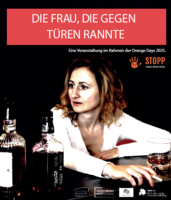
25 November is the International Day for the Elimination of Violence against Women and also marks the start of the Orange Days. As part of these campaign days, people around the world are taking a stand against discrimination and all forms of violence against girls and women. In the theatre monologue “The Woman Who Ran Into Doors”, based on a novel by Roddy Doyle, the protagonist Paula Spencer recounts her life marked by violence. For the 39-year-old woman, most of her life is already behind her. And it hasn’t gone well. The floral bedroom curtain that fluttered in the summer breeze above her cot never existed – but her father’s abuse did.
The story told was that of an alcoholic woman who, despite all adversity and humiliation, takes control of her life. Played by the actress Michaela Allendorf. Far removed from sentimentality or moralising, she portrayed a process of self-awareness within a spiral of violence from which there seems to be no escape.
Following the theatre performance, a panel discussion on the topic of “Violence against women” took place with Michaela Allendorf (freelance actress), Dr Janina Leyk (conTakt Counselling Centre, University of Oldenburg) and Nadine Finke (Wildwasser Oldenburg e.V.), Franziska (Oldenburg Women’s Shelter) and Maxi Seidel (AStA, University of Oldenburg).
Organisers:
Studierendenwerk Oldenburg, AStA of the University of Oldenburg, University of Oldenburg, Office for University and Trade Union Co-operation,
Likes for Democracy! Going viral against right-wing attempts at appropriation
Lecture | Thu, 20.11.2025, 18:00 | online via BigBlueButton
For too long, the field on social media platforms was left to right-wing parties. This allowed the AfD to build up an enormous reach on TikTok and promote ideological and nationalist content to young people. The success of the party's strategy can be seen in the results of the last European elections. But how can content that promotes democracy combat this and win over more likes? We discussed the power of social media to influence our democracy with journalist and futurologist Deana Mrkaja and talked about strategies and projects to counter right-wing attempts at appropriation in the digital age.
Speaker:
Deana Mrkaja studied political science, peace and conflict research and futurology in Berlin. She is an award-winning journalist and TikTok virtuoso. She produces highly acclaimed online reports and was Head of Social Media at Berliner Morgenpost.
The lecture took place as part of the event series "Right-wing networks: manifestations, explanatory approaches and counter-strategies" and was organised in cooperation with Arbeit und Leben Niedersachsen and DGB Oldenburg-Ostfriesland.
Forum Arbeitsrecht Oldenburg: Labour law in times of crisis
Lecture | Tue, 11.11.2025, 18.00 | University of Oldenburg | BIS-Saal

Unfortunately, the lecture had to be cancelled due to illness.
The lectures at the Oldenburg Labour Law Forum bring together practitioners and academics in the region. The aim of the forum is to exchange experiences with current labour law problems and to further develop one's own points of view.
Advisor:
Inken Gallner has been President of the Federal Labour Court since January 2022 and is Chair of the First University Senate, which is responsible for substantive works constitution, staff representation and spokesperson committee law, freedom of association, collective bargaining capacity and collective bargaining competence as well as industrial action law.
Organisers:
The forum arbeitsrecht oldenburg is organised by the Institute of Law, Department of Civil Law and Labour Law (Prof. Dr. Christiane Brors) in cooperation with the German Association of Labour Courts. It is planned and organised with the Oldenburg Employers' Association, the Office for University and Trade Union Co-operation, DGB Rechtsschutz - GmbH Oldenburg and the Oldenburg Labour Court.
Climate policy under pressure. How far-right parties are mobilising against climate protection
Lecture | Tue, 28 Oct 2025, 18:00 | online via BigBlueButton
Trump, the AfD and the FPÖ: the electoral success of far-right parties poses a growing challenge for climate policy. Particularly in times of economic uncertainty, mobilisation against wind power, heat pumps etc. proves to be especially powerful and goes far beyond the mere denial of man-made climate change. The lecture shed light on how this far-right mobilisation undermines ambitious climate policy. Afterwards, Manès Weisskircher discussed with the participants possible courses of action for politics and society to counteract the AfD's climate obstructionism.
Speaker:
Dr Manès Weisskircher is head of the BMBF junior research group REXKLIMA (Right-wing extremism versus climate protection?) at the Institute of Political Science, TU Dresden. He is also an affiliated researcher at the Center for Research on Extremism (C-REX) at the University of Oslo and a visiting researcher at the Centre for Civil Society Research, Wissenschaftszentrum Berlin. Among other things, he is the editor of the anthology "Contemporary Germany and the Fourth Wave of Far-Right Politics".
The lecture was part of the event series "Right-wing networks: manifestations, explanatory approaches and counter-strategies". The event was organised in cooperation with Arbeit und Leben Niedersachsen and DGB Oldenburg-Ostfriesland.
Searching for historical traces: city tour on National Socialism in Oldenburg
City tour | Thu, 16.10.2025, 16:00 - approx. 18:15 | Oldenburg city centre
Experience the city as a learning space and make history tangible at various locations. This is possible with the help of a city tour. With the city tour on National Socialism in Oldenburg, we would like to offer the opportunity to explore an important part of regional history.
The tour of National Socialism in Oldenburg covers almost four kilometres and includes ten stops from the Pferdemarkt through the city centre to the old Oldenburg State Parliament and ends at the memorial wall for the Jewish victims of the Holocaust. Aspects such as possible reasons for the early successes of the NSDAP in Oldenburg, the war experiences of the city's inhabitants and the increasing anti-Semitism that ultimately led to the Holocaust were addressed at the memorial sites.
At each station, visitors were able to work out information independently. The stations were designed to appeal to people with and without prior knowledge. A free digital version of the city tour via Actionbound also made it possible to retrace individual parts or the entire tour individually.
Speaker
Kevin Mennenga, Education Coordinator at Arbeit und Leben Niedersachsen
The city tour took place as part of the event series "Right-wing networks: manifestations, explanatory approaches and counter-strategies" . The event was organised in cooperation with Arbeit und Leben Niedersachsen and DGB Oldenburg-Ostfriesland.
Good work, good life. Strengthen the Working Hours Act, don't soften it!
Lecture | Wed, 15.10.2025, 17:00 - 18:30 | online via BigBlueButton

A daily working time of eight hours was long regarded as a social achievement in Germany. However, the German government is planning to reform the Working Hours Act to replace the current limit with a maximum weekly working time. This would allow working days to be extended to up to 13 hours. This is being argued under the heading of flexibilisation. "We are giving employees and companies more flexibility by introducing a weekly maximum working time instead of a daily one," said Federal Chancellor Friedrich Merz in his government statement. But would the planned maximum weekly working hours really be beneficial for employees? Would this make it possible to achieve a better work-life balance?
In her presentation, Dr Yvonne Lott shed light on the dangers of the planned reform of the Working Hours Act and why it needs to be strengthened rather than watered down. She also discussed which legal, collectively agreed and company regulations are useful for better working and living conditions with regard to working hours.
Speaker:
Dr Yvonne Lott is head of the Gender Research Department at the Hans Böckler Foundation's Institute of Economic and Social Research (WSI).
The online event was organised in cooperation with the Office for University and Trade Union Co-operation in Osnabrück.
Lecture
Current work distribution and working time preferences of employees
Dr Yvonne Lott, WSI

AfD - the enemy of employees
Lecture | Thu, 18.09.2025, 18:00 hrs | online
The AfD likes to portray itself as an advocate for the "little people", although its real policies primarily serve the interests of high earners and the rich. However, dependent employees have nothing to expect from the party. It opposes everything that trade unions are fighting for on behalf of employees. The AfD rejects the wealth tax for multimillionaires, an increase in the minimum wage or greater collective bargaining coverage. And yet the AfD is voted for more often than average by people who would be the first to suffer from its labour and social policies.
Why is this the case? What interests are reflected in the AfD vote? And how can trade unions deal with these contradictions? These questions were at the centre of Gerd Wiegel's online lecture.
Speaker:
Gerd Wiegel is Head of the Democracy, Migration and Anti-Racism Policy Department at the DGB Federal Executive Board. He has been working and publishing on the extreme right in Germany and Europe for many years.
Lecture AfD - the enemy of employees
Gerd Wiegel, DGB Federal Executive Committee
The lecture was part of the event series "Right-wing networks: manifestations, explanatory approaches and counter-strategies". The event was organised in cooperation with Arbeit und Leben Niedersachsen and DGB Oldenburg-Ostfriesland.
The 4-day week: option or utopia?
Closing event | Thu, 14.08.2025, 16:30 - approx. 18:45 | BIS-Saal, University of Oldenburg

There are currently many debates about the future of work. Fuelled by discussions about the economic situation and shortages of skilled workers, working hours play a central role. In the run-up to his first government statement on 14 May 2025, Friedrich Merz emphasised: "We need to work more and, above all, more efficiently in this country. We will not be able to maintain this country's prosperity with a four-day week and work-life balance." The four-day week is attracting both supporters and critics. Business organisations, for example, are calling for longer working hours and rejecting a 4-day week. At the same time, more and more companies and institutions are offering a 4-day week in order to increase their attractiveness on the labour market. And the majority of full-time employees would like a shorter working week.
As part of the final event of the future discourse "Rethinking working hours - in times of skilled labour shortages", we took another look at the 4-day week. Is the four-day week a model for the future? What are the potential advantages and disadvantages of different 4-day week models for employees and employers? What operational requirements are needed to implement a 4-day week? Prof Dr Julia Backmann from the University of Münster presented key findings from Germany's largest pilot project on the 4-day week on these and other questions. Following the presentation, we discussed the pros and cons of the working time model with various stakeholders from academia and the world of work. Julia Backmann (University of Münster), Heiko Henke (Oldenburg Chamber of Crafts), Dorothee Koch (Regional Managing Director, DGB Oldenburg-Ostfriesland) and Sofia Heuser (Young People's Secretary, ver.di Weser-Ems district) contributed their specific perspectives and experiences.
The local radio station oldenburg eins recorded the event: https://youtu.be/2GQNLjBqGXc
The event took place as part of the future discourse "Rethinking working hours - in times of skilled labour shortages" and was sponsored by the Lower Saxony Ministry of Science and Culture.
The changing world of work: A man of his class
Film + discussion | Wed, 02.07.2025, 18:00 | cine k Oldenburg
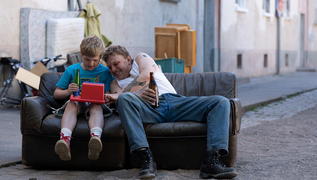
Feature film, 2024, D, 89 min.
Christian's life seems predetermined. He grows up with his siblings in poor circumstances, with a hard-working, drinking, violent father. When Christian's mother dies, his aunt Juli takes him and his siblings in against their father's wishes. Despite resistance from the youth welfare office, the aunt manages to get Christian to go to grammar school. At school, Christian repeatedly has to deal with prejudice. In the family, he gets caught between the fronts of his aunt and his father.
The film, based on the novel by Christian Baron, provides insights into phenomena such as the shame that people living in poverty often feel, images of masculinity, class pride, poorly paid, health-destroying work and structural disadvantage due to social background and a lack of economic means.
Venue: cine k, Kulturetage, Bahnhofsstraße 11, OL
An end of project by: University of Oldenburg, Office for University and Trade Union Co-operation, Arbeit und Leben Niedersachsen, DGB Region Oldenburg-Ostfriesland in co-operation with cine k and Medienbüro Oldenburg
A man of his class
Reading + discussion | Tue, 24 June 2025, 18:00 | University of Oldenburg | BIS-Saal
Christian Baron read from his book *Ein Mann seiner Klasse*, published in 2020. In his auto-sociobiography, the author and journalist describes growing up in precarious circumstances in Kaiserslautern in the 1990s: his childhood was marked by poverty and violence at the hands of his alcoholic father, as well as by the early death of his mother. In his book, Baron describes his experience of social exclusion at the hands of educational and welfare institutions and reflects on his own difficult educational journey to his Abitur and university studies as a story of social mobility. Last but not least , *Ein Mann seiner Klasse* is also a reckoning with his late father.
Published in 2020, the book featured on the *Spiegel* bestseller list; a stage adaptation by Schauspiel Hannover was invited to the Berliner Theatertreffen in 2022; and in 2024, a TV film *Ein Mann seiner Klasse* was broadcast on ARD, based on the book. We will be screening the TV film in co-operation with cine k Oldenburg on 2 July 2025 at 6.00 pm. Christian Baron’s new novel *Drei Schwestern* is due to be published shortly , and he will be giving a preview of it.
Following the reading, a discussion took place with Christian Baron and the literary scholar Prof. Dr Urte Helduser (University of Oldenburg). There was also an opportunity for questions from the audience.
Speaker:
Christian Baron, born in Kaiserslautern in 1985, lives in Berlin as a freelance writer and journalist. After studying political science, sociology and German language and literature in Trier, he worked for several years as a newspaper editor.In 2020, his literary debut, *Ein Mann seiner Klasse*, was published by Claassen, for which he received the Klaus-Michael-Kühne Prize and the ‘Aufstieg durch Bildung’ literature prize from the noon Foundation.
Organisers:
Institute for German Studies and Office for University and Trade Union Co-operation, student body of German Studies, University Trade Unions at the University of Oldenburg
Searching for historical traces: city tour on National Socialism in Oldenburg
City tour | Thu, 05.06.2025, 16:00 - approx. 18:15 | Oldenburg city centre
Experience the city as a learning space and make history tangible at various locations. This is possible with the help of a city tour. With the city tour on National Socialism in Oldenburg, we want to offer the opportunity to explore an important part of regional history.
The tour on National Socialism in Oldenburg covers almost four kilometres and has ten stops from the Pferdemarkt through the city centre to the old Oldenburg State Parliament and ends at the memorial wall for the Jewish victims of the Holocaust. Aspects such as possible reasons for the early successes of the NSDAP in Oldenburg, the war experiences of the city's inhabitants and the increasing anti-Semitism that ultimately led to the Holocaust were addressed at the memorial sites.
Information could be acquired independently at each station. The stations were designed to appeal to people with and without prior knowledge. A free digital version of the city tour via Actionbound also made it possible to retrace individual parts or the entire tour individually.
Speaker
Kevin Mennenga, Education Coordinator at Arbeit und Leben Niedersachsen
The city tour took place as part of the event series "Right-wing networks: manifestations, explanatory approaches and counter-strategies" . The event was organised in cooperation with Arbeit und Leben Niedersachsen and DGB Oldenburg-Ostfriesland.
Changing world of work: Heroine
Film + discussion | Wed, 04.06.2025, 18:00 | cine k Oldenburg
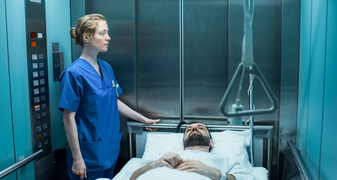
Feature film, 2025, Germany/Switzerland, 95 min.
It's just another day. Floria (Leonie Benesch) gets off the bus and enters the hospital where she works as a nurse. Floria loves her academic appointment, she is knowledgeable and dedicated to her work. However, the heavy workload caused by chronic understaffing on the ward means that she is unable to devote enough time to all of the patients. But Floria tries anyway. The young woman is constantly pushing herself to her limits and beyond. This overload not only has consequences for Floria personally. Because on this day, when a colleague is also absent, she makes a serious mistake.
In her feature film, director Petra Biondina Volpe portrays the often challenging day-to-day work of a nurse in a hospital. In doing so, she highlights the serious shortcomings of the current care situation and makes it clear what needs to change
.
Venue: cine k, Kulturetage, Bahnhofsstraße 11, OL
An end of project by: University of Oldenburg, Office for University and Trade Union Co-operation, Arbeit und Leben Niedersachsen, DGB Region Oldenburg-Ostfriesland in co-operation with cine k and Medienbüro Oldenburg
The changing world of work: Toni Erdmann
Film + discussion | Wed, 21.05.2025, 18:00 | cine k Oldenburg
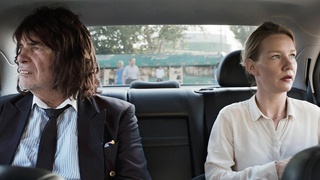
Feature film, 2016, D, 166 min.
The film tells the story of Winfried, a music teacher with a pronounced penchant for joking, and his daughter Ines, a single business consultant who travels the world to optimise companies. After the death of his dog, Winfried spontaneously decides to visit his daughter in Romania, who is working on a major outsourcing project. Once there, he annoys Ines with tepid jokes and subliminal criticism of her performance-orientated life between meetings, hotel bars and countless emails. When Winfried interferes more and more in his daughter's professional life, the two come to blows.
In this comedy, director Maren Ade combines the touching story of an estranged father-daughter relationship with a satire on ways of living and working in capitalism. The film has received numerous awards, including the European Film Award as well as the German and Austrian Film Awards.
Venue: cine k, Kulturetage, Bahnhofsstraße 11, OL
An end of project by: University of Oldenburg, Office for University and Trade Union Co-operation, Arbeit und Leben Niedersachsen, DGB Region Oldenburg-Ostfriesland in co-operation with cine k and Medienbüro Oldenburg
The changing world of work: The trade unionist
Film + discussion | Tue, 29.04.2025, 18:00 | cine k Oldenburg

Feature film, 2022, DF, 122 min.
Maureen Kearney (Isabelle Huppert) is found tied up and traumatised in her own flat. There is no trace of the perpetrator and she can only remember fragments of what happened. The investigators are working under high pressure, as Maureen was a staff councillor at the French industrial group Areva and a trade unionist on the trail of dubious dealings in the nuclear industry that could also incriminate influential decision-makers. Suddenly, new evidence emerges that calls the raid into question. Based on a true story, this gripping thriller shows the struggle of an intrepid trade unionist who has to defend herself against a supposedly overpowering opponent.
Venue: cine k, Kulturetage, Bahnhofsstraße 11, OL
An end of project by: University of Oldenburg, Office for University and Trade Union Co-operation, Arbeit und Leben Niedersachsen, DGB Region Oldenburg-Ostfriesland in cooperation with cine k and Medienbüro Oldenburg
Dealing with right-wing and anti-democratic attitudes in everyday (university) life
Workshop | Tue, 15.04.2025, 15:00 - 18:00 | V03 0-D001, University of Oldenburg

In the canteen, in seminars, lectures or internships, are disparaging remarks made about students because of their origin, religion or skin colour? Is someone making fun of queer people in public? Your aunt breaks up a family celebration with discriminatory remarks about people with disabilities?
This workshop is the right place for anyone who feels speechless in such moments and is most annoyed with themselves afterwards - namely for not having said anything. Silence can signal admission and make us feel powerless, and we want to tackle this. In this way, we can work together to create a climate in our environment that does not simply accept anti-democratic, right-wing and discriminatory slogans. But what is the best way to counter such slogans? How do we show civil courage?
In the workshop, strategies were developed to effectively counter discrimination and slogans and to recognise typical communication patterns. In the next step, the participants considered what they want to and can achieve in a specific situation. The workshop was lively and practical.
Speaker:
Helga Barbara Gundlach is a trainer, advisor, lecturer and moderator in the field of intercultural competence and conflict management.
The event was organised by Students at Work | Campus Office of the Office for University and Trade Union Co-operation in co-operation with the AStA of the University of Oldenburg. The workshop took place as part of the event series "Right-wing networks: manifestations, explanatory approaches and counter-strategies", which is organised by the Office for University and Trade Union Co-operation, Arbeit und Leben Niedersachsen and the DGB Oldenburg-Ostfriesland.
Fundamentals of relevant economics - with Prof Dr Heiner Flassbeck
Book launch | Thu, 10.04.2025, 18:30 | hybrid: Library Hall, University of Oldenburg and online
The problems of our time, such as the climate and biodiversity crisis and social inequality, are based on the way we do business. This shows that we need critical economics. With this event, we want to offer an introduction to criticising the prevailing economic theories.
Although economics has a variety of theories and methods to understand real problems, the scientific discourse is usually limited to a few approaches and remains stuck in old patterns of thought. Heiner Flassbeck 's book "Grundlagen einer relevanten Ökonomik", published in September 2024, offers an insight into findings from over 50 years of macroeconomic work, refutes long-standing myths and explains the last hundred years of economic history in an accessible way.
The author presented the main features of the book at the event and was available for questions and discussions. The chapters outline the basic principles of the relevant economics and provide an overview of the analysis in relevant theses:
1: "The Great Depression is still not understood after a hundred years."
2: "Schumpeter is more important than Keynes."
3: "There is no wage-driven substitution between labour and capital."
4: "There is no transformation of saving into investment controlled by a market interest rate."
5: "Money is important, but inflation is always and everywhere a wage phenomenon."
6: "International trade is determined by absolute advantages and disadvantages; there are no comparative advantages that could be utilised by developing countries."
7: "Capital markets, including cross-border financial markets, are never efficient but destabilising."
8: "The state must control the three macroeconomic prices, interest rates, wages and exchange rates, with co-operation between countries; at the same time, the price of fossil energy should be systematically pushed up by the international community in line with falling supply."
The event was a beginner-friendly introduction to the criticism of prevailing economic theories. It was aimed not only at students and academics, but also at a broad audience.
Of princesses, politicians and prostitutes
City tour | Sat, 22.03.2025 | 15:00 - approx. 16:30 | Oldenburg city centre

To mark International Women's Day, the DGB Oldenburg-Ostfriesland region and the Office for University and Trade Union Co-operation organised a city tour entitled "Of princesses, politicians and prostitutes". The tour was organised by the Centre for Women's History e. V. in Oldenburg and presented different worlds of women in the royal seat of Oldenburg at various stations from the castle to the Waffenplatz.
Die Unbeugamen 2 - Good morning, beautiful people!
Film | Fri, 07.03.2025 | 16:00 h | Casablanca Oldenburg
To mark International Women's Day, the Department for Women's, Gender Equality and Gender Policy and the State Women's Committee of GEW Lower Saxony, together with the Cooperation Centre for Universities and Trade Unions, hosted a film screening of "Die Unbeugsamen 2 - Guten Morgen, Ihr Schönen!" at the Casablanca cinema in Oldenburg.
With his documentary film "Die Unbeugsamen", director Torsten Kurner created a cinematic monument to the female politicians of the Bonn Republic and their fight for political participation. With the sequel "Die Unbeugsamen 2 - Guten Morgen, Ihr Schönen!" Kurner turns his gaze to the other side of the Iron Curtain and draws a lively group portrait of 15 women from the most diverse areas of society in the GDR. The film offers a captivating stage for the women's impressive life achievements and their fight for equal opportunities.
At 16:00 in the conservatory of the Casablanca (Johannisstraße 17 in Oldenburg), the deputy chairwoman of the GEW, Isabel Rojas Castaneda and Claudia Czycholl from the Office for University and Trade Union Co-operation welcomed the participants, and at 17:00 the film "Die Unbeugamen 2" was shown.
Creating peace - through war capability or civil conflict resolution?
Event | Thu, 06.03.2025, 18:00-20:30 | Library Hall, University of Oldenburg

War is raging in many parts of the world; military conflicts are increasing and spreading. Armaments are being built up and nuclear weapons are being threatened. What is actually needed is peaceability, but instead "warability" is demanded and a lot of money and resources are spent on it. What leads to a peaceful world and what is an aberration? Can international conflicts be resolved and conflicts of interest reduced beyond military logic? How can peace be created? And what can and should our society contribute to this?
These questions were discussed in light of current events. 24 February marked the anniversary of the Russian government's major attack on Ukraine. For over three years, this unjustifiable war has claimed countless victims. The aim of the event was to take a critical look at the militarisation of society in the wake of the "turnaround" and to discuss alternative concepts and solutions beyond the logic of military escalation.
Hanne-Margret Birckenbach (Emeritus Professor of Peace and Conflict Studies and winner of the Göttingen Peace Prize 2023) and Johannes Varwick (Professor of International Relations and European Politics at the University of Halle-Wittenberg) gave keynote speeches at the event, which were then discussed with the audience.
Video recordings of the event and interviews
Lectures:
Input Prof. Dr Hanne-Margret Birckenbach: https://www.youtube.com/watch?v=gzDkyYnkiTk
Input Prof. Dr Johannes Varwick: https://www.youtube.com/watch?v=98JQz1kf9TM
Discussion round:
Prof. Dr Hanne-Margret Birckenbach with Prof. Dr Johannes Varwick (moderated by Dr Claudia Czycholl): https://www.youtube.com/watch?v=eW6ZMb6niUU
Interviews with students:
Interview with Prof Dr Hanne-Margret Birckenbach: https://www.youtube.com/watch?v=venCY56mUhw
Interview with Prof Dr Johannes Varwick: https://www.youtube.com/watch?v=GNZdcGJCMHs
The event was organised and/or supported by:
Office for University and Trade Union Co-operation, University of Oldenburg | Arbeit und Leben Niedersachsen | Antimilitaristisches Bündnis Oldenburg | attac Regionalgruppe Oldenburg | Bildungswerk ver.di Region Oldenburg | DGB Region Oldenburg-Ostfriesland | Ev.-Luth. Kirche in Oldenburg, Kirche und Gesellschaft | FORUM St. Peter | GEW Bezirksverband Weser-Ems | IG Bau-Agrar-Umwelt BV Nordwest-Niedersachsen | Katholische Hochschulgemeinde Oldenburg | Ökumenisches Zentrum Oldenburg e.V. (ÖZO) | pax christi Gruppe Oldenburg | ver.di Bezirk Weser-Ems | werkstatt zukunft e.V.

How serious are skills shortages in the north-west?
Extent, causes and strategies
Event | Fri, 28.02.2025, 10:00-13:00 | BIS-Saal, University of Oldenburg
Finding and securing skilled labour is a challenge for many companies in the region - despite economic developments and crises in the industry that are mitigating the problem. In some occupational groups, vacancies can hardly be filled. But how serious are the bottlenecks in the region? What are the causes of these bottlenecks? And what measures are really effective in securing skilled labour?
These questions were discussed together with an interested audience. To this end, a study on skills shortages in 12 selected occupational groups in the north-west was presented, which was compiled by the Office for University and Trade Union Co-operation. The study is the result of a project carried out by the Office for University and Trade Union Co-operation with the DGB region Oldenburg-Ostfriesland and the individual regional trade unions with the support of the Hans Böckler Foundation.
Programme
- Opening: Dorothee Koch (Managing Director of the DGB Region Oldenburg-Ostfriesland)
- Lecture: Mohamed Faily (DGB Federal Executive Committee - Head of Department for Precarious Employment, Labour Migration and Skilled Labour Immigration)
- Presentation of the study: Dr Uwe Kröcher and Felix Bernshausen (Office for University and Trade Union Co-operation at the University of Oldenburg)
- Discussion with
- Matthias Brandner (Chamber of Agriculture, Specialist in Employee Counselling)
- Jörg Frerichs (HWK Ostfriesland, Managing Director)
- Tina Heliosch (Head of the Vechta and Osnabrück Employment Agencies)
- Dorothee Koch (Managing Director of the DGB Oldenburg-Ostfriesland region)
- Heiner Paffenholz (Oldenburg Chamber of Industry and Commerce, Head of Skilled Labour Consultancy)
Citizen's income - a hammock my arse
Facts, misconceptions and myths of a heated debate
Lecture | Thu, 20.02.2025, 17:00 | BIS-Saal, University of Oldenburg

In January 2023, unemployment benefit II (Hartz IV) was replaced by the citizen's allowance. After one year, the standard rates of basic income support for the unemployed were increased by €61 to €561 per month. According to the decision of the coalition government, there will be no increase in the transfer payment in 2025. However, it is uncertain what will happen to the citizen's income after the federal elections. The AFD and CDU want to abolish the citizen's income, while the FDP wants to change it. The common core of the plans is that tougher sanctions and benefit cuts are to be introduced.
Since the introduction of the Citizen's Income, the debate about the design and level of the Citizen's Income has been ongoing. The political and media debates are usually not well-founded, but are characterised by misconceptions and sometimes (right-wing) populist false claims with social explosive force: According to these claims, the citizen's income is often misused, recipients can rest while receiving benefits and work is no longer worthwhile because the benefits are too high. In addition, the restriction of sanctions would result in considerable financial damage to the federal budget.
In her presentation, Bettina Kohlrausch took a critical look at these statements. She focussed on the relationship between the minimum wage and the citizen's income. She showed that the cliché "recipients of the citizen's income do not want to work" does not correspond to reality. She also refuted the assumption that higher sanctions would create incentives to work. She also discussed whether the current standard needs are even sufficient to enable people to live in dignity and participate in society.
Speaker:
Prof. Dr Bettina Kohlrausch has been Director of the Hans Böckler Foundation's Institute of Social Sciences and Professor of Social Transformation and Digitalisation at Paderborn University since the beginning of May 2020.
The presentation slides will be available here shortly.
Four-day week - What does it look like in practice?
Lecture | Thu, 06.02.2025, 17:00-18:30 | online
In recent years, the debate surrounding the four-day week has gathered momentum and is becoming increasingly important in the world of work. Employees are often interested in a shorter working week to achieve a better balance between academic appointments and private life. Employers, on the other hand, see a four-day week as an opportunity to better attract and retain skilled workers.
But what does it look like in practice? What four-day week models do companies and organisations offer? What should be considered when introducing a four-day week? What experiences have employees and employers had with the working time models?
These and other questions were discussed in the online event on the basis of two practical reports on two different models of a four-day week. Sabine Reger, Head of the Main Office at Mengen City Council, and Works Council Chairwoman Christina Kreft from DRK KV Sangerhausen e.V. reported on their specific experiences of implementing a four-day week and the new daily routine in the areas of city administration and care.
The event took place as part of the future discourse "Rethinking working hours - in times of skilled labour shortages" and is sponsored by the Lower Saxony Ministry of Science and Culture.
TikTok, hate trends and the danger of radicalisation from the right: how social media influences young people
Lecture | Thu, 30.01.2025, 17:30 | Cultural Centre PFL Oldenburg
Quickly edited music videos, funny memes and trendy challenges - the social media platform TikTok delights millions of young users with an endless stream of entertaining short videos. But behind the seemingly harmless façade lurks a disturbing reality: political and, above all, far-right content is increasingly making its way into the feed. Their supporter networks in particular are making targeted use of the platform's reach and mechanisms to subtly win over children and young people in favour of their ideologies. In her presentation, Una Titz discussed the growing influence of anti-democratic and far-right tendencies on social media platforms and presented various measures that can be taken to counteract these dynamics in the digital space.
Speaker:
Una Titz, an experienced right-wing extremism researcher at the Amadeu Antonio Foundation, takes a critical look at current digital developments. In her work, she shows how inhuman hate cultures are taking over the digital space and how platforms are deliberately instrumentalised to manipulate emotions and shape opinions.
The lecture was part of the event series "Right-wing networks: manifestations, explanatory approaches and counter-strategies" . The event is organised in cooperation with Arbeit und Leben Niedersachsen and DGB Oldenburg-Ostfriesland.
2024
Shorter, longer, more flexible - How do we want to work?
A workshop for employees and Works and Staff Councils
Workshop | Wed, 20.11.2024, 14.00 - 17.00 | University of Oldenburg, Ökocentrum
There are currently many debates about the future of work. Working hours play a central role in this: business associations, for example, are calling for longer working hours in order to cover labour requirements. At the same time, more and more companies and institutions are introducing a four-day week to counteract shortages of skilled workers and increase their attractiveness on the labour market. And more and more employees do not want to work full-time in order to have more free time for themselves.
The aim of the workshop was to explore the opportunities, challenges and implementation possibilities of various working time models. To this end, knowledge of legal regulations on the topic of working hours was imparted and different working time models and their advantages and disadvantages (workload, effects on health, work-life balance, etc.) were discussed. The workshop also focussed on the wishes, suggestions and design issues of employees and interest groups with regard to a 4-day week, shorter working hours and/or flexible working hours.
Advisor: Margareta Steinrücke is a labour and gender sociologist and coordinator of the Bremen Working Time Initiative. She has also been active for many years at ver.di, particularly in women's and educational work, in the attac federal working group ArbeitFairTeilen and in the European Work-Time Network.
The workshop took place as part of the future discourse "Rethinking working time - in times of skilled labour shortages" and was sponsored by the Ministry of Science and Culture of Lower Saxony.
Four-day week - a model for the future?
Lecture | Thu, 19.09.2024, 17:30-19:00 | online
with Dr Anna Arlinghaus, Managing Director of XIMES GmbH (research and consulting)
More time - that's what many employees want. More and more companies and organisations are looking into the four-day working week model in order to offer skilled workers the most attractive working conditions possible. But is the four-day week a model for the future for all sectors? What are the potential advantages and disadvantages for employees and employers? How can a four-day week be implemented? What operational requirements are needed?
The Austrian research and consulting company XIMES GmbH has advised many companies on these and other questions relating to the four-day week, supported them during implementation and evaluated the process as well as the working time models in several companies. In her presentation, Dr Anna Arlinghaus presented different variants of the four-day week as well as results from the accompanying studies and discussed both the opportunities and challenges of implementation with the participants.
Lecture
The four-day week in practice
Dr Anna Arlinghaus, Managing Director of XIMES GmbH

The event took place as part of the future discourse "Rethinking working hours - in times of skilled labour shortages" and was sponsored by the Ministry of Science and Culture of Lower Saxony.
A fair and sustainable transformation of the economy and society.
Trade unions and environmental movements in dialogue
Symposium | Fri, 06.09.2024, 10 a.m. | University of Oldenburg

We are in a time of great upheaval. The economy and society must be climate-neutral by 2045 at the latest. This will require a transformation that is associated with enormous challenges and is by no means free of conflict. Conflicts are already being sparked by relatively modest transformation steps: cancellation of diesel subsidies in the agricultural sector, requirements for heating systems, increasing the CO2 tax or subsidies for electric cars. It is clear that social (distribution) conflicts are closely interwoven with ecological transformation conflicts. This applies in particular to the necessary reorganisation of industrial economic and employment structures.
The aim of the conference was to facilitate a constructive dialogue between science, trade unions and climate and environmental protection movements in order to jointly shape the transition to a sustainable society in a fair manner. The conference discussed the associated challenges and solutions from different perspectives and did not shy away from taboo topics.
Programme
10:00 a.m. Opening
- Dr Uwe Kröcher (Office for University and Trade Union Co-operation, University of Oldenburg)
- Kristin Reimers (Lower Saxony Alliance for Sustainability)
10:15 a.m. Lecture: Trade union challenges for the socio-ecological transformation
- Elke Hannack (Deputy Federal Chair of the DGB)
10:45 a.m. Lecture: What transformation are we talking about? Opportunities and challenges in the cooperation between environmental organisations and trade unions
- Ruth Krohn (advisor for socio-ecological industrial policy at the German Federation for the Environment and Nature Conservation BUND)
11:15 a.m. Discussion
11:45 Break
12:00 - 13:30 Parallel sessions
A Climate-just society - How can climate neutrality be achieved in a socially just way?
Making society climate-neutral requires major, cost-intensive structural upheavals. What political strategies can be used to distribute the resulting burdens and benefits fairly? And how socially just is the ecological transformation actually perceived to be?
- Andrea Arcais (Managing Director of the IGBCE Labour and Environment Foundation)
- Sara Holzmann (Bertelsmann Foundation)
B Socially responsible mobility transition - How do we drive together towards a sustainable future?
Transforming the transport sector in a climate-friendly way is particularly challenging. The automotive industry is not only a key industry in terms of employment policy, but the car is also deeply rooted in society. How can a mobility transition be implemented in urban and rural areas in a socially responsible way? What insights from the "Wir fahren zusammen" campaign are useful for this?
- Merlin Jonack (NABU, Transport Officer)
- Andreas Schackert (ver.di Federal Group Leader Buses and Railways)
- Conny Schönhardt (Head of Mobility and Vehicle Construction, IG Metall Executive Board)
C Actors in the workplace - How do employees become active in the socio-ecological transformation?
For employees, the climate-neutral transformation of the economy is often associated with great uncertainties. Where can support for a transformation be found in industry, trade and hospitals? How can employees be active players in the socio-ecological transformation?
13:30 Lunch break
14:15 Lecture: Class versus climate? Transformation conflicts using the example of the automotive industry
- Prof. Dr Klaus Dörre (University of Jena)
15:00 Panel discussion: Overcoming transformation conflicts
- Ulrich Schachtschneider (freelance social scientist)
- Christian Sprute (Works Council VW Emden)
- Ruth Krohn (BUND)
16:15 Closing remarks
16:30 End
Conference documentation
The lecture by Prof Dr Klaus Dörre "Class versus climate? Transformation conflicts using the example of the automotive industry" was pre-recorded as a video. The slides of the speakers Sara Holzmann (Bertelsmann Foundation), Merlin Jonack (NABU) and Ruth Krohn (BUND) will be made available here shortly.
Organisers
Network of Cooperation Centres for Universities and Trade Unions in Lower Saxony and Bremen, Lower Saxony Alliance for Sustainability, DGB Oldenburg-Ostriesland, Arbeit und Leben Niedersachsen e.V.


Network of cooperation centres
The network of co-operation offices for universities and trade unions in Lower Saxony and Bremen
www.kooperation-hochschule-gewerkschaft.de
Office for University and Trade Union Co-operation
SON at the TU Braunschweig
Dr Britta Wittner
Tel.: 0531 391-4280
koop-son@tu-braunschweig.de
www.koop-son.de
Institute of Labour and Economics, University of Bremen
Dr André Holtrup
Tel.: 0421 218617-29
holtrup@iaw.uni-bremen.de
www.iaw.uni-bremen.de
Office for University and Trade Union Co-operation
Georg-August-Universität Göttingen
Dr Frank Mußmann
Tel.: 0551 39-24756 or 39-27468
kooperationsstelle@uni-goettingen.de
www.kooperationsstelle.uni-goettingen.de
Office for University and Trade Union Co-operation
Region Hannover - Hildesheim at Leibniz Universität Hannover
Dr Petra Köster
Tel.: 0511 9296-3326
petra-franziska.koester@hs-hannover.de
www.koop-hg.de
Office for University and Trade Union Co-operation
at the University of Oldenburg
Dr Uwe Kröcher
Dr Claudia Czycholl
Tel.: 0441 798-2909 or -4617
kooperationsstelle@uni-oldenburg.de
www.kooperationsstelle.uni-oldenburg.de
Office for University and Trade Union Co-operation in Osnabrück
Dr Carmen Thamm
Tel.: 0541 33807-1814 or -1816
kooperationsstelle@uni-osnabrueck.de
www.kooperationsstelle-osnabrueck.de
50 years of co-operation agreement between universities and trade unions
Festive event | Thu, 05.09.2024, 18.00 hrs | University of Oldenburg - Aula

"University in the clutches of the DGB" was the headline of the daily newspaper Die Welt on the occasion of the cooperation agreement concluded on 17 December 1974 between the young University of Oldenburg, the DGB and the educational association Arbeit und Leben. Although conservative circles fiercely opposed the university-union co-operation in the early days, it became a model of success in Oldenburg and was transferred to other regions. The co-operation has contributed to improving working and living conditions in the region and has always aimed to take greater account of the interests and problems of employees in academia.
Around 150 guests from education, trade unions, business, politics and society attended the celebratory event on 5 September 2024 in the auditorium of the University of Oldenburg.
The guests were treated to a festive programme with Elke Hannack (Deputy Chair of the German Trade Union Confederation), Prof. Dr Ralf Bruder (Chair of the University of Oldenburg), Dr Jürgen Lüthje (former Chancellor of the University of Oldenburg), Dr Mehrdad Payandeh (Chair of the DGB Lower Saxony - Bremen - Saxony-Anhalt District) and others. In addition to reviews and outlooks on the co-operation work of university trade unions, lively discussions took place afterwards over food and drinks.
Liberated Education - Education for Freedom. Universities in North and East Syria
Lecture | Sat, 17.08.2024, 16:00 | University of Oldenburg, Bibilothekssaal

with Dr Carsten Krinn, lecturer at the School of Social Work at Esslingen University of Applied Sciences
Since 2012, the Kurdish, Arab and Assyrian inhabitants of Rojava, the predominantly Kurdish region in the state of Syria, and from 2015 also in other neighbouring areas in northern and eastern Syria, have been jointly promoting democratic self-administration independent of the Syrian Baath regime. This grassroots democratic model, which is committed to the principle of gender equality and places particular emphasis on the liberation of women, is seen by many people as pointing the way forward for the multi-ethnic, multi-religious societies of the Middle East.
An education system that develops new approaches free of hierarchy, patriarchy, violence and nationalism plays a major role in this - in a region that is surrounded by nationalist and religious extremist forces. The radically reorganised education system is multilingual, meaning that Arab and, for the first time, Kurdish and Assyrian pupils can be taught in their family language.
Democratic universities have been established in Qamishlo, Kobanî, Afrîn (occupied by Turkey since 2018) and Raqqa. This is despite the daily military attacks by Turkey aimed at displacing the population, the ongoing threat of terror from the so-called Islamic State and the difficult economic and ecological conditions.
What is different and emancipatory about this education system? Can this promising education system succeed? What are the current challenges from the perspective of the actors and observers?
The speaker
Dr Carsten Krinn is a lecturer at the School of Social Work at Esslingen University of Applied Sciences and deals with the higher education landscape in the liberated areas. In autumn 2023, he was able to gain an impression of the people's efforts on site.
The organisers
Verein "Städtepartnerschaft Oldenburg-Raqqa e.V." and the Office for University and Trade Union Co-operation of the Carl von Ossietzky University of Oldenburg
Generation Z - How do we want to work?
A workshop for apprentices, students and JAVs
Workshop | Wed, 14.08.2024, 9.00 - 13.00 | University of Oldenburg - A01 0-006
The labour market is changing. On the one hand, many business associations are calling for longer working hours in order to cover labour requirements in companies. On the other hand, many employees want to work less and have more free time. As future employees, apprentices in particular are confronted with the new working time debate: should and do we want to work more or less in the future? Is the 4-day week a model for the future? How can working hours be organised flexibly? What do we want from future employers with regard to working hours?
These questions were discussed in the workshop with students, apprentices and apprentice representatives. Various working time models and their advantages and disadvantages were presented and the participants worked together to identify their suggestions, wishes and ideas for employers when it comes to working hours. The workshop also provided an opportunity to share their own experiences on the topic of working hours in a training company or part-time job.
The workshop took place as part of the future discourse "Rethinking working time - in times of skilled labour shortages" and is funded by the Lower Saxony Ministry of Science and Culture. More information about the project can be found here: https: //uol.de/kooperationsstelle/projekte/arbeitszeit-neu-denken
The changing world of work: Perfect Days
Film + discussion | Tue, 02.07.2024, 6 pm | cine k Oldenburg

Feature film, 2023, DF, 123 min.
Hirayama cleans public toilets in Tokyo. He seems perfectly content with his simple, secluded life and, away from his highly structured daily routine, devotes himself to his passion for music, which he listens to on audio cassettes, and literature, which he reads every evening in second-hand paperbacks. Through a series of unexpected encounters, a past that he has long since left behind gradually comes to light. PERFECT DAYS is a deeply moving and poetic reflection on the beauty of the everyday world and the uniqueness of every human being.
Wim Wenders' film portrays simple, stoic work; the background to life outside of work is only gradually revealed. A very poetic film, sober and simple.
Venue: cine k, Kulturetage, Bahnhofsstraße 11, OL
In addition to the main entrance, a side entrance leads from the inner courtyard of the Kulturetage to the cine k on the second
floor. After the film screenings, there will be a discussion with critical reflection for all interested parties.
Tickets + further information on the film series on the cine k website
An end of project by: University of Oldenburg, Office for University and Trade Union Co-operation, Arbeit und Leben Niedersachsen, DGB Region Oldenburg-Ostfriesland
in cooperation with: cine k, Medienbüro Oldenburg
Gender and medicine - why the two must be considered together
Lecture | Mon, 24.06.2024, 18:00 | University of Oldenburg - BIS-Saal
Many people know that heart attack symptoms differ between the sexes. What other gender-specific differences exist in the recognition and treatment of diseases? How can gender-sensitive medicine counteract health inequalities, especially between women and different genders?
Gender-sensitive medicine still receives too little attention at present - both in research and in medical training. In their introductory lecture on gender-sensitive medicine, doctors Awa Naghipour and Laura Wortmann provided information on the influence of gender on health, illness and the medical treatment of people. The speakers research and teach at the Chair of Gender-Sensitive Medicine at the Bielefeld School of Medicine.
The importance of gender-sensitive medicine in Oldenburg and experiences on this topic were discussed with the critical physicians after the lecture.
Speakers
Awa Naghipour is a doctor and scientist. After studying human medicine at the Charité in Berlin and working clinically in internal medicine, she joined the Chair of Gender-Sensitive Medicine at Bielefeld University in 2022. Her research focus is on gender and discrimination sensitivity, intersectionality and the transfer of scientific findings into teaching and clinical practice.
Laura Wortmann is a doctor and scientist. She studied human medicine at the Medical School and University Hospital Jena. She has been a research assistant at the Chair of Gender-Sensitive Medicine at Bielefeld University since 2022. Her research focus is on gender-sensitive teaching in medicine, curriculum development and teaching research.
Organisers
Office for University and Trade Union Co-operation, Kritische Mediziner*innen and Equal Opportunities Officer of School VI
The changing world of work: work on demand
Film + discussion | Wed, 19.06.2024, 6 pm | cine k Oldenburg

Documentary, 2020, DF, 86 min.
Earning money quickly and easily via an app - that's the promise of digital service providers such as Uber and Deliveroo. But the drivers and delivery staff have to be available at all times and never get off work. According to estimates, by 2025 more than half a billion people worldwide will be doing jobs that are controlled by large internet platforms. "Work on Demand" shows the everyday life of modern digital day labourers and takes a look at the future of work.
In the documentary "Work on Demand", Canadian journalist and screenwriter Harold Crooks takes a critical look at the phenomenon of the gig economy or platform economy. The
questionable recruitment tactics of the powerful tech companies are scrutinised, as is the market-based control of work and wages via platforms; the various effects are highlighted. A profound look at a seemingly unstoppable trend in the world of work.
Venue: cine k, Kulturetage, Bahnhofsstraße 11, OL
In addition to the main entrance, a side entrance leads from the inner courtyard of the Kulturetage to the cine k on the second
floor. After the film screenings, there will be a discussion with critical reflection for all interested parties.
Tickets + further information on the film series on the cine k website
An end of project by: University of Oldenburg, Office for University and Trade Union Co-operation, Arbeit und Leben Niedersachsen, DGB Region Oldenburg-Ostfriesland
in cooperation with: cine k, Medienbüro Oldenburg
Forum Arbeitsrecht Oldenburg: Monitoring by artificial intelligence in the employment relationship
Lecture | Thu, 13.06.2024, 18.00 | University of Oldenburg - BIS-Saal
The term artificial intelligence (AI) is not new, but is currently a trendy term. The speakers used case studies to explain how the IT-supported monitoring of services, the planning of the assignment of tasks, the handling of sick leave and the monitoring of electronic communication are to be classified under labour law. AI was considered from a legal perspective, but also from the perspective of software technology.
Speakers
Prof Dr Andreas Winter has headed the Software Engineering department at the University of Oldenburg since 2009. He previously conducted research at the Universities of Koblenz, Waterloo (Ontario) and Mainz. Current research work in the Software Engineering department includes the development of IOT-based experimental and environmental information systems, the provision of software systems and data interoperability in smart regions.
Joachim Thöne has been a labour judge since 1992 and Director of the Oldenburg Labour Court since December 2010 and has also been involved in IT issues in the labour courts for over 20 years. The Oldenburg Labour Court was the first court in Lower Saxony to switch to legally binding electronic files.
The event was open to the public and took place in the BIS hall at the University of Oldenburg. Certificates of attendance for lawyers were only issued on site.
The forum arbeitsrecht oldenburg is organised by the Institute of Law, Department of
Civil Law and Labour Law (Prof. Dr. Christiane Brors) in cooperation with the German
Labour Court Association. It is planned and organised with the Oldenburg Employers' Association,
the Office for University and Trade Union Co-operation, DGB Rechtsschutz - GmbH Oldenburg
and the Oldenburg Labour Court.
The forum's presentations bring together practice and science in the region. The aim of the forum is to exchange experiences with current labour law problems and to further develop own points of view.
Searching for historical traces: city tour on National Socialism in Oldenburg
City tour | Thu, 13.06.2024, 16:00 - approx. 18:00 | Oldenburg city centre
Experience the city as a learning space and make history tangible at various locations. This is possible with the help of a city tour. With the city tour on National Socialism in Oldenburg, we want to offer the opportunity to explore an important part of regional history. The tour was created by the Coordination Centre against Right-Wing Extremism and Xenophobia in Oldenburg, which is part of the Lower Saxony Work and Life Education Association.
The tour on National Socialism in Oldenburg covers almost four kilometres and has ten stops from the Pferdemarkt through the city centre to the old Oldenburg State Parliament and ends at the memorial wall for the Jewish victims of the Holocaust. Aspects such as possible reasons for the early successes of the NSDAP in Oldenburg, the war experiences of the city's inhabitants and the increasing anti-Semitism that ultimately led to the Holocaust are addressed at the memorial sites.
Information can be acquired independently at each station. The stations are designed to appeal to people with and without prior knowledge. A free digital version of the city tour via Actionbound also makes it possible to retrace individual parts or the entire tour individually.
Speaker
Jasmina Bindner, project worker at the Coordination Centre against Right-Wing Extremism and Xenophobia in Oldenburg
The city tour took place as part of the event series "Right-wing networks: manifestations, explanatory approaches and counter-strategies". The event was organised in cooperation with the Coordination Office against Right-Wing Extremism and Xenophobia at Arbeit und Leben Niedersachsen and the DGB Oldenburg-Ostfriesland.
The organisers reserved the right to exercise their domiciliary rights and refuse entry to or exclude people from the event who belong to right-wing extremist parties or organisations, are associated with the right-wing extremist scene or have already made racist, nationalist, anti-Semitic or other inhumane statements in the past.
More or less work? Rethinking working time
Debate | Mon, 10 June 2024, 6.15 pm | online
with Verena Albrecht (Oldenburg Employers' Association)
and Prof. Dr Beate Zimpelmann (Bremen Working Time Initiative)
There are currently many debates about the future of work. Fuelled by discussions on possible solutions to the need for skilled workers, working time plays a key role. Should we work more or less in the future? Is the 4-day week a model for the future? And how can working hours be organised flexibly in order to meet the interests of employees and employers?
These and other questions were the focus of the event on the future organisation of working hours. In two short inputs, Beate Zimpelmann from the Bremen Working Time Initiative and Verena Albrecht from the Oldenburg Employers' Association shed light on the pros and cons of more or fewer working hours. This was followed by a debate on the different ideas for the future organisation of working time with active participation from the audience.
The event took place online and was aimed at companies, interest groups, trade unions and associations as well as interested employees, apprentices and students.
The evening event took place as the kick-off event of the future discourse "Rethinking working time - in times of skilled labour shortages", which is funded by the Lower Saxony Ministry of Science and Culture. You can find more information about the project here: https: //uol.de/kooperationsstelle/projekte/arbeitszeit-neu-denken

The changing world of work: Amitié
Film + discussion | Tue, 04.06.2024, 6 pm | cine k Oldenburg

Feature film, 2023, DF, 103 min.
Two people are travelling in a bus: Agnieszka from Poland, to care for an elderly gentleman who is slowly drifting into oblivion. Dieudonné from the Ivory Coast to work in a huge greenhouse. They are not alone. Armies of friendly carers look after confused Germans. Migrant workers harvest, pack and deliver organic vegetables. At first glance, this may look like a 21st century slave labour system. But the supposedly subalterns communicate via a perfect network: AMITIÉ. A self-learning artificial intelligence that is capable of exchanging information, teaching languages, comparing migration routes, finding jobs and transferring money. An AI that anyone can join, a virtual reality that anyone can enter. Friendship has replaced fraternisation. If it weren't for the policeman on the hunt for smugglers!
Venue: cine k, Kulturetage, Bahnhofsstraße 11, OL
In addition to the main entrance, a side entrance leads from the inner courtyard of the Kulturetage to the cine k on the second
floor. After the film screenings, a discussion with critical reflection took place for all interested parties.
Tickets + further information on the film series on the cine k website
An end of project by: University of Oldenburg, Office for University and Trade Union Co-operation, Arbeit und Leben Niedersachsen, DGB Region Oldenburg-Ostfriesland
in cooperation with: cine k, Medienbüro Oldenburg
Europe on the way to the far right?
Lecture | Thu, 30 May 2024, 6 pm | Library of the Neues Gymnasium Oldenburg

with Prof Dr Fabian Virchow (right-wing extremism expert at Düsseldorf University of Applied Sciences)
Populist or extreme right-wing parties are now in government in numerous European countries and are using this to pursue anti-worker policies and make democratic control of those in power structurally more difficult. An increase in votes for extreme right-wing parties can also be expected in the European Parliament elections. The lecture illustrated the structural attacks on democracy that are being carried out by the far right to secure power and gave an outlook on the effects that a strengthened far-right parliamentary group in the European Parliament would have.
Fabian Virchow is Professor of Theories of Society and Theories of Political Action at Düsseldorf University of Applied Sciences and heads the research focus on right-wing extremism/neo-Nazism (FORENA). He researches and publishes on the history, worldview and political (violent) practice of the extreme/populist right and on social practices of remembering and forgetting right-wing violence. He is co-editor of the Zeitschrift für Rechtsextremismusforschung, the Handbuch Rechtsextremismus and the Edition Rechtsextremismus
The evening lecture took place as part of the event series "Right-wing networks: manifestations, explanatory approaches and counter-strategies". The event was organised in cooperation with the Coordination Office against Right-Wing Extremism and Xenophobia at Arbeit und Leben Niedersachsen, the DGB Oldenburg-Ostfriesland and in co-operation with the Neues Gymnasium Oldenburg.
The organisers reserved the right to exercise their domiciliary rights and refuse entry to or exclude people from the event who belong to right-wing extremist parties or organisations, are associated with the right-wing extremist scene or have already made racist, nationalist, anti-Semitic or other inhumane statements in the past.

The changing world of work: The Assistant
Film + discussion | Wed, 22.05.2024, 6 pm | cine k Oldenburg

Feature film, 2019, OmU, 87 min.
Without ever mentioning Harvey Weinstein's name, "The Assistant" reveals how structural abuse of power and sexual discrimination work. At the same time, it shows the attempt at individual defence and the "invisibility" of assistant activities.
The hard-working and discreet Jane (Emmy winner Julia Garner) is the new assistant to a powerful film producer. Without making a face, she cleans the sofa in the boss's office after young actresses have been there for a "meeting". She practically never gets to see her boss, but the fear of him is omnipresent in the company. Her male colleagues like to offload sensitive boss matters onto Jane's desk. But gradually she can no longer bear the silence about the questionable incidents ...
The film consistently adopts the female perspective in order to reveal the subtle intricacies of work and power structures and to show the hurdles that those affected have to struggle with when they denounce transgressions and want to take action against abuse of power.
Venue: cine k, Kulturetage, Bahnhofsstraße 11, OL
In addition to the main entrance, a side entrance leads from the inner courtyard of the Kulturetage to the cine k on the second
floor. After the film screenings, a discussion with critical reflection took place for all interested parties.
Tickets + further information on the film series on the cine k website
An end of project by: University of Oldenburg, Office for University and Trade Union Co-operation, Arbeit und Leben Niedersachsen, DGB Region Oldenburg-Ostfriesland
in cooperation with: cine k, Medienbüro Oldenburg
"About young lads and old men" - An introduction to fraternity criticism with examples from Oldenburg
Lecture | Wed, 24.04.2024, 18:00 | University of Oldenburg
The lecture highlighted the differences between the various types of fraternities, as well as the similarities and lack of demarcations. Lucius Teidelbaum also gave an introduction to the criticism of all student fraternities and the principle of the student fraternity. Student fraternities form a kind of parallel culture for conservative academic men. In this micro-milieu, content such as gender images from pre-democratic times are still passed on today. The lecture was underpinned by examples from Oldenburg - even though Oldenburg is not a corporate stronghold. After the lecture, there was room for discussion and personal observations.
Speaker
Lucius Teidelbaum is a freelance journalist, publicist and researcher on the 'extreme right' and related grey areas. In 2023, he published the book "Vom Querdenken zur Querfront? Corona protests from the right" published by Unrast-Verlag.
The event took place at the Carl von Ossietzky University in room A01 0-007. Participation was free of charge.
The event was organised by Students at Work | Campus Office of the Office for University and Trade Union Co-operation. The lecture is part of the event series "Rechte Netzwerke: Erscheinungsformen, Erklärungsansätze und Gegenstrategien" organised by the Office for University and Trade Union Co-operation, the Koordinierungsstelle gegen Rechtsextremismus und Fremdenfeindlichkeit bei Arbeit und Leben Niedersachsen and the DGB Oldenburg-Ostfriesland.
The organisers reserved the right to exercise their domiciliary rights and refuse entry to or exclude people from the event who belong to right-wing extremist parties or organisations, are associated with the right-wing extremist scene or have already made racist, nationalist, anti-Semitic or other inhumane statements in the past.
International Women's Day: Feminist cabaret with Sunna Huygen and disco
Cabaret and disco | Friday, 08.03.2024, admission from 18:00 | Cadillac Oldenburg

Cabaret artist Sunna Huygen was in Oldenburg for International Women's Day or Feminist Fight Day on 8 March with her current programme OzeanZeit:
Time is running out and the sea is narrow. While we are still complaining about wet feet, the water is already up to our necks. The climate is changing and the patriarchy is striking back. Sunna Huygen dives into the Mariana Trench of capitalism, searches for the saving feminist punchline and mutinies against ignorance with poetry.
The cabaret was followed by music and dance.
Participation in the event was open to FLINTA (women, lesbians, intersex, non-binary, trans and agender people).
from 18:00 Admission with champagne and snack
from 18:45 Welcome and political cabaret by Sunna Huygen
from 20:30 Disco
The evening was organised together with the DGB Region-Oldenburg Ostfriesland, the individual trade unions and the Rosa Luxemburg Foundation.
The AfD's survey high - findings on the AfD's willingness to vote from the WSI Labour Force Panel
Lecture | Thursday, 07.03.2024, 18:00 | online via BBB
The AfD has been performing particularly strongly in the election polls for the Bundestag elections for months. In the latest Sunday poll by Infratest Dimap (04/01/2023), the AfD has a share of 22 per cent. Andreas Hövermann analysed data from the Hans Böckler Foundation's Labour Force Panel to find out the causes of this development. In addition to voter migration, the study sheds light on the profile of AfD voters in terms of their demographic and labour-related characteristics as well as their concerns, their trust in democracy and their perspective on the pandemic and the war in Ukraine. In order to explain in more detail the AfD's rise in popularity among voters, we will analyse how new AfD voter groups that have recently joined the party differ from established voters in these respects. In the lecture, Andreas Hövermann presented the key findings of the study. He also discussed how democratic parties can reach AfD voters, taking other study findings into account.
Speaker
Sociologist Dr Andreas Hövermann works at the Hans Böckler Foundation on the project "Social Living Conditions, Transformation and Democratic Integration". From 2010 to 2017, he was a research associate at the Institute for Interdisciplinary Research on Conflict and Violence at Bielefeld University and was involved in projects on group-focused enmity and the Friedrich Ebert Foundation's Centre Studies.
The evening lecture took place as part of the event series "Right-wing networks: manifestations, explanatory approaches and counter-strategies". The event is organised in cooperation with the Coordination Office against Right-Wing Extremism and Xenophobia at Arbeit und Leben Niedersachsen and the DGB Oldenburg-Ostfriesland.
The organisers reserve the right to make use of their domiciliary rights and to refuse entry to or exclude from the event persons who belong to right-wing extremist parties or organisations, are associated with the right-wing extremist scene or have already made racist, nationalist, anti-Semitic or other inhuman statements in the past.
Socio-ecological transformation conflicts - from threat to liberation
Workshop | Friday, 23.02.2024, 9:00 - 14:00 | University of Oldenburg

Climate and resource protection is forcing far-reaching changes to the economy and way of life in the industrialised countries of the North-West. This is associated with far-reaching social conflicts: On the one hand, a relevant section of society sees the socio-ecological transformation as a massive threat to its social and/or economic position and rejects political measures and concepts for more climate protection. On the other hand, many people are calling for much more far-reaching transformation steps (than are currently being implemented politically) and are questioning their own way of life and the capitalist economic system in this context. There appears to be a polarisation of two camps, which can be characterised as "We First" versus "We Care" and which block each other to a relatively similar extent. A liberation perspective beyond traditional concepts appears to be necessary in order to achieve hegemony of successful transformation policies.
The workshop analysed the social drivers and opponents of transformation and how these attitudes can be explained. In addition, political strategies for an emancipatory and socially just transformation were discussed, which could lead to social majorities in favour of transformation.
Various perspectives, assessments and questions on the topic were discussed in the workshop. Which social groups can be the main drivers of transformation? What motivations and ideological connections play a role? What strategic conclusions can be drawn for a successful transformation concept?
Programme
- 09:00 Start and opening
- 09:10 Theses on the socio-ecological transformation conflict, Dr Ulrich Schachtschneider
- 09:40 Social milieus and conflict axes of socio-ecological transformation, Dr Dennis Eversberg, University of Jena, Institute of Sociology
- 10:00 am Discussion
- 10:45 a.m. Break
- 11:00 a.m. "Care" as a necessary component of a transformation, Prof. Dr Gabriele Winker (former Professor of Labour Studies and Gender Studies at the Technical University of Hamburg)
- 11:20 am Discussion
- 12:00 p.m. Break
- 12:40 p.m. Trade unions as social agents of transformation, Dr Steffen Lehndorff, Research Fellow at the IAQ, University of Duisburg-Essen
- 13:00 Discussion
- 13:45 Concluding with lunch together in the canteen
The new socio-ecological class conflict - clashes of mentality and interests in the dispute over transformation
Lecture | Thursday, 22 February 2024, 18:00 | University of Oldenburg, Room A01 0-005
Climate and resource protection is forcing far-reaching changes to the economy and way of life in the industrialised countries of the North-West. This is associated with far-reaching social conflicts. On the one hand, these changes appear to be a threat of social or economic decline. On the other hand, much more far-reaching transformation steps are being demanded than are currently being implemented politically.
Resistance to the transformation is already being sparked by relatively modest transformation steps: the cancellation of diesel subsidies in the agricultural sector, requirements for heating systems, an increase in the CO2 tax or subsidies for electric cars. According to Dennis Eversberg's thesis, this hides a new socio-ecological class conflict that is just as influential on society today as the 'old' industrial conflict between capital and labour. Based on current representative survey data from a new study, the lecture analysed the connections between socio-ecological differences in mentality and social situations, drawing on Bourdieu, which structure the socio-ecological class conflict.
Is the transformation in danger of failing due to massive resistance? Is the dimension of social inequality given too little consideration in the management of transformation risks? How are individual attributions of responsibility for climate-neutral action subjectively assessed? And what political conclusions can be drawn from the results for a socially just and enforceable transformation strategy? These and other questions were discussed at the event.
Dr Dennis Eversberg holds a doctorate in sociology and is head of the BMBF junior research group "Mentalities in flux. Imagined worlds in modern bio-circuit-based societies" (flumen) at the Institute of Sociology at Friedrich Schiller University Jena.
Watch out, police! Uniformed and right-wing? Incidents - backgrounds - effects
Lecture | Thursday, 01.02.2024, 18:30 | University of Oldenburg
In recent years, reports of right-wing extremist incidents involving the police have repeatedly caused a stir. Reporting has focussed in particular on uncovered chat groups in which officers spread right-wing extremist, racist and anti-Semitic content. In the presentation, advisor Dr Fatoş Atali-Timmer used current research findings to show the extent and manifestations of this problem. Using selected examples from various areas, the background and effects as well as the structural dimensions of right-wing extremist incidents in the police force were highlighted. What measures can be taken and what conclusions can be drawn from the events of recent years?
Advisor:
Dr Fatoş Atali-Timmer is a research assistant at the Institute of Educational Sciences at the University of Oldenburg. Her research focus is on racism/criticism, racism-critical police research, anti-Semitism, migration education and neo-Nazism/right-wing extremism. Her monograph "Interkulturelle Kompetenz bei der Polizei. Eine rassismuskritische Studie" will be published by Barbara Budrich Verlag.
The event took place in the BIS Saal at the University of Oldenburg. Participation in the event was free of charge and open to all interested parties.
The evening lecture was part of the event series "Right-wing networks: manifestations, explanatory approaches and counter-strategies". The event was organised in cooperation with the educational association Arbeit und Leben Niedersachsen Nord and the DGB Oldenburg-Ostfriesland.
The organisers reserved the right to exercise their domiciliary rights and refuse entry to or exclude people from the event who belong to right-wing extremist parties or organisations, are associated with the right-wing extremist scene or have already made racist, nationalist, anti-Semitic or other inhumane statements in the past.
The end of capitalism - why growth and climate protection are incompatible
Lecture | Thursday, 25.01.2023, 19:00 | Auditorium of the Neues Gymnasium Oldenburg

Humanity is ruining the entire planet, and the climate crisis is particularly threatening. Politicians and businesses are therefore hoping for "green growth". But in the view of business journalist Ulrike Herrmann, this is an illusion. Green electricity from solar panels and wind turbines will not be enough to fuel permanent growth. The economy would necessarily have to shrink, which would be the end of capitalism because it is only stable as long as there is growth. In her latest book, Ulrike Herrmann describes what the future could look like - without growth, without profits, with an ecological circular economy in which only what can be recycled can be consumed. In her view, the British wartime economy of the 1940s, in which private property was not abolished but binding production targets and consumption standards applied, is a model for the path to a shrinking economic system.
The book's theses were presented by Ulrike Herrmann and then critically discussed.
Ulrike Herrmann is business editor at the "tageszeitung" (taz). She is a trained banker and studied history and philosophy at the FU Berlin. She is a regular guest on radio and television. She has written several bestsellers. Her latest book: "The end of capitalism. Why growth and climate protection are not compatible - and how we will live in the future" is also available from Büchergilde Gutenberg.
Participation in the event was free of charge and open to all interested parties. A recording of the Werkstatt Zukunft event is available on YouTube .
Organiser
Arbeit und Leben Niedersachsen, Büchergilde Gutenberg - Buchhandlung Zwantine Lübbers, Bürgerverein Etzhorn, Deutscher Gewerkschaftsbund - Region Oldenburg-Ostfriesland, NaturFreunde Deutschlands - Ortsgruppe Oldenburg, Niedersachsen Allianz für Nachhaltigkeit, Office for University and Trade Union Co-operation of the Carl von Ossietzky University of Oldenburg, Repair Café Etzhorn, ReparaturRat Oldenburg e.V., Scientists for future - Regionalgruppe Oldenburg, Students for future Oldenburg, Werkstatt Zukunft


Right-wing populism in Europe - networks, alliances and issues
Lecture | Thursday, 18.01.2024, 18:00 hrs | online

Although right-wing populists see the EU as an attack on national sovereignty, they are forming Europe-wide alliances. Prior to recent European elections, there were several attempts by the French Rassemblement National, the Dutch PVV and Matteo Salvini's Lega, among others, to form an alliance of right-wing populist parties. The right-wing populist group "Identity and Democracy" is currently the fifth largest in the European Parliament. But Europe's right-wing populists are not a homogeneous bloc. Not all right-wing populist parties belong to the joint group. The positions of the European right also diverge widely on numerous issues, such as their attitude towards Russia. The lecture therefore focused on two questions: Firstly, which right-wing populist alliances and networks exist in the run-up to the 2024 European elections? Secondly, on which key issues are right-wing populist parties largely in agreement in the run-up to the election - and on which issues are there differences of opinion?
Speaker:
Dr Anne Küppers is a research associate and lecturer at the Institute of Political Science at Friedrich Schiller University Jena. Her research focus is on right-wing populism, climate change denial, attitudes towards democracy and inner-party democracy. She has also been project coordinator of the Thuringia Monitor since summer 2020.
Participation in the event was free of charge and open to all interested parties. The event took place online via BigBlueButton.
The evening lecture was part of the event series "Right-wing networks: manifestations, explanatory approaches and counter-strategies". The event was organised in cooperation with the educational association Arbeit und Leben Niedersachsen Nord and the DGB Oldenburg-Ostfriesland.
The organisers reserve the right to exercise their domiciliary rights and to refuse entry to or exclude from the event persons who belong to right-wing extremist parties or organisations, are associated with the right-wing extremist scene or have already made racist, nationalist, anti-Semitic or other inhumane statements in the past
2023
Home today, office tomorrow - office space concepts for hybrid work
Closing event | Thursday, 07.12.2023, 17:00 hrs | online
Two days in the home office, three days in the office: this model has become the new normal for many employees. Hybrid working often leads to changes in the design of office spaces that are no longer required to the same extent and with the same equipment as before. The final event of the future discourse "Hybrid work - the new normality of tomorrow" will look at various office space concepts and discuss their effects. How will office space with desk sharing be realised in practice if office space is saved? What concepts are being used to respond to the more communication-orientated usage requirements for office space? What effects can be expected on work organisation and team structures?
Two large regional companies, EWE and the Oldenburgisch-Ostfriesische Wasserverband (OOWV), presented their office space concepts in response to these and other questions. They discussed the considerations on which the concepts are based, reported on their initial experiences of working in the redesigned premises and discussed these with Astrid Schmidt from the ver.di federal administration's Innovation and Good Labour department.
The event was free of charge and was aimed at companies, interest groups, trade unions and associations as well as interested employees. The event took place online via BigBlueButton.
Programme
- 17:00 Introduction "Hybrid work" by the project team (Prof. Dr Thomas Breisig, Dr Claudia Czycholl, Hiltraud Grzech-Sukalo, Dr Uwe Kröcher)
- 17:15 Presentation of new office space concepts at the EWE Group (Sven Bubenzer, Liane Ring, Group Real Estate Management of EWE AG)
- 17:30 Presentation of new office space concepts at OOWV (Christoph Oltmann, expert for digitalisation in the "Digital Office" at Oldenburgisch-Ostfriesischer Wasserverband)
- 17:45 Commentary by Astrid Schmidt (ver.di Federal Administration, Innovation and Good Labour Department)
- 18:00 Break
- 18:10 Joint discussion
- 19:00 End of the event
The programme and registration information can also be found in our invitation flyer.
The event took place as part of the future discourse "Hybrid workplaces - the normality of tomorrow". The Future Discourse is funded by the Ministry of Science and Culture of Lower Saxony. You can find more information on our project homepage.
Sexism and sexual harassment in the workplace
Lecture | Tuesday, 05.12.2023, 18:00 | online

Sexism and sexual harassment in the workplace harms employees and companies. One in eleven employees has been affected by this in the last three years, women significantly more often than men. In her lecture, Professor Monika Schröttle presented the results of a representative study by the Federal Anti-Discrimination Agency (2019) and discussed the resulting obligations for employers.
Advisor: Prof Dr Monika Schröttle holds the professorship for "Participation and Social Work" at Ravensburg-Weingarten University of Applied Sciences. She is also head of the research area "Gender, Disability, Human Rights and Violence" at the Institute for Empirical Sociology at the University of Erlangen-Nuremberg.
Participation in the event was free of charge and open to all interested parties. The event took place online via BigBlueButton.
The online event took place as part of the series "Frauen*realitäten verändern! Women in work, politics and society". The event series is organised in cooperation with the DGB Oldenburg-Ostfriesland, the Bildungsungsvereinigung Arbeit und Leben Niedersachsen Nord. The lecture on 05.12.2023 took place in co-operation with the Office for University and Trade Union Co-operation South-East Lower Saxony at the TU Braunschweig and the DGB Region South-East Lower Saxony.
forum arbeitsrecht oldenburg: No relaxation on holidays - the latest developments in holiday law
Thursday, 23 November 2023, 18:00 in lecture theatre V03 0-D002

The case law of the Federal Labour Court on leave law is constantly evolving in the area of conflict between the Federal Leave Act and Art. 7 of the European Working Time Directive (2003/88/EC). In his presentation, Ralf Zimmermann traced the latest developments in holiday law and explained the structures of the entitlement to paid annual leave. He focused in particular on the aspects of calculation, fulfilment, expiry and limitation of holiday and holiday compensation.
Speaker: Ralf Zimmermann has been a judge at the Federal Labour Court (BAG) since 2016 and is assigned to the 9th University Senate, which is responsible for holiday law, among other things. Prior to his academic appointment at the BAG, he worked as a judge in the labour courts of Lower Saxony, most recently as a judge at the Hanover Labour Court. He is also co-author of the Münchner Handbuch zum Arbeitsrecht and the Handkommentar zum Kündigungsschutzrecht by Gallner/Mestwerth/Nägele (HaKo-KSchR).
Participation in the event was free of charge and took place at the University of Oldenburg in lecture theatre V03 0-D002. Certificates of attendance could only be issued on site. After the event, participants were cordially invited to continue the dialogue over drinks and pretzels.
Organisers:
The forum arbeitsrecht oldenburg is organised by the Institute of Law, Department of Civil Law and Labour Law (Prof. Dr. Christiane Brors) in cooperation with the German Association of Labour Courts. In addition to the Office for University and Trade Union Co-operation, cooperation partners include the Oldenburg Employers' Association, DGB Rechtsschutz GmbH Oldenburg and the Oldenburg Labour Court. The forum with its lectures brings together practice and science in the region. It offers the opportunity to exchange experiences with current labour law problems and to further develop one's own points of view.
Presentation of the project "NeMiA - Network Migrant Women and the Labour Market"
Wednesday, 08 November 2023, 18:00, online via BigBlueButton

Among the various groups of people on the labour market, migrant women have to overcome some of the biggest hurdles, as they are often disadvantaged in two ways. Women with a migrant background are particularly common among precarious employees. As a consequence, this group is also much more affected by the risk of poverty in old age.
To strengthen the situation of migrant women, the DGB district of Lower Saxony - Bremen - Saxony-Anhalt founded the "NeMiA - Network Migrant Women and the Labour Market" in February 2019. Since 2020, the network has been organised in co-operation with the Lower Saxony Education Association Arbeit und Leben. NeMiA has been funded by the European Social Fund Plus since the beginning of 2023.
The aim of the project is to promote the integration of women with a migration background into the labour market. Companies, public administration and associations are to be supported in opening up more to this target group.
The main focal points of the network are
- Strengthening the fairer integration of migrant women into the labour market
- Expanding and deepening the activities of the NeMiA network, in particular the expansion to other regions of Lower Saxony
- Intercultural opening of companies, the public sector and organisations
Project manager Naciye Celebi-Bektas (DGB) and project coordinator Judith Frerking (Arbeit und Leben) presented NeMiA in an online presentation and were then available to talk and discuss about the project and the topic. You can find the presentation of the event here.
The online event took place as part of the series "Frauen*realitäten verändern! Women in work, politics and society". The event series is organised in cooperation with the DGB Oldenburg-Ostfriesland and the Bildungsungsvereinigung Arbeit und Leben Niedersachsen Nord.
Now or never! Better working conditions for student employees
Wednesday, 08 November 2023, 18:00 in A01 0-005
Collective bargaining is currently underway for employees of the federal states (TV-L). After the first round of negotiations, it is clear that a collective agreement for student employees (TV-Stud) is also being negotiated. A collective agreement (TV-Stud) means a general improvement in the working conditions of student employees.
At the event, we provided information on the outcome of the first and second round of negotiations on the conclusion of a TV-Stud and planned together how we can build up further concrete pressure for our demands, including strike action if necessary. In order to realise our demands, we need many people to inform themselves and join in!
Our core demands:
- Higher and regularly rising wages that secure a living wage: Wage increases must be harmonised with the wage increases of employees.
- An end to fixed-term contracts: for a minimum contract term of at least 24 months
- Own staff representation: real co-determination rights through the inclusion of student employees in the staff representation laws of the federal states
Organisers: ver.di Jugend Niedersachsen Bremen, GEW Gewerkschaft für Erziehung und Wissenschaft, Students at Work|Campus Office for University and Trade Union Co-operation Oldenburg, AStA der University of Oldenburg, TV Stud Oldenburg, Office for University and Trade Union Co-operation Oldenburg
Online exchange: challenges and design options for hybrid work
Thursday, 17 August 2023, 17:30-19:00, online via BigBlueButton
Hybrid working is increasingly becoming the norm in many companies and organisations. Employees work partly on site at the company premises, partly from home or in other locations, be it in a café or while travelling. The establishment of hybrid working models goes hand in hand with new requirements for workplace concepts (e.g. saving office space), work organisation (e.g. remote working) and digitalisation (e.g. data security).
As part of the online exchange, we talked about challenges and experiences with hybrid working models in a relaxed atmosphere and discussed design options. There was also the opportunity to network with each other. Company management, interest groups, supervisors with personnel responsibility as well as employees, trade unionists and employers' associations were invited.
The online exchange took place as part of the future discourse "Hybrid workplaces - the normality of tomorrow". The Future Discourse is funded by the Lower Saxony Ministry of Science and Culture. You can find more information on our project homepage.
Sabrina Apicella: The Amazon principle. Changes to the business model and work in the mail order business
Monday, 3 July 2023, 18:15-19:45, hybrid via BigBlueButton
Amazon is one of the companies with the highest turnover in the world. Since it was founded in the USA in 1994, the company has changed retail structures and, above all, the way people work there. Digitally taylorised, simple work has been established. This reorganisation has considerable similarities with the change in traditional factory work in the mid-1950s. It leads to the deskilling of sales work and the precarisation of temporary and seasonal workers. Amazon creates low wages and fights against co-determination and trade unions. This leads to resistance among the Amazon workforce, as is now clearly evident in international strikes. At the same time, a majority of the workforce is adapting to the working conditions.
Dr Sabrina Apicella has been researching the strike movement at Amazon since 2013 and published her doctoral thesis on the subject in 2021. On 3 July 2021, she presented her findings and discussed the implications for trade union action.
Securing skilled labour in the socio-ecological transformation - Annual conference of the network of Office for University and Trade Union Co-operation Lower Saxony/Bremen
Friday, 30 June 2023, 10:00 - 16:00 at the IG BCE building, Königsworther Platz 16, Hanover

The conference of the network of the Office for University and Trade Union Co-operation Lower Saxony-Bremen took place on Friday, 30 June 2023 in Hanover at the IGBCE premises (Königsworther Platz 6).
As part of the conference, we looked at the relevance of good working and qualification conditions for a sustainable skilled labour strategy in the context of transformation. In addition to the scientific examination of the topic, the conference discussed both the current situation in practice and the necessary political measures to deal with it. In workshops, we then focussed on the specific design needs of different groups of people across all sectors. With contributions from Michaela Evans (IAT Gelsenkirchen), Mark Baumeister (NGG), Stefan Friedrich (Lower Saxony Ministry of Labour, Social Affairs and Health), Michael Linnartz (IG BCE), Maximilian Schmidt (Arbeit und Leben Niedersachsen) and others.
Further information on the programme can be found on the event page.
Searching for historical traces: city tour on National Socialism in Oldenburg
Thursday, 15 June 2023, 4:30 pm - approx. 6:30 pm, Oldenburg city centre
Experience the city as a learning space and make history tangible at various locations. This is possible with the help of a city tour. With the city tour on National Socialism in Oldenburg, we wanted to offer the opportunity to explore an important part of regional history. The tour was created by the Coordination Centre against Right-Wing Extremism and Xenophobia in Oldenburg, which is part of the Lower Saxony Work and Life Education Association.
The tour on National Socialism in Oldenburg covers almost four kilometres and has ten stops from the Pferdemarkt through the city centre to the old Oldenburg State Parliament and ends at the memorial wall for the Jewish victims of the Holocaust. Aspects such as possible reasons for the early successes of the NSDAP in Oldenburg, the war experiences of the city's inhabitants and the increasing anti-Semitism that ultimately led to the Holocaust are addressed at the memorial sites.
At each station, visitors were able to work out information independently and the space was open for dialogue. The stations were designed to appeal to people with and without prior knowledge. A free digital version of the city tour via Actionbound also makes it possible to retrace individual parts or the entire tour individually.
Speakers:
Jasmina Bindner, project worker at the Coordination Centre against Right-Wing Extremism and Xenophobia in Oldenburg
Participation in the event was free of charge.
The city tour took place as part of the event series "Right-wing networks: manifestations, explanatory approaches and counter-strategies". The event was organised in cooperation with Bildungsvereinigung Arbeit und Leben Niedersachsen Nord and DGB Oldenburg-Ostfriesland.
The organisers reserved the right to exercise their domiciliary rights and refuse entry to or exclude people from the event who belong to right-wing extremist parties or organisations, are associated with the right-wing extremist scene or have already made racist, nationalist, anti-Semitic or other inhumane statements in the past
Online exchange: challenges and design options for hybrid work
Thursday, 25 May 2023, 17:30-19:00, online via BigBlueButton
Hybrid working is increasingly becoming the norm in many companies and organisations. Employees work partly on site at the company premises, partly from home or in other locations, be it in a café or while travelling. The establishment of hybrid working models goes hand in hand with new requirements for workplace concepts (e.g. saving office space), work organisation (e.g. remote working) and digitalisation (e.g. data security).
As part of the online exchange, we talked about challenges and experiences with hybrid working models in a relaxed atmosphere and discussed design options. There was also the opportunity to network with each other. Company management, interest groups, supervisors with personnel responsibility as well as employees, trade unionists and employers' associations were invited.
The online exchange took place as part of the future discourse "Hybrid workplaces - the normality of tomorrow". The Future Discourse is funded by the Lower Saxony Ministry of Science and Culture. You can find more information on our project homepage.
Film series "The changing world of work"
Tuesday, 16 May 2023 - Tuesday, 27 June 2023, cine k, Bahnhofsstraße 11, Oldenburg

- 16 May 2023, 18:00
As in real life(Feature film, 2022, DF, 106 min.) - 30 May 2023, 18:00
The capital of the 21st century (documentary, 2019, OmU,103 min.) - 13 June 2023, 18:00
Made in Bangladesh (feature film, 2019, OmU, 95 min.) - 27 June 2023, 18:00
The Cleaners (documentary, 2018, OmU, 92 min.)
16 May 2023, 18:00
As in real life (feature film, 2022, DF, 106 min.)
Renowned writer Marianne begins a temporary double life in the style of Günter Wallra. She gives up all the comforts of the Parisian cultural elite and travels to the northern French port city of Caen to take on a low-paid job and immerse herself in the world of the underprivileged
beyond the well-supplied middle class. A job as a cleaner on an English ferry proves to be a
stroke of luck - extreme drudgery, stupid remarks from the boss, unfair pay - a classic case of dirty work.
She not only experiences exploitation and humiliation at work, but also pride, close solidarity and touching friendship despite the hard labour. Marianne soon forms such a deep friendship with some of the tough cleaners that her true identity becomes the biggest
problem. The film is a free adaptation of the book by French journalist Florence Aubenas, who documented her impressions in the book "Putze: mein Leben im Dreck" ("The Night Cleaner").
30 May 2023, 18:00
Capital in the 21st century (documentary, 2019, OmU, 103 min.)
Capital in the 21st Century is an adaptation of one of the most groundbreaking and influential books of our time. In his bestseller, French economist Thomas Piketty proves that inequality in the accumulation of wealth and power has increased historically. He refutes the widespread assumption that the accumulation of capital always goes hand in hand with social progress and has thus provoked a great deal of contradiction.
For his documentary film, director Justin Pemberton interviewed a number of renowned economists such as Faiza Shaheen, Gillian Tett and Joseph Stiglitz in order to interpret Piketty's thesis in a lyrical way. Thomas Pikettey himself co-wrote the screenplay. A journey through time from the French Revolution through two world wars to the internet age. A stirring film that will change the way we look at the economic processes of our modern world.
13 June 2023, 18:00
Made in Bangladesh (feature film, 2019, OmU, 95 min.)
Shimu is in his early 20s and works in a textile factory in Dhaka, Bangladesh. Having come to the city from the village, she initially worked as a housemaid. Now she earns a better wage, but the working conditions are characterised by injustice and exploitation. When a short circuit causes a fire, one of her colleagues dies and others are more seriously injured. Shimu escapes with a shock. After the workers are then denied part of their wages, Shimu decides to form a trade union with others. She resists the pressure and threats from the management as well as her husband's ban on her involvement. Shimu is no longer prepared to submit to the patriarchal structures - neither at work nor in her marriage.
The film is based on the actual experiences of a young trade union leader who told director Rubaiyat Hossain about her life under poor working conditions, patriarchal family structures and Islamisation after the Rana Plaza fire in 2013 and the deaths of over a thousand textile workers. A film that encourages people to stand up for their own interests.
27 June 2023, 18:00
The Cleaners (documentary, 2018, OmU, 92 min.)
This multi-award-winning documentary reports on the dark side of social media and its
platform companies. These companies have controversial content analysed by human content moderators. They delete everything that is deemed inappropriate according to the companies' guidelines and have to make this decision within a few seconds. In the documentary, five of these content
moderators from Manila talk about the traumatising confrontation with hate speech, violent videos and
pornographic content and the difficult decisions they have to make every day.
The film describes the borderline working conditions of the protagonists, who did not want to end up
as rubbish collectors, but now remove the rubbish from the internet. The film also poses the almost unsolvable question of what criteria should be used to delete content. One content moderator: "If you make a mistake, you can ruin more than just one life. It can start wars."
Organiser
The film series was organised by
Office for University and Trade Union Co-operation |
Prof. Dr. Thomas Breisig and Prof. Dr. Christiane Brors, Institute for Economics and
Law at the University of Oldenburg |
Arbeit und Leben Niedersachsen |
DGB Region Oldenburg-Ostfriesland |
Medienbüro Oldenburg |
cine k


Esterwegen Remembrance Day - trip to the memorial event
Saturday, 06 May 2023, 9:15 departure from the CinemaXX car park, Stau 79-85

12 former camps are located in what is now the district of Emsland. Thousands of people were imprisoned in the camps, including numerous "political prisoners" who stood in the way of the National Socialists enforcing their rule - Carl von Ossietzky was also interned in Esterwegen.
The event in the run-up to 8 May consisted of a joint bus trip from Oldenburg to the Esterwegen memorial site, which was intended to commemorate the Emsland camps. An information event and a guided tour of the exhibition rooms took place there. After a lunch break, the commemoration of the end of the Second World War began at the camp cemetery in Bockhorst. At the camp cemetery, a wreath was laid at the memorial stone for Carl von Ossietzky and red carnations were distributed. The Oldenburg branch, in co-operation with the AStA of the University of Oldenburg, the German Trade Union Federation - OL-Ostfriesland region, the Office for University and Trade Union Co-operation and the ver.di works group C. v. O. University organised the event at the Esterwegen Memorial.
Participation in the event was free of charge.
The event was organised jointly by the ver.di Oldenburg local association, the AStA of the University of Oldenburg, the German Trade Union Federation - OL-Ostfriesland region, the Office for University and Trade Union Co-operation and the ver.di works group of the University of Oldenburg.
The organisers reserve the right to exercise their domiciliary rights and to refuse entry to or exclude from the event persons who belong to right-wing extremist parties or organisations, are associated with the right-wing extremist scene or have already made racist, nationalist, anti-Semitic or other inhuman statements in the past
Hannah Engelmann-Gith: Queer World Conspiracy? On queer hostility in modern conspiracy ideologies
Thursday, 27 April 2023, 6:15 pm, BIS Hall at the University of Oldenburg
Tales of secret networks and sinister plans give every thriller that certain something. In internet forums and on radio stations dedicated to them, they take on such abstruse forms that political comedy programmes no longer even need to exaggerate them to emphasise their bizarre entertainment value. But Reichsbürger*innen, Kapitolstürmer*innen and right-wing terrorists make it clear how dangerous it can be when conspiracy myths shape entire world views.
In her lecture, Hannah Engelmann-Gith showed how various forms of misanthropy come together in current conspiracy narratives. In doing so, she drew on source material from right-wing extremist, but also Christian and middle-class milieus. In view of the link between anti-Semitism and racism with misogyny and queer hostility, she argues in favour of emancipatory alliance politics.
Advisor:
Hannah Engelmann-Gith is a volunteer advisor for the education and action network Wandel e.V. As a Rosa-Luxemburg-Stiftung doctoral scholarship holder, she researches anti-queer ideology.
Participation in the event was free of charge.
The event was organised by Students at Work | Campus Office of the Office for University and Trade Union Co-operation in cooperation with the FemRef Autonomes Feministisches Referat of the University of Oldenburg. The lecture took place as part of the event series "Right-wing networks: manifestations, explanatory approaches and counter-strategies" organised by the Office for University and Trade Union Co-operation, the Bildungsungsvereinigung Arbeit und Leben Niedersachsen Nord and the DGB Region Oldenburg-Ostfriesland.
The organisers reserve the right to exercise their domiciliary rights and to refuse entry to or exclude from the event persons who belong to right-wing extremist parties or organisations, are associated with the right-wing extremist scene or have already made racist, nationalist, anti-Semitic or other inhumane statements in the past
Forum Berufsbildung 2023 - Sustainability in academic appointments
Friday, 21 April 2023, 9:30 - 16:00, Library Hall University of Oldenburg

For some time now, the aim in vocational education and training has been to "enable learners to implement sustainability in work-related learning and work processes" (National Education Plan). In 2021, the dimension of sustainability was added to the old standard occupational profile item "environmental protection". However, sustainability aspects have only been explicitly included in a few training regulations to date. There are integration deficits in the teaching of sustainability-related (action) competences, the (subject) curricular and didactic implementation, in the practical training phases and locations and in the ability of the trainees to implement them.
The Vocational Education and Training 2022 forum focussed on implementation problems and possible solutions for integrating sustainability goals into vocational education and training. The focus was on company and academic appointments as well as the theoretical training phase. The aim was to draw a conceptual balance of the integration of sustainability topics and to discuss learning location-specific solutions in practice. Participants also had the opportunity to engage in in-depth dialogue on examples specific to their field of work.
Programme:
Presentation slides: Company trainers and their role as sustainable change agents in VETSD Expectations, potential and pre-programmed failure?
Prof Dr Tobias Schlömer (Helmut Schmidt University/University of the Federal Armed Forces Hamburg)
Presentation slides: How does sustainability come into vocational training practice? -Experiences and findings from the scientific monitoring of pilot projects
Prof. Dr Werner Kuhlmeier (University of Hamburg)
Working groups:
A) Sustainability in commercial vocational training
Slides from BBS Haarentor-Oldenburg,
Slides from the BÜFA Group.
B) Sustainability in training occupations in food production and sustainability in industrial-technical and craft-based vocational training
Slides from BBS Buxtehude,
Slides from LUFA Nord-West and the University of Osnabrück
Organiser
The Vocational Education and Training Forum is organised by
Office for University and Trade Union Co-operation, University of Oldenburg
Chair of Vocational and Business Education, University of Oldenburg (Dr Andreas Slopinski)
Chair of Vocational and Business Education, University of Osnabrück (Prof. Dr Dietmar Frommberger)
in co-operation with:
Oldenburg Chamber of Industry and Commerce
Oldenburg Chamber of Crafts
Lower Saxony Chamber of Agriculture


Online exchange: challenges and design options for hybrid work
Wednesday, 19 April 2023, 17:30-19:00, online via BigBlueButton
Hybrid working is increasingly becoming the norm in many companies and organisations. Employees work partly on site at the company premises, partly from home or in other locations, be it in a café or while travelling. The establishment of hybrid working models goes hand in hand with new requirements for workplace concepts (e.g. saving office space), work organisation (e.g. remote working) and digitalisation (e.g. data security).
As part of the online exchange, we talked about challenges and experiences with hybrid working models in a relaxed atmosphere and discussed design options. There was also the opportunity to network with each other. Company management, interest groups, supervisors with personnel responsibility as well as employees, trade unionists and employers' associations were invited.
The online exchange took place as part of the future discourse "Hybrid workplaces - the normality of tomorrow". The Future Discourse is funded by the Lower Saxony Ministry of Science and Culture. You can find more information on our project homepage.
Practical conference: Hybrid working - here today, there tomorrow...
Wednesday, 22 March 2023, 10:00 - 17:00, lecture hall building A14 of the University of Oldenburg

Working exclusively on the shop floor is a thing of the past. Hybrid working is increasingly becoming the norm. Employees work one day at their desk at home, the next day in the office and another day in a coworking space or while travelling. The establishment of hybrid workplaces goes hand in hand with new requirements for workplace concepts (e.g. saving office space), work organisation (e.g. remote working) and digitalisation (e.g. data security). The organisation of hybrid work is largely subject to co-determination at the workplace.
The new and changing challenges of increasing home office work and its effects on face-to-face work were examined in more detail at the practical conference in presentations and workshops. The focus was on options for organising the various aspects of hybrid work. The conference provided new impetus and an in-depth exchange of experiences.
The event took place as part of the future discourse "Hybrid work - the normality of tomorrow" sponsored by the Lower Saxony Ministry of Science and Culture.
More detailed information on the conference can be found in the programme flyer. Here you will also find materials on selected items from the conference programme:
Hybrid work at a glance - trends and experiences
Prof. Dr Ingo Matuschek, University of Applied Sciences of the Federal Employment Agency
Practice and design options for hybrid work
Sandra Mierich, Hans Böckler Foundation
Designing hybrid workspaces
Against the backdrop of the COVID-19 pandemic, mobile-flexible working outside the workplace, especially working from home, has received a boost. Working in hybrid teams also has an impact on office workspaces in the workplace, which are gaining in importance as places for interaction and collaboration and are becoming more flexible, for example through desk sharing and different work zones. Virtual interaction spaces are also playing a more important role in everyday working life. The workshop showed what spaces and places of hybrid working (can) look like and discussed together what needs to be considered.
Dr Alexandra Bernhardt, Department of Labour, Industrial and Economic Sociology at the Friedrich Schiller University Jena
Work organisation and labour relations of hybrid work
Since the coronavirus pandemic, hybrid working has increasingly become the norm. The combination of face-to-face work and working from home or other locations requires intelligent organisational solutions in terms of content, responsibilities and working hours. It is important to consider how work requirements are shifting, necessary skills are changing and how management relationships need to be organised. The workshop served to discuss these aspects in greater depth on the assumption that the potential solutions will have to take company and department-specific influences into account to a large extent.
Prof. Dr Thomas Breisig, Chair of Organisation and Human Resources at the University of Oldenburg
Digitalisation of hybrid work - opportunities & risks
How is the world of work changing as part of the digital transformation - and what does this mean for employees? Digital tools can make work easier and enable greater autonomy and a better work-life balance. If the digital transformation is organised well and in a socio-politically sensible way, if the focus is on good, healthy working conditions, if the risks are addressed with foresight and the potential is tapped. The workshop highlighted key areas of action that need to be considered in order to ensure that the digitalisation of hybrid work can be well designed.
Astrid Schmidt, Telecommunications/Innovation and Good Labour at ver.di
Workplace co-determination and shaping hybrid work
The COVID-19 pandemic has seen a real boom in hybrid forms of work. A return to a rigid office and presence culture is no longer conceivable for many employees and employers. Desk-sharing, co-working spaces and the option of working from home offer flexibility, reduce commuting times and lower office space costs. On the other hand, employees are experiencing the dissolution of work boundaries, increased pressure to perform and work intensification. The workshop discussed options for the co-determination of hybrid work in the workplace.
Thalke Iggena, lawyer at the law firm for labour law silberberger.lorenz in Düsseldorf
Oeins aktuell on the practice conference and hybrid working
Report on hybrid working (01:00-05:45 min.) as part of the programme oeins aktuell from 14.04.23


Natascha Strobl: Cross-front strategies of the New Right
Thursday, 16 March 2023, 18:00-20:00, online via BigBlueButton
As early as the 1970s, the New Right launched attempts to establish a so-called cross-front. However, it remained an attempt. With the emergence of the Identitarians in 2012, a new activism emerged in the scene that was intended to take the ideas of the New Right to the streets. At the "vigils for peace", the New Right once again worked on a cross-front, which it was finally able to realise in the course of the coronavirus demonstrations. Natascha Strobl analyses this strategy and explains the means and goals with which the New Right works and how it could develop in the future.
Advisor:
Natascha Strobl is a political scientist and journalist. She writes for Der Standard, Zeit online and taz, among others. In 2021, she received the recognition prize of the Bruno Kreisky Prize for the political book.
Participation in the event was free of charge.
The evening lecture took place as part of the event series "Right-wing networks: manifestations, explanatory approaches and counter-strategies". The event is organised in cooperation with the educational association Arbeit und Leben Niedersachsen Nord and the DGB Oldenburg-Ostfriesland.
The organisers reserve the right to exercise their domiciliary rights and to refuse entry to or exclude from the event persons who belong to right-wing extremist parties or organisations, are associated with the right-wing extremist scene or have already made racist, nationalist, anti-Semitic or other inhumane statements in the past
Uta Meier-Gräwe: Counting toads instead of kissing princes!
Monday, 06 March 2023, 18:00-20:00, online via BigBlueButton
Women are still more affected by poverty in old age than men. They often work in lower-paid academic appointments and are less likely to hold management positions. 80 per cent of employees in the undervalued SAHGE occupations - social work, domestic services, health/care, education - are women. Other factors that have a long-term negative financial impact include family-related career breaks, part-time employment, mini-jobs often due to childcare and/or caring for relatives, as well as separation and divorce.
In her online presentation, Uta Meier-Gräwe discussed the various causes of old-age poverty among women. She also discussed ways in which this can be effectively combated and appealed to women to focus on their financial independence.
Advisor:
Prof.in em. Dr Uta Meier Gräwe has been a member of the expert commission for the preparation of the Federal Government's Gender Equality Report and the Heinrich Böll Foundation's Family Policy Commission since 2015. From 1994-2018, she held the professorship for Economics of the Private Household and Family Research at Justus Liebig University Giessen.
Participation in the event was free of charge.
The online lecture took place as part of the week of action around the feminist day of struggle on 8 March under the motto "relevant, rebellious, revolutionary!".
The action week was organised in cooperation with: DGB Oldenburg-Ostfriesland, Arbeit und Leben Niedersachsen Nord, Rosa Luxemburg-Stiftung Niedersachsen, ver.di Bildungswerk, Students at Work | Campus Office of the Office for University and Trade Union Co-operation Oldenburg, ver.di Bezirk Weser-Ems, GEW Weser-Ems, NGG-Region Oldenburg-Ostfriesland, IG Metall Oldenburg und Wilhelmshaven, Gewerkschaft der Polizei Landesbezirk Niedersachsen, IG BCE Bezirk Oldenburg, EVG und IG Bauen-Agrar-Umwelt Bezirksverband Nordwest-Niedersachsen
Online exchange: challenges and design options for hybrid work
Wednesday, 22 February 2023, 17:30-19:00, online via BigBlueButton
Hybrid working is increasingly becoming the norm in many companies and organisations. Employees work partly on site at the company premises, partly from home or in other locations, be it in a café or while travelling. The establishment of hybrid working models goes hand in hand with new requirements for workplace concepts (e.g. saving office space), work organisation (e.g. remote working) and digitalisation (e.g. data security).
As part of the online exchange, we talked about challenges and experiences with hybrid working models in a relaxed atmosphere and discussed design options. There was also the opportunity to network with each other. Company management, interest groups, supervisors with personnel responsibility as well as employees, trade unionists and employers' associations were invited.
The online exchange took place as part of the future discourse "Hybrid workplaces - the normality of tomorrow". The Future Discourse is funded by the Lower Saxony Ministry of Science and Culture. You can find more information on our project homepage.
2022
Energy transition in crisis? On the socio-ecological transformation of the energy industry in the north-west region
Friday, 2 December 2022, 10:00 - 12:45, Cultural Centre PFL, Peterstraße 3, Oldenburg

The energy industry is still responsible for a large proportion of greenhouse gas emissions. The war in Ukraine has seriously jeopardised some strategic approaches for a climate-friendly restructuring of the industry. For example, the search for a replacement for Russian natural gas as a bridging technology is leading to an intensification of fossil fuels in the short term. Nevertheless, the climate-neutral transformation of the energy industry remains a major social goal. However, the transformation means job losses in areas of the fossil, conventional energy industry - a sector that has so far guaranteed a high quality of employment, especially in comparison to the renewable energy sectors.
The transformation of the energy industry is of great importance for the north-west region. How this can be shaped in a socio-ecological way, particularly from an employment policy perspective, was the subject of a joint project by the DGB Oldenburg-Ostfriesland region, the Lower Saxony Alliance for Sustainability, the education association ARBEIT UND LEBEN Niedersachsen Nord and the Office for University and Trade Union Co-operation at the University of Oldenburg.
How can the phase-out of coal, oil and natural gas be cushioned in the interests of employees? What energy industry framework conditions are needed, particularly from the perspective of the region, so that a transformation can succeed and be organised in a socially just way? These and other questions were investigated by means of interviews with stakeholders and works councils from the energy industry, a workshop and a subsequent study by Prof. Dr Ulrich Scheele. While most studies and projects on the energy transition focus on technical solutions, this study focussed on the social dimension and employment policy implications.
A summary of the study is already available.
Key results of the study and the end of project were presented for discussion at the closing event. In addition, company interest groups, trade unions and energy policy stakeholders were given the opportunity to exchange ideas.
Programme
10:00 a.m. Opening
Dorothee Koch, Managing Director of the DGB Oldenburg-Ostfriesland region
Niklas Knepper, Lower Saxony Alliance for Sustainability
10:15 a.m. Presentation
Energy transition in the face of the energy crisis - strategies of the state government
Olaf Lies, Lower Saxony Minister for Economic Affairs, Construction, Transport and Digitalisation
10:45 a.m. Presentation of the study results
Socio-ecological transformation of the energy industry in the north-west
apl. Prof. Dr Ulrich Scheele, ARSU GmbH
11:15 a.m. Break
11:30 a.m. Discussion round
How do we shape the energy transition in the future?
with:
Olaf Lies, designated Minister of Economic Affairs of Lower Saxony
Kristian Evers, shareholder of Papier- und Kartonfabrik Varel
Prof. Dr Carsten Fichter, Professorship of Wind Energy Technology, Energy Economics and Storage, Bremerhaven University of Applied Sciences
apl. Prof. Dr Ulrich Scheele, ARSU GmbH
Immo Schlepper, Head of Department A at ver.di Lower Saxony-Bremen
Moderation: Dr Petra F. Köster (Office for University and Trade Union Co-operation Hannover-Hildesheim)
12:30 p.m.
Closing remarks or perspectives for a socially minded energy transition
Dr Uwe Kröcher, Office for University and Trade Union Co-operation (deputising for Johannes Grabbe, DGB Lower Saxony - Saxony-Anhalt - Bremen, who is ill)
12:45 pm End and informal discussion
For documentation: the invitation flyer.
Project participants "Socio-ecological transformation of the energy industry":
Bildungsvereinigung Arbeit und Leben Nord gGmbh, DGB Region Oldenburg-Ostfriesland, Office for University and Trade Union Co-operation of the Carl von Ossietzky University of Oldenburg and the Lower Saxony Alliance for Sustainability


Femicides. Murders of women in Germany - book presentation with Julia Cruschwitz
Thursday, 24 November 2022, 18:00, online via BigBlueButton
25 November is the International Day for the Elimination of Violence against Women. Violence against women takes place every day, including in Germany: one in three women is a victim of physical and/or sexualised violence at least once in her life. In 2020, 139 women were killed by their partner or ex-partner in Germany, according to police statistics. There was an attempted murder every other day - although it is assumed that the number of unreported cases is much higher.
For the book "Femicides. Frauenmorde in Deutschland", authors Julia Cruschwitz and Carolin Haentjes spoke to scientists, criminologists, police officers, social workers, lawyers, survivors, witnesses and relatives and analysed scientific studies. Her book shows that femicide is a problem for society as a whole, but there are sensible ways to better protect women from male violence - we just have to finally take them.
Authors:
Julia Cruschwitz studied communication sciences, Hispanic studies and literature. She has been working as a freelance author for television since 2003, mainly for the political programmes FAKT and exakt from Mitteldeutscher Rundfunk.
Carolin Haentjes has been working as a freelance journalist and feature writer for Deutschlandradio and Mitteldeutscher Rundfunk, among others, since completing her studies in political science, cultural studies and literature.
The online book launch took place as part of the event series "Frauen*realitäten verändern! Women in work, politics and society". The event was organised in cooperation with DGB Oldenburg-Ostfriesland and Bildungsvereinigung Arbeit und Leben Niedersachsen Nord.
From home, on the move and at work - the challenges of hybrid working
Wednesday, 23 November 2022, 17:00, online kick-off event of the new future discourse
Working exclusively in the office is a thing of the past. Since the outbreak of the COVID-19 pandemic and the associated absence from the workplace, working from home has characterised the everyday lives of many employees. In the meantime, home office use in Germany has levelled off at an average of 1.4 days per week for full-time employees. Hybrid working models, in which employees work partly on site at the company premises and partly from home or at other locations, have therefore become much more important for the world of work. Hybrid working is becoming the norm. The establishment of hybrid working models goes hand in hand with new requirements for workplace concepts (e.g. saving office space), work organisation (e.g. remote working) and digitalisation (e.g. data security).
The event focussed on the challenges of hybrid working models. Panel guests Dorothee Koch (Managing Director of the DGB Oldenburg Ostfriesland region), Dr Christian Pundt (District Administrator of the Oldenburg district) and Rea Kodalle (Managing Director of the Graduate School 3GO and member of the Staff Council of the University of Oldenburg) contributed their different perspectives and experiences.
The event marked the start of the practice-oriented future discourse "Hybrid workplaces - the normality of tomorrow", which discusses central challenges and problems as well as possible solutions for the design of location-flexible working models in a close exchange between practice and research. The Future Discourse is sponsored by the Lower Saxony Ministry of Science and Culture. You can find more information on our project homepage.
Football World Cup in Qatar - human rights sidelined?
Tuesday, 15 November 2022, 18:00, University of Oldenburg (Library Hall)

The opening match of the Men's World Cup in Qatar took place on 20 November 2022. In the run-up to the event, we discussed the human rights situation in Qatar and the role of sport in this regard. The panel discussion focused on the following questions: In view of the numerous human rights violations, is it even politically justifiable to hold a World Cup in Qatar? Have the latest labour law reforms in Qatar led to a fundamental improvement in the situation? What influence can fan initiatives, clubs, sports associations or trade unions have on the awarding of international sporting events?
Panel guests:
- Micòl Feuchter, sports sociologist, University of Oldenburg
- Sylvia Schenk, lawyer and head of the "Sport Working Group" of Transparency International Germany
- Dietrich Schulze-Marmeling, football author and historian
Moderation:
- Thorsten Poppe, journalist and Presidential Board of the Association of German Sports Journalists e.V.
A recording of the event by the regional broadcaster Oldenburg Eins can be accessed at: https://www.youtube.com/watch?v=b3GtWc9KT5E


Heike Radvan: Women in (extreme) right-wing scenes - still overlooked and underestimated? Challenges for pedagogy
Thursday, 10 November 2022, 18:00, University of Oldenburg (Library Hall)
In her presentation, Heike Radvan focussed on the roles, tasks and functions that women have assumed in (extreme) right-wing groups in the past and present. She focussed on the following questions: What ideas of gender are prevalent in right-wing ideology? And how are women who are involved in (extreme) right-wing groups perceived? Which dominant images are widespread and how do they pre-structure perceptions? At the end of the event, challenges and options for educational action were explored together with the participants.
Advisor:
Heike Radvan is a professor of "Methods and Theories of Social Work" at the Brandenburg University of Technology in Cottbus. In 2020, she was honoured with the Alice Salomon Award for her work against right-wing extremism, anti-Semitism and anti-feminism.
The evening lecture was part of the event series "Right-wing networks: manifestations, explanatory approaches and counter-strategies". The event is organised in cooperation with the educational association Arbeit und Leben Niedersachsen Nord and the DGB Oldenburg-Ostfriesland.
On the same wavelength - connecting old and new feminist struggles
Thursday, 27 October 2022, 18:00, online via BigBlueButton
We still live in a patriarchal society in Germany. This can be seen, for example, in the fact that women still bear the main burden of unpaid care work (caring and nursing activities), even if they are employed (even full-time). In addition, women are underrepresented in positions related to power and status - be it in management and decision-making bodies or parliaments. In order to counter these patriarchal structures, it is important to join forces and work together for gender equality in all areas of society.
In her presentation, Dr Britta Wittner discussed what feminists have already achieved in recent decades and what young feminists are currently trying to fight for. She then discussed with the participants practical ways in which different feminist movements can be networked in order to fight for a gender-equitable society with joint strength.
Advisor: Dr*in Britta Wittner, psychologist, works at the Office for University and Trade Union Co-operation SüdOstNiedersachsen and the Chair of Work, Organisational & Social Psychology at the TU Braunschweig. Her work focusses on social and gender justice.
The lecture took place as part of the event series "Frauen*realitäten verändern! Women in work, politics and society". The event was organised in cooperation with the DGB Oldenburg-Ostfriesland, the educational association ARBEIT UND LEBEN Niedersachsen Nord and the Office for University and Trade Union Co-operation SüdOstNiedersachsen at the TU Braunschweig.
DGB Democracy Congress 2022
Saturday, 03 September 2022, 09:00 - 18:30, Cultural Centre PFL Oldenburg

Many democratic achievements are being caught in the crossfire and democratic institutions are suddenly facing unusually strong criticism and even general mistrust. Political discussions are quickly becoming polarised and highly emotionally charged at all levels, from the Bundestag to the internet. There is not enough objective dialogue! With the Democracy Congress, the DGB Oldenburg-Ostfriesland, together with its 14 district and city associations, would like to make a contribution to promoting precisely this objective exchange.
Democracy is not a sure-fire success, as history has shown and the present demonstrates. It does not run indefinitely, it has breaking points and it has to be reformed again and again. In order to prevent authoritarian systems in the future, we must therefore proactively engage with the organisation of our democracy: What makes it work? What are its pillars? What are its weaknesses? What is missing and what do we need, especially in view of the current problems, so that democracy can continue to function in the future?
The Democracy Congress on Saturday, 3 September 2022 at the PFL Cultural Centre in Oldenburg was dedicated to this important and wide range of topics. The state of democracy and co-determination in Germany was discussed in two introductory presentations. Afterwards, there was the opportunity to rethink and discuss various facets of the topic in 12 workshops. The topics of the workshops ranged from sustainability, changes in labour, citizen participation to lobbying, forms of protest and the fight against the right. The congress and workshops were open to anyone interested in exploring the questions of our democracy and future.
Participation in the event was free of charge. Further information on the congress and registration at: oldenburg-ostfriesland.dgb.de/demokratiekongress. If you have any questions, please contact: oldenburg@dgb.de or 0441- 2187610.
Organisers:


Oldenburg under National Socialism - a city tour via Actionbound with Jasmina Bindner and Kevin Mennenga
Wednesday, 31 August 2022, 4:30 pm - 6:30 pm, Oldenburg city centre
Anyone interested in history was invited to use their smartphone to go on a tour of the history of the city of Oldenburg during National Socialism. The Coordination Centre against Right-Wing Extremism and Xenophobia, which is part of the educational association Arbeit und Leben Niedersachsen Nord, created the opportunity to explore this important part of the city's history using the free "Actionbound" app. The tour covers almost four kilometres over ten stops from Pferdemarkt, through the city centre, to the old state parliament and ends at the memorial wall for the Jewish victims of National Socialism in Oldenburg. At the event, the city tour was presented, undertaken together and additional information on its use in various educational contexts was provided.
Speakers:
Jasmina Bindner, project worker at the coordination centre against right-wing extremism and xenophobia in Oldenburg
Kevin Mennenga, education coordinator at the education association ARBEIT UND LEBEN Niedersachsen Nord
The city tour took place as part of the event series "Right-wing networks: manifestations, explanatory approaches and counter-strategies". The event is organised in cooperation with the educational association Arbeit und Leben Niedersachsen Nord and the DGB Oldenburg-Ostfriesland.
Closing event of the future discourse "Working between home and office"
Monday, 11 July 2022, 6:00 p.m. - 8:00 p.m., online event

The COVID-19 pandemic has played a significant role in shifting work to home offices for many employees. While employers had reservations about working from home before the pandemic, this scepticism gave way to widespread acceptance of this form of work after some time. Most employees and companies recognised advantages, in particular the elimination of commuting, the possibility of flexible and autonomous working hours and better work results. Even though disadvantages can certainly be observed, such as permanent availability or the increasing dissolution of work boundaries, most employees are (very) satisfied with working from home and would like to continue to use this work location in the future - although usually only on a few days a week. Both employees and companies are therefore in favour of hybrid forms of work between home office and on-site work.
Our project focused in particular on experiences with regulations for organising work from home. To this end, we looked at company and service agreements before and during the coronavirus pandemic. The main focus was on the question of which regulations have proven successful and what further regulation is required. The main results of the project were presented at the closing event and empirical findings were summarised.
In a keynote speech, Prof Dr Hajo Holst (University of Osnabrück) presented the results of the working environment monitor "Working in the coronavirus crisis" in relation to working from home. The results obtained from multiple surveys highlighted the various design requirements for good working from home in the future.
The event took place as part of the future discourse "Working between Home & Office" sponsored by the Lower Saxony Ministry of Science and Culture. Further information on the future discourse can be found on our project homepage.
Working under the Academic Fixed-Term Contracts Act
The reality of fixed-term contracts at German universities
Thursday, 07 July, 18:00 - 20:00 in the library hall, Uhlhornsweg

Short employment contracts, permanent fixed-term contracts, lots of overtime, no planning security - these are the characteristics of working conditions in science and research.
It has been clear since #IchBinHanna that reforms are urgently needed and overdue!
These precarious and difficult employment relationships are made possible by the WissZeitVG. This special law on fixed-term contracts, which only applies to academia, was introduced in 2007. It was revised in 2016 with the aim of putting an end to the misuse of fixed-term contracts and ensuring appropriate employment contract durations. A new evaluation commissioned by the BMBF has now analysed whether this goal has been achieved.
Unfortunately, no, says Sonja Staack, ver.di - Education, Science & Research. During the event, she will present the results of the evaluation and explain her assessment.
Dr Mathias Kuhnt, TU Dresden, presents the findings of an alternative evaluation of the WissZeitVG. The Network for Good Work in Science has initiated this to focus on working conditions in addition to the fixed-term situation. The speakers are connected online.
We cordially invite all academic staff and interested parties to discuss, formulate positions and demands and influence the reform process of the WissZeitVG.
The event is being organised in co-operation with the doctoral student representatives at the University of Oldenburg and the ver.di works group at the University of Oldenburg.
How can we achieve climate neutrality by 2045?
Politicians discuss with Fridays and Scientists for Future
Thursday, 07 July 2022, 17:00 - 19:00, online panel discussion

The latest report from the Intergovernmental Panel on Climate Change makes it clear that a rapid and radical transformation of our economy and way of life is necessary. But what does this require? How can we achieve climate neutrality by 2045 at the latest? And what measures should be implemented to achieve this, for example in the areas of transport, housing and the economy? Politicians discussed these and other questions with Fridays and Scientists for Future at the end of the ClimateKnowledge 2022 student project day.
Panel guests:
- Imke Haake, top candidate for the Lower Saxony state parliament of the Oldenburg FDP
- Olaf Lies, Environment Minister of Lower Saxony (SPD)
- Susanne Menge, Member of Parliament - Ammerland-Oldenburg constituency (Alliance 90/The Greens)
- Barbara Woltmann, Member of Oldenburg City Council (CDU)
- Jonas Berndmeyer (Fridays and Students for Future Hannover)
- Prof Dr Bernd Siebenhüner (Scientists for Future, University of Oldenburg)
Moderation: Anna Krämer (Climate Protection Manager at the University of Oldenburg)
Organisers:
University of Oldenburg (Office for University and Trade Union Co-operation and Didactic Centre for Teacher Training), Landesmuseum Natur und Mensch, Scientists for Future - Regional Group Oldenburg, Students for Future Oldenburg, Fridays for Future Leer, Fridays for Future Oldenburg, Gewerkschaft Erziehung und Wissenschaft - Weser-Ems
Conference: Discrimination in the world of work - recognising and acting
Tuesday, 05 July 2022, 10:00-17:00, part 2
People experience discrimination in all areas of life - including in the world of work.
According to the international "Diversity and Inclusion Study 2019", employees in Germany experience discrimination at work, particularly on the basis of gender, age and racial attributions. Many other factors can lead to discrimination and exclusion, such as disability, religion, sexual identity and appearance. Especially when discrimination occurs repeatedly, this can have serious health and biographical consequences. Experiences of discrimination often lead to increased feelings of stress, depression, sleep disorders, self-doubt and dissatisfaction.
The General Equal Treatment Act (AGG) was passed in Germany in 2006 to protect against discrimination in working life. According to the law, no one may be discriminated against on racial grounds or because of their ethnic origin, gender, religion or ideology, disability, age or sexual identity.
Nevertheless, discrimination in access to employment and in the workplace occurs time and again. Whether sexual harassment, the lack of equal pay for jobs of equal value or racist insults: Employers, employees and interest groups should not only be aware of their rights and obligations, but also practise anti-discriminatory and diversity-sensitive behaviour and know how to react in such cases.
This was the focus of the annual conference of the Office for University and Trade Union Co-operation in Lower Saxony and Bremen. In presentations and workshops, we dealt with legal aspects and various dimensions of discrimination, among other things, and explored options for action together.
Programme on 05 July 2022 in Oldenburg
10:00 - 10:30 a.m., Welcome
- Prof. Dr Annett Thiele, Vice President for Young Academics, Gender equality and Diversity at the University of Oldenburg
- Dorothee Koch, Regional Managing Director DGB Region Oldenburg-Ostfriesland
10:30 - 11:20 a.m., Trade union anti-discrimination work - experiences, approaches, further development
- Elke Hannack, Deputy Federal Chair of the DGB
11:40 - 12:30, Counselling and complaints office - instruments for a discrimination-sensitive organisational culture
- Sewita Mebrahtu, consultant for anti-discrimination, complaint and contact structures in organisations, ADE University of Bremen
13:30 - 16:00, parallel workshops incl. break
Racism at work - what to do?
- Sara Paßquali, trainer & counsellor for anti-discrimination, anti-racism, antiziganism and diversity
Solidarity with trans*, inter* and non-binary people in the world of work
- Mine Pleasure Bouvar, power-critical speaker and anti-discrimination trainer on the topics of trans*hostility and trans*misogyny
Taking a stand against right-wing positions in the workplace - but how?
- Jasmina Bindner, Coordination Centre against Right-Wing Extremism and Xenophobia Oldenburg and Ronja Kiese, Youth Education Officer, ARBEIT UND LEBEN Niedersachsen e.V.
Classism - What role does social background play in the world of work?
- Dr Francis Seeck, social scientist, author and anti-discrimination trainer16:00 - 17:00, Evaluation: What do we take away from the workshops?
- Podium with the workshop leaders
Event documentation
Dorothee Koch, Managing Director of the DGB Region Oldenburg-Ostfriesland
by Elke Hannack, Deputy Federal Chairwoman of the DGB
by Sewita Mebrahtu, employee of the ADE, University of Bremen
Slides:
Counselling and complaints office - instruments for a discrimination-sensitive organisational culture
(Sewita Mebrahtu, ADE, University of Bremen)

Sorry, we missed you (feature film in the film series Working World in Transition)
Wednesday, 15.06.2022, 18:30 at cine k, Kulturetage, Bahnhofsstr. 11

Parcel carrier Ricky Turner and his wife Abbie, who works as a carer for the elderly, have insecure jobs. Both suffer from their zero-hour contracts and Ricky can only find alternatives as a handyman or in construction. Because of his job, Ricky is obliged to hire a delivery van for his company with strict delivery times and to pay heavily in advance. He persuades his wife to sell her car, even though she needs it for her job. This is the only way he can pay for the van. Meanwhile, Ricky's debts increase immensely due to his employment situation and his wife's patients suffer more and more from neglect. A vicious circle from which the Turner family finds it difficult to break out. The film screening was followed by a discussion with Maria Olivotti, Chairwoman of the Works Council of German Post AG in the Oldenburg region.
Jasmina Bindner and Kevin Mennenga: Oldenburg under National Socialism - a city tour via Actionbound
Tuesday, 14 June 2022, 4:30 pm - 6:30 pm, Oldenburg city centre
Anyone interested in history was invited to use their smartphone to go on a tour of the history of the city of Oldenburg during the Nazi era. The Coordination Centre against Right-Wing Extremism and Xenophobia, which is part of the educational association ARBEIT UND LEBEN Niedersachsen Nord, created the opportunity to explore this important part of the city's history using the free "Actionbound" app. The tour covers almost four kilometres over ten stops from Pferdemarkt, through the city centre, to the old state parliament and ends at the memorial wall for the Jewish victims of National Socialism in Oldenburg. At the event, the city tour was presented, undertaken together and additional information was provided on its use in various educational contexts. A smartphone and the "Actionbound" app were required for participation.
Speakers:
Jasmina Bindner, project worker at the coordination centre against right-wing extremism and xenophobia in Oldenburg
Kevin Mennenga, education coordinator at the education association ARBEIT UND LEBEN Niedersachsen Nord
Participation in the event was free of charge.
The city tour took place as part of the event series "Right-wing networks: manifestations, explanatory approaches and counter-strategies". The event was organised in cooperation with the educational association ARBEIT UND LEBEN Niedersachsen Nord and the DGB Oldenburg-Ostfriesland.
The organisers reserved the right to exercise their domiciliary rights and refuse entry to or exclude from the event persons who belong to right-wing extremist parties or organisations, are associated with the right-wing extremist scene or have already made racist, nationalist, anti-Semitic or other inhumane statements in the past
In the best hands (feature film in the film series Working World in Transition)
Wednesday, 01.06.2022, 20:00 at cine k, Kulturetage, Bahnhofsstr. 11
Comic artist Raphaela and publisher Julie have been a couple for ten years, but now their relationship seems to be at an end. During one of their heated arguments, Raphaela falls, breaks her arm and the two end up in a Paris emergency room. Outside, violent protests by the "yellow waistcoats" are raging, the hospital is filling up with injured demonstrators, the staff are at their wits' end and the situation threatens to escalate. When the angry lorry driver Yann is transferred to Raphaela's room, prejudices and class resentment clash. But over the course of the eventful night, they also find a lot of common ground. The film tackles topical issues such as the nursing crisis in hospitals and the division of society. Their film, which celebrated its acclaimed world premiere at the last Cannes Film Festival, is as bitter as it is funny, as full of energy as it is touching.
Andreas Speit: Distorted thinking - Dangerous world views in alternative milieus
Tuesday, 26 April 2022, 18:00 to 20:00, online event
They are taking to the streets for "freedom and fundamental rights". For them, the state measures against the spread of COVID-19 are the first step towards a dictatorship. In this context, the mask requirement is seen as a political muzzle and the vaccination recommendation as a physical attack. In the Querdenken movement, critics of the coronavirus measures and opponents of vaccination join QAnon supporters and Reichsbewegte. Within a very short space of time, the movement has become so rapidly radicalised that individual actors have long been working with right-wing extremists. Those who prefer vegan food and alternative medicine, send their children to Waldorf institutions, seek spiritual fulfilment or protect nature and animals are not necessarily free of right-wing ideas and conspiracy narratives. In his lecture, Andreas Speit scrutinised values and ideas in alternative milieus that are often anything but progressive or emancipatory. In addition, options for action were discussed together with the participants.
Speaker: Andreas Speit is a freelance journalist, author and publisher of numerous books on right-wing extremism and neo-Nazism in Europe. He has received several awards for his work, including "TON ANGEBEN. Right-wing extremism as reflected in the media" (2012).
The evening lecture took place as part of the event series "Right-wing networks: manifestations, explanatory approaches and counter-strategies" took place. The event was organised in cooperation with the educational association ARBEIT UND LEBEN Niedersachsen Nord and the DGB Oldenburg-Ostfriesland.
Peacekeeping through armament?
Thursday, 21 April 2022, 18:00 - 20:00, online as a video conference

Bewilderment, fear and anger are understandable reactions to the Russian government's war of aggression against Ukraine. Just a few days after the war began, the German government supplied weapons to Ukraine and is planning a massive rearmament of the Bundeswehr. According to SIPRI, 52.8 billion euros were already spent on the military in Germany in 2020, compared to at least 61.7 billion euros in Russia. The German government has now decided on a special fund of 100 billion euros and announced constitutionally guaranteed annual spending of 2% of GDP on the Bundeswehr. These steps are necessary to counter the growing threat posed by the Russian government. This marks a turning point in security policy, changing the German government's previously rather reserved position in military conflicts. But how should the military threat situation in Europe actually be assessed? What gains in peace could be observed as a result of past armament processes? What are the options for a new European security architecture in view of the war in Ukraine? And what financial and economic consequences would this rearmament policy have for other societal challenges such as combating social inequality or climate change? We discussed these questions together at the event.
Speakers:
Marius Pletsch, Informationsstelle Militarisierung e.V. (IMI) and editor of the magazine "Wissenschaft und Frieden"
Paul Schäfer, publicist and editor of the magazine "Wissenschaft und Frieden", until 2013 defence and disarmament policy spokesperson for the DIE LINKE parliamentary group in the Bundestag
The event took place as part of the event series War in Ukraine - Causes, Consequences, Consequences.
War and (social) media: the truth dies first
Thursday, 14 April 2022, 18:00 - 20:00, at the PFL Cultural Centre, Peterstraße 3, Oldenburg
"In war, the truth always dies first," wrote Günter Gaus about the war in Yugoslavia. War and the media have a special relationship. The media play a role that should not be underestimated when it comes to legitimising viewpoints and even acts of war. Social media play a central role here: In addition to trustworthy content, many rumours, unverified images and videos and targeted false reports circulate there - including around the war in Ukraine.
At the event, we looked at the current problems of reporting on the Russia-Ukraine conflict and the war in Ukraine. The central questions we addressed were: How and what is being reported about the situation in Russia and Ukraine? What is the state of freedom of information and freedom of opinion in both countries? What information is actually available from the war zone? What can be considered war propaganda? What role do social media play in the information war? Can social media contribute to the formation of political resistance? Finally, the question of how the war in Ukraine is reported in the German media was also addressed.
Advisor: Melina Borčak (journalist & film author, Berlin). She herself fled to Germany as a child during the Bosnian war, had to return and has been fighting for education against fake news and propaganda ever since.
The event took place as part of the event series War in Ukraine - Causes, Consequences, Consequences took place.
Ukraine and Russia - from crisis to war
Background and explanations
Thursday, 7 April 2022, 18:00 - 20:00, online as a video conference
On 24 February 2022, the Russian government ordered a major attack on Ukraine. The unjustifiable war has already claimed countless victims and threatens to destroy the largest country in Europe. An end to the fighting is not yet in sight. But how did the Russia-Ukraine conflict escalate to such an extent after the annexation of Crimea and the secession attempts in eastern Ukraine? How can the war be explained against the backdrop of recent developments in the region following the collapse of the Soviet Union? What political and economic interests is the Russian government pursuing? How should the tension between the growing Ukrainian national consciousness and the profound socio-cultural connection with Russia be assessed? These and other questions on the current and historical background to the war in Ukraine were examined at the event.
Speakers:
Yana Lysenko (Research Centre for Eastern Europe at the University of Bremen)
Prof. Dr Gerd Hentschel (Slavicist, University of Oldenburg)
Andreas Zumach (Journalist, e.g. for the taz, Netzwerk Friedenskooperative, Berlin)
The event took place as part of the event series War in Ukraine - Causes, Consequences, Consequences.
Shaping the energy transition socially - workshop on employment policy perspectives of the energy industry for the north-west region
Friday, 25 March 2022, 9:30 am - 1:30 pm, online event

The energy industry in the north-west is undergoing a socio-ecological transformation process in which, on the one hand, fossil fuels such as coal, gas and oil are being phased out, but on the other hand, the region is already characterised to an above-average extent by renewable energies. While the region has so far benefited from the energy transition with an increase in employment, further expansion has been stalling for some time and the wind energy sector in particular has fallen into crisis. How can the phase-out of coal, oil and natural gas be cushioned in the interests of employees and what prospects are opening up for renewable energies, particularly in terms of industrial employment?
In the workshop, we gained an overview of employment trends from the perspective of works councils and trade unions in the various segments of the energy industry and discussed approaches to politically shaping the energy transition. Works councils and trade union representatives from the affected sectors were invited. These include "fossil energy" companies (coal and gas-fired power plants, oil and gas production, refineries, gas and oil pipelines, cavern storage facilities), renewable energies (in particular onshore and offshore wind turbine construction) and traditional energy supply companies (electricity and gas distribution grids).
Interim results of a study being conducted by ARSU GmbH on behalf of the DGB and the Lower Saxony Alliance for Sustainability were presented. There was a broad exchange of views on the situation, prospects and possibly also concrete disputes and demands in the individual segments of the energy industry.
Further information can be found in the invitation flyer can be found in the invitation flyer.
The workshop took place as part of two projects ("SocialTransEnergy", organised by the DGB Oldenburg-Ostfriesland region with the Dutch trade union federation FNV, funded by the Ems-Dollart region; and "Socio-ecological transformation of the energy industry", funded by the Lower Saxony Alliance for Sustainability). The aim of the projects is to quantitatively and qualitatively assess the respective employment trends and summarise existing structural policy approaches to securing employment, conversion ideas and (re)qualification and to develop joint structural policy strategies from an employee perspective in co-operation with other economic and civil society actors.
For the coal phase-out, regions where coal-fired power plants are located also receive considerable structural policy funds to organise the phase-out. The project aims to develop its own ideas on which structural policy measures make sense from an employee perspective and which concepts/programme make sense for the other segments of the energy industry.
Project participants "Socio-ecological transformation of the energy industry":
Bildungsvereinigung Arbeit und Leben Nord gGmbh, DGB Region Oldenburg-Ostfriesland, Office for University and Trade Union Co-operation of the Carl von Ossietzky University of Oldenburg and the Lower Saxony Alliance for Sustainability
SocialTransEnergy project:
The SocialTransEnergy project is part of the umbrella project "Labour Market North". The lead partner is the Ems Dollart Region (EDR) in Bad Nieuweschans. The project is funded by the European Regional Development Fund (ERDF) as part of the INTERREG V A programme Germany-Netherlands. Co-financiers are the Dutch Ministerie van Sociale Zaken en Werkgelegenheid, the Lower Saxony Ministry for Federal and European Affairs and Regional Development and the provinces of Groningen, Drenthe and Fryslân.


Workshop "Working from home without boundaries - how to counteract this?"
Thursday, 17 March 2022, 9:00 am - 1:00 pm, video conference
Working from home has long been the norm for many employees and is favoured by the majority. Greater self-determination and organisational autonomy, the elimination of commuting times, a better work-life balance or a better compatibility of academic appointment and private life are often cited as advantages. At the same time, however, the risk of overload is increasing for many people, which is primarily linked to the phenomenon of work becoming unbounded: employers' constant demands for availability can be observed, as can the excessive demands placed on employees to set boundaries between work and private life and to legitimise these to others and themselves.
The negative side effects of unbounded working can also be seen in connection with new management methods, which are referred to as "indirect management". Here, entrepreneurial success criteria are applied to the work of dependent employees and internalised by them to a much greater extent than in previous work regimes of direct control. This gives rise to phenomena that are discussed under the heading of "interested self-endangerment". These manifest themselves in presenteeism and unhealthy behaviour at work and have a negative impact on the ability to work and private life. Corporate business goals are prioritised over personal health.
In order to avoid the negative effects of remote working, individual and collective reflection on the organisation of availability requirements is necessary in addition to strengthening self-management skills. These coping strategies were presented and tested in practice during the workshop.
The speaker at the workshop was Prof. Dr Jan Dettmers, work and organisational psychologist at the Fern Universität Hagen. He has been researching the topic of work and health and the effects of unbounded work for many years. Among other things, he has developed a design and training concept for dealing with extended availability in a way that promotes health.
The event took place as part of the future discourse "Working between Home & Office" sponsored by the Lower Saxony Ministry of Science and Culture.
The event was aimed at company and institution managers as well as Works and Staff Councils and other interested representatives of companies and institutions.
Further information can be found on our project homepage.
Veronika Kracher: Incels. History, language and ideology of an online cult
Online book reading on the occasion of the International Women's Struggle Day on 8 March
Friday, 04 March 2022, 18:00 - 20:00, online event

Incel - the term stands for "involuntary celibate" and means something like "involuntary celibacy", i.e. people who live involuntarily without a partnership or sex. Incels are (often young) men who have been organising themselves online on platforms for years, clearly naming culprits who are supposed to be responsible for their misery: Women. Misogynistic hatred, violent fantasies and calls for violence are not limited to the online space, however.
Since 2014 at the latest, it has been clear that the fantasised attacks on women are being put into practice. On 23 May 2014, Elliot Rodgers murdered six people and injured 13 others in California. He left behind a page-long anti-feminist and deeply misogynistic manifesto. This was followed by further acts of violence that invoked Rodgers' manifesto and the Incel ideology.
The Incel ideology is spread globally - including in Germany. The attackers in Halle and Hanau clearly publicised their hatred of women, spread anti-feminist propaganda and used Incel platforms. However, the phenomenon has received little attention in Germany to date and the danger posed to women by incels is underestimated by the authorities.
Veronika Kracher gets to the bottom of the phenomenon in her book "Incels: Geschichte, Sprache und Ideologie eines Online-Kults" (2020, ventil-Verlag). At the event, she read from her book online and gave insights into the history of the movement, the memes and language of the Incels and their ideology. Afterwards, there was the opportunity to ask questions and discuss with the author.
Advisor: Veronika Kracher is a sociologist, author and journalist who specialises in the incel subculture, the alt-right, image boards such as 4chan and right-wing terrorism. Other research focuses include feminism and critique of patriarchy, anti-Semitism, literary theory and pop culture. Her regular publications appear in "konkret", "Jungle World" and "Neues Deutschland", among others.
The reading was part of the event series "Frauen*realitäten verändern! Women in work, politics and society". The event was organised in cooperation with the DGB Oldenburg-Ostfriesland and the educational association ARBEIT UND LEBEN Niedersachsen Nord.
Rolf Schleyer: Conspiracy thinking and anti-Semitism in times of the pandemic
Wednesday, 02 February 2022, 18:00 - 20:00 Online event
It is no coincidence that conspiracy myths of all kinds are being formed around the coronavirus. Research into the novel virus is still in its infancy and the door is wide open for myths and speculation. The conspiracy narratives very often have an anti-Semitic basis or can be linked to anti-Semitic attempts to explain the world - and this at a time when anti-Semitism is more evident and open than in previous decades. In his lecture, Rolf Schleyer explored the question of whether and where connections can be drawn between traditional anti-Jewish myths and conspiracy narratives and current anti-Semitic statements in the context of the pandemic.
Speaker: Rolf Schleyer, political scientist, lecturer at the Federal Education Centre in Wetzlar and founding member of the Network for Political Education, Culture and Communication e.V.
The evening lecture took place as part of the event series "Right-wing networks: manifestations, explanatory approaches and counter-strategies". The event was organised in cooperation with the educational association ARBEIT UND LEBEN Niedersachsen Nord and the DGB Oldenburg-Ostfriesland.
Lecture material for the event:
Conspiracy thinking and anti-Semitism in times of the pandemic
2021
Trade unions in the Great Transformation - conservative or transformative interest politics?
Sunday, 18 April 2021, 11 a.m., online discussion with Prof. Dr Klaus Dörre

The transformation of industrialised society into a carbon-neutral economy and way of life will lead to major upheavals and upheavals that will put trade unions in particular under considerable pressure. Klaus Dörre speaks of an "economic-ecological pincer crisis" in which trade unions find themselves: on the one hand, climate change is forcing a CO2-neutral economy with completely new products and concepts; on the other hand, the previous strategy of redistribution will no longer work because the redistribution mass from the surplus product has so far been fed by fossil-based economic growth, which is no longer ecologically sustainable. There is enormous pressure on the labour force to simply secure jobs. However, this puts trade unions in danger of only protecting the status quo and fighting against ecological regulations.
The discussion with Klaus Dörre is an in-depth discussion of an introductory event that took place on 22 February 2021. The focus will be on questions of how to shape a sustainability revolution, which Dörre sees as a key to overcoming the pincer crisis while at the same time pursuing a policy of redistribution. Concepts of a Green New Deal will be scrutinised in the same way as forms of economic democracy to steer a sustainability revolution.
The input has already been published in the form of a video with slides on the documentation page for the event. The event will take place online, registration using the registration form is required.
The event is being organised in co-operation with the Linkes Forum Oldenburg.
Caterina Woj and Andrea Röpke: When right-wing extremists infiltrate independent schools
Thursday, 09 December 2021, 17:00 - 19:00, online
Journalists Caterina Woj and Andrea Röpke spent over a year researching right-wing influence in schools in Germany for the WDR documentary. The problem has been suppressed until now, and it is not only counselling centres that are sounding the alarm. It is right-wing extremist teachers or parents with anti-democratic views who are trying to expand areas of power, especially in independent schools. Stealthily and initially unnoticed, they use the opportunities offered by self-administration and co-determination rights to exert ideological influence on children and teaching content. The authors of the WDR documentary have followed many cases and realised how afraid the parents and teachers affected are to speak openly about them. The film illustrates the full extent of the problem using the example of some schools, such as in Minden and Güstrow, and presents options for action for those affected.
Another film by Röpke and Woj on the subject was produced for the Mobile Counselling Prevention Service in Lower Saxony: www.wabe-info.de/portal/meldungen/der-film-jetzt-online-freie-schulen-im-visier-der-extremen-rechten-900000410-10007.html?rubrik=900000001
Andrea Röpke is a freelance journalist and author specialising in National Socialism and right-wing extremism. Andrea Röpke has received several awards for her research, including the "Paul Spiegel Prize for Civil Courage" (2015) and the "Otto Brenner Prize" (2017).
Caterina Woj produces and realises documentary films, documentaries, reports, magazine articles and radio features. Her work has received several awards. She is also a guest lecturer at the Berlin University of the Arts on the "Cultural Journalism" master's programme.
The evening lecture took place as part of the series of events entitled "Right-wing networks: manifestations, explanatory approaches and counter-strategies" took place. The event was organised in cooperation with the educational association ARBEIT UND LEBEN Niedersachsen Nord and the DGB Oldenburg-Ostfriesland.
Company and service agreements for working from home -
In-depth workshop on the design of company regulations
Tuesday, 07 December 2021, 9:00 am - 1:00 pm; online event via BigBlueButton
Speakers: Prof. Dr Wolfgang Däubler, (labour law expert, former University of Bremen).
In many companies and organisations, there is a growing need to further develop the "emergency regulations" for working from home made during the coronavirus pandemic and to establish binding rules. Most employees - although not all - want to continue working from home at least part of the time. This has a variety of consequences for work organisation.
In the workshop, we took a closer look at the key content of service and works agreements and discussed strategies for negotiation processes. To this end, Prof. Dr Wolfgang Däubler gave a presentation explaining the labour law background to the various regulatory aspects of teleworking, working from home and mobile working. This was followed by a joint exploration of specific implementation options, including the aspects of authorisation and access to home office, (health-friendly) design of office and home office workplaces, cost distribution and working hours/availability.
The event was aimed at company and institution managers as well as works and Staff Councils and other interested representatives of companies and institutions.
Presentation of the workshop
Further information on the project: uol.de/kooperationsstelle/homeoffice
Helge Regner: Current manifestations of anti-Semitism and the work of RIAS Niedersachsen
Thursday, 11 November 2021, 18:00 - 20:00, online event
A side effect of the COVID-19 pandemic in Germany is the mobilisation potential that resistance to an alleged global conspiracy can generate. This is because the measures to contain the coronavirus pandemic or the pandemic itself are seen as such a conspiracy by some of the population. The protesting groups are united by the belief that they are being deceived and manipulated by a more or less specific group. Anti-Semitic narratives are openly spread as part of these conspiracy ideologies. What new and old manifestations of anti-Semitism are and to what extent conspiracy ideologies have to do with them was the topic of the lecture. It was not limited to an abstract discussion, but used concrete incidents from the work of the Research and Information Centre on Anti-Semitism (RIAS) to show how anti-Semitism presents itself today and what motives are behind it.
Helge Regner is an employee of RIAS. His work focuses on political theory and international relations as well as analysing theories of inequality. He has also been involved in trade union education work for many years.
The evening lecture took place as part of the series of events entitled "Right-wing networks: manifestations, explanatory approaches and counter-strategies" took place. The event was organised in cooperation with the educational association ARBEIT UND LEBEN Niedersachsen Nord and the DGB Oldenburg-Ostfriesland.
Working from home: What can and should be regulated?
Introductory workshop on the drafting of works and service agreements
Wednesday, 3 November 2021 and Friday, 24 September 2021, 9:00 am - 1:00 pm; online event via BigBlueButton
In many companies and organisations, there is a growing need to develop the "emergency regulations" for working from home that were put in place during the coronavirus pandemic into regular service or works agreements. Both employers and Works and Staff Councils are faced with the challenge of drafting satisfactory regulations together, as most employees want to continue working from home at least part of the time. This has a variety of consequences for work organisation.
In the workshop, we took a closer look at various regulatory aspects of service and works agreements. These included topics such as the decision-making processes for working from home, issues relating to the (health-friendly) design of office and home office workplaces and the costs to be incurred, as well as aspects of data protection, liability and insurance regulations and working time regulations. Specific regulatory options were discussed in thematically changing small groups. Participants were able to put forward their own thematic wishes and there was also a constructive exchange of ideas.
The event was aimed at company and institution management as well as works and Staff Councils and other interested representatives of companies and institutions.
Further information on the project: uol.de/kooperationsstelle/homeoffice
Anja Roß: Antifeminism today - digital, networked, vulnerable
Tuesday, 26 October 2021, 6:00 pm - 8:00 pm, online event
Anti-feminism is increasingly becoming the focus of social debate and is often associated with the rise of the New Right. The Leipzig Authoritarianism Study (2020), which researches right-wing extremist attitudes in the German population, is the first time the phenomenon of anti-feminism has been mentioned. But what exactly does anti-feminism mean? How does the term differ from sexism and misogyny? And is it actually a new social phenomenon?
The lecture focused on anti-feminist movements that organise themselves on the social web and are linked by the narrative of "gender mania". Masculists, men's rights groups and pro-life movements spread hate and agitation online against everything that has to do with 'gender'. Using the example of queer-feminist online activists, who are significantly affected by anti-feminist digital violence, counter-strategies were presented and a discussion held on how to deal with anti-feminism appropriately.
Anja Roß is a media educator and works as a research assistant at the University of Oldenburg. She is writing her doctoral thesis on queer-feminist activism online and digital violence.
The event was organised by Students at Work | Campus Office of the Office for University and Trade Union Co-operation in cooperation with ver.di Jugend Weser Ems and the Autonomous Feminist Department of the University of Oldenburg. The evening lecture took place as part of the series of events entitled "Right-wing networks: manifestations, explanatory approaches and counter-strategies" organised by the Office for University and Trade Union Co-operation, the educational association ARBEIT UND LEBEN Niedersachsen Nord and the DGB Oldenburg-Ostfriesland.
Working between home and office: Online regulars' table
Monday, 25 October, 17:00; online event via BigBlueButton
Both employers and works and Staff Councils are facing the challenge of regulating working from home in regular service and works agreements even after the coronavirus pandemic. This is because most employees want to continue working from home at least part of the time. The whole range of regulations on entitlements, working hours, availability, equipment, data protection and data security aspects, etc. will be covered. As many institutions and companies are currently in the process of drawing up or revising agreements, there is a great need for dialogue.
The regulars' table was a forum for works and Staff Councils, trade unionists and company and institution managers or "HR managers" who are faced with the task of agreeing company regulations on working from home.
Further information on the project: uol.de/kooperationsstelle/homeoffice
Working from home: What can and should be regulated?
Introductory workshop on the drafting of works and service agreements
Friday, 24 September 2021, 9:00 am - 1:00 pm; online event via BigBlueButton
In many companies and organisations, there is a growing need to develop the "emergency regulations" for working from home that were put in place during the coronavirus pandemic into regular service or works agreements. Employers as well as works councils and Staff Councils are faced with the challenge of drafting satisfactory regulations together, as most employees want to continue working from home at least part of the time. This has a variety of consequences for work organisation.
In the workshop, we will take a closer look at various regulatory aspects of service and works agreements. These include topics such as the decision-making processes for working from home, issues relating to the (health-friendly) design of office and home office workplaces and the costs to be incurred, as well as aspects of data protection, liability and insurance regulations and working time regulations. Specific regulatory options are discussed in thematically changing small groups. Participants can bring in their own thematic wishes. Sufficient time is provided for constructive dialogue.
The event is aimed at company and institution management as well as works and Staff Councils and other interested representatives of companies and institutions. The workshop provides the necessary knowledge for the work of the company interest representation and thus complies with the exemption requirements of §37 (6) BetrVG and §40 in conjunction with §37 (1) NPersVG as well as §39 (5) BremPersVG in conjunction with §41 (1) BremPersVG. A separate resolution of the Works Council or Staff Council is required for participation.
Unfortunately, the event is fully booked due to high demand. However, you can register on the waiting list and will be notified as soon as places become available.
Further information on the project: uol.de/kooperationsstelle/homeoffice
Christian Pfeil: (No) way back?!
Counselling and support services for people leaving the far-right scene
Thursday, 16 September 2021, 6:00 pm - 8:00 pm, online event
People who want to break away from right-wing extremist scenes are often confronted with a variety of problems - threats from former "comrades", social isolation, problems in the housing and labour market and, last but not least, an inhuman ideology that must be dealt with in a lengthy process if the break from the "movement" is to be sustainable and successful. Germany now offers a wide range of special distancing and exit programmes.
Since July 2020, there has also been a civil society-organised offer for north-west Lower Saxony with "Distance - Ausstieg Rechts". The lecture will provide an insight into exit processes as well as practical, educational support for those leaving right-wing extremist contexts.
Dr Christian Pfeil is an educational scientist and completed his doctorate on the topic of "Exit processes from right-wing extremist scene contexts". As part of his teaching activities at the University of Oldenburg, he is scientifically involved with entry and exit processes.
Since 2020, he has been the coordinator of the civil society exit support organisation "Distance - Ausstieg Rechts" for north-west Lower Saxony
Participation in the event is free of charge. Please register using the online registration form or by emailing . The venue will be communicated in good time.
The evening lecture is part of the event series "Right-wing networks: manifestations, explanatory approaches and counter-strategies" takes place. The event is being organised in cooperation with the educational association ARBEIT UND LEBEN Niedersachsen Nord and the DGB Oldenburg-Ostfriesland.
The organisers reserve the right to exercise their domiciliary rights and to refuse entry to or exclude from the event persons who belong to right-wing extremist parties or organisations, are associated with the right-wing extremist scene or have already made racist, nationalist, anti-Semitic or other inhumane statements in the past
Changing women's realities! Women* in work, politics and society
Tuesday, 07 September 2021, 18:00 - 20:00, online meeting with video conferencing system
Women are relevant, rebellious, revolutionary!
- Are you interested in women's rights, equal rights and equal opportunities?
- Are you involved in this field on a voluntary or academic appointment basis?
- Do you want social life to be gender-equitable and diverse?
- Do you think it's high time to create a strong alliance?
We think so too!
Together with you, we want to make various women*'s realities visible at events and campaign for necessary changes in work, politics and society.
We cordially invite you to the next online exchange on 07 September 2021 from 18:00 to 20:00.
New registrations please send an email to or call 0441 2187610.
The event is organised by the Office for University and Trade Union Co-operation in cooperation with the DGB Region Oldenburg-Ostfriesland and the educational association ARBEIT UND LEBEN Niedersachsen Nord.
Housing turnaround now! - Housing policy discussion with the parties for the federal and local elections
Friday, 03 September 2021, 18:00 - 20:00, hybrid event: in the library hall of the University of Oldenburg or online via video conference


The demand for housing in Oldenburg and the region is increasing, and affordable flats in particular are hard to find. Property and rental prices have been rising much faster than the inflation rate for years. As a result, more and more people are having to spend an increasing proportion of their income on housing. Housing is no longer just an expression of social inequality, but increasingly also a cause of it. This is because property ownership is rare among households with less than the average income, meaning that lower income groups in particular are affected by rising rents. In future, the demand for affordable housing is likely to increase even further if the population in Oldenburg increases according to the city's forecasts.
Housing policy to date has not been able to limit the rise in rents and provide sufficient affordable housing. On the contrary, for example, the number of social housing units in the city of Oldenburg fell from 3,850 in 2005 to 2,500 in 2019, which only accounts for 2.7 % of all housing units. A radical turnaround is needed in housing policy, both at municipal and federal level.
In the run-up to the upcoming local and federal elections, we invited the parties standing for election to discuss ways out of the housing policy misery. In our view, housing supply must not be left to the market. Above all, a federal and local political framework must be created: the public sector must build housing itself again, housing construction must become non-profit again and a rent cap must effectively limit price increases.
With: Hans-Henning Adler (councillor, DIE LINKE Oldenburg), Daniel Fuhrhop (mayoral candidate for BÜNDNIS 90/DIE GRÜNEN), Klaus Raschke (councillor, CDU Oldenburg), Dennis Rohde (member of the Bundestag for the SPD) and Benno Schulz (district executive of the FDP Oldenburg-Stadt)
Moderation: Dorothee Koch (Regional Managing Director, DGB region Oldenburg-Ostfriesland)
Oldenburg Alliance Housing for All:
ALSO Arbeitslosenselbsthilfe Oldenburg e.V., attac Regionalgruppe Oldenburg, Bündnis 90/DIE GRÜNEN - Stadtverband Oldenburg, DGB Region Oldenburg-Ostfriesland, Industriegewerkschaft Bauen-Agrar-Umwelt IG BAU - Weser-Ems, DIE LINKEN - Kreisverband Oldenburg, ver.di Orstverein Oldenburg
in co-operation with the Office for University and Trade Union Co-operation at the University of Oldenburg
After the coronavirus crisis: wage restraint or income growth?
Monday, 5 July 2021, 17:00 - 18:30, online event

with Dierk Hirschel, Chief Economist of the trade union ver.di and the ver.di works group at CvO University Oldenburg
Employers usually call for wage restraint after a crisis. Calls for lower wages, an increase in the retirement age to 68 or 70 and fewer holidays are already being heard, including from the world of economics. Employees have already had to bear considerable burdens and accept losses: People have lost their jobs, many were and are on short-time working or have had considerable additional burdens for months due to working from home or managing the crisis situation. In real and nominal terms, many employees have less in their pockets than before the coronavirus crisis.
This raises the question: who should pay for the crisis and who should shoulder the burden? The majority of employers and their economists are calling for the public sector to make savings at the expense of wages and social benefits. The chief economist at ver.di, Dierk Hirschel, on the other hand, is in favour of the exact opposite: in a crisis, the state must ensure that demand is stimulated. Therefore, wage restraint under inflation compensation cannot be the answer, but can lead to an exacerbation of the crisis.
In addition to a lecture by Dierk Hirschel, representatives of the ver.di works group at the University of Oldenburg discussed what solidarity means in the crisis and to what extent employees should make offensive demands in the next wage dispute after the summer break.
The event took place as part of the series "Who pays the bill? Social and economic consequences of the coronavirus crisis". Further events are planned.
Organisers: Office for University and Trade Union Co-operation, DGB Oldenburg-Ostfriesland region, education association ARBEIT UND LEBEN Niedersachsen and ver.di works group at the University of Oldenburg
Lecture
After the corona crisis: wage restraint or income growth?
Dr Dierk Hirschel, Head of Economic Policy, ver.di Federal Administration
Third Mission - rethinking the social responsibility of science
Saturday, 01 July 2021, 10:00 - 16:00, Leibnizhaus, Hanover

with contributions from State Secretary Dr Sabine Johannsen, Deputy GEW Chairman Andreas Keller and Prof Dr Peer Pasternack, among others.
In addition to research and teaching, universities also have a "third mission". This involves knowledge transfer and mutual networking between universities and stakeholders from business, politics, culture and civil society. In February 2020, the Lower Saxony state parliament called for this 'third mission' to be "anchored as a fundamental building block alongside research and teaching" and "to intensify the existing activities within the framework of third mission and to develop an interdepartmental state transfer strategy with the involvement of chambers, associations, trade unions and expertise from science and research".
The importance of these activities is demonstrated not least by the current coronavirus and climate crisis and the associated social challenges. This is because science has a key role to play in society in the wake of the coronavirus crisis. Politicians are asking scientists for advice on camera, and more and more serious political decisions are being made based on scientific findings that could radically change social life. What social responsibility does science have here? What role does science play? To what extent are questions from the world of work adequately taken into account? Which perspectives and actors are involved in overcoming crisis situations and social transformation processes, and which are ignored?
The aim of the conference was to discuss and rethink the social responsibility of science against the background of our current experiences. The focus was on three topics: sustainable mobility; working from home and mobile forms of work; and the healthcare system after the coronavirus crisis.
In presentations and panel discussions, various needs and demands on science were discussed and the social benefits, especially for employees and trade unions, were addressed. In addition, the conference aimed to discuss networking and cooperation opportunities between science and the world of work in more detail and to jointly consider how cooperation centres can make a greater contribution to this.
The conference was organised by the Network of Cooperation Centres for Universities and Trade Unions in Lower Saxony and Bremen. Participation was free of charge.
Discourse on the future: "Working between home and office - company regulations and further education"
Wednesday, 23 June 2021, 5:00 pm - 7:00 pm, online kick-off event
With the outbreak of the Covid-19 pandemic, many employees have shifted to working from home. While a few months ago it was assumed that there would be a short-term increase in working from home, it has long been clear that even after the pandemic, a large proportion of employees will continue to work from home in whole or in part. However, the last few months have clearly shown that working from home does not automatically lead to good working conditions. Against the background of these experiences, the question arises as to which company regulations have proven successful, what further agreements are needed and what further education and training is useful and necessary to ensure socially and health-compatible working from home. The associated challenges and various solutions are analysed in the practical project.
"Working between home and office" ties in with the recently completed future discourse "Digital - Mobile" and the research project "prentimo - prevention-oriented design of mobile work". As part of an online survey and various event formats, the opportunities and risks of home office models are to be analysed and communicated in their concrete form and supported with best practice examples to accompany the process. The possibilities for realising opportunities and preventing risks associated with working from home from the perspective of the stakeholder groups involved will be taken into account. The project is aimed at employees, interest groups, trade unions, employers and employers' associations, further education institutions and municipal representatives from the fields of labour, family, Gender equality, health and economic policy.
Programme of the kick-off event
- 17:00 Opening
- 17:15 Lecture and discussion
Home office in the service sector - opportunities, risks and design options
Dr. Elke Ahlers, Hans Böckler Foundation
- 18:00 Lecture and discussion
Working from home - experiences at the Oldenburgisch-Ostfriesischer Wasserverband
Christoph Oltmann, Niklas Mosch, OOWV
- 18:30 Discourse on the future: content and implementation
- 19:00 End of the event
Lecture
Working from home in the service sector - opportunities, risks and design options
Dr Elke Ahlers, WSI of the Hans Böckler Foundation, Düsseldorf
Presentation
Working from home - experiences at the Oldenburgisch-Ostfriesischer Wasserverband
Christoph Oltmann, Niklas Mosch, OOWV
Anyone interested can contact Christoph Oltmann,
or Niklas Mosch, directly .
Working with work contracts and temporary labour - attempts to regulate the meat industry system
Monday, 21 June 2021, 6:15 pm - 7:45 pm, online event

In the course of the coronavirus pandemic, the poor working and living conditions in the meat processing industry that have been observed for years have come to the fore. These can be explained above all by the massive use of contracts for work and temporary work, especially with mostly Eastern European workers, whereby labour protection conditions are systematically undermined and the lowest wages are paid in the industry. The conditions are described as ranging from "organised irresponsibility" (NRW Labour Minister Karl-Josef Laumann) to "modern slavery" (Pastor Peter Kossen). At the end of 2020, the Labour Protection Control Act largely banned contracts for work (as of 1 January 2021) and temporary work (as of 1 April 2021) - under specific conditions in each case.
In doing so, the legislator is recognising that effective occupational health and safety can only be achieved through direct control in the processing company and not with an opaque system of subcontractors who assign responsibility to each other. The hitherto "successful" business model of industrial meat processing in conjunction with strong and globally operating trading groups and a growing export business has so far been defended against all existing attempts at regulation (industry minimum wage, voluntary commitments, etc.). The question will be whether the agreed regulations will have an effect and what other framework conditions need to be changed in order to substantially improve working and living conditions. And how should we assess the collective agreement reached with the NGG trade union in the meat industry at the end of May 2021, which agreed industry-wide minimum wages and allowed the limited use of temporary labour?
with Matthias Brümmer (Managing Director of the NGG food, beverages and catering trade union - Oldenburg/East Friesland region)
Mark Haarfeldt: Hooliganism and politics.
East German football fans between the GDR and reunification
Thursday, 10 June 2021, 18:00 - 20:00, online event
When serious riots broke out between demonstrators and the People's Police at Dresden's main railway station at the beginning of October 1989, numerous supporters of SG Dynamo Dresden were also present. Football fans in Leipzig also followed the call for the Monday demonstrations that heralded the end of the GDR. While the period leading up to the unification of the FRG and GDR went down in the history books as a peaceful revolution, football presented a completely different picture in the last two seasons of the GDR's top division. From the 1970s onwards, football fan culture in the GDR was very popular, especially among young men. The international successes of the GDR clubs inspired tens of thousands of people and at the same time created a space for articulations outside the conformist code of behaviour of the SED. The lecture took a look back at the "Wild Times", in which social upheaval, social insecurity and new political developments had a massive impact on people and sport.
Mark Haarfeldt is a speaker at the DGB-Bildungswerk (Federation) and also a volunteer at the Duisburg Institute for Linguistic and Social Research
The evening lecture was organised in co-operation with VfB für Alle e. V. as part of the event series "Right-wing networks: manifestations, explanatory approaches and counter-strategies" took place. The event was organised in cooperation with the educational association ARBEIT UND LEBEN Niedersachsen Nord and the DGB Oldenburg-Ostfriesland.
Economisation in the healthcare sector - film "The market-driven patient"
Friday, 28.05.2021 17:30 - 21:00, online film screening and discussion

Economic pressure in inpatient healthcare has been a reality since the introduction of a flat rate per case system in 2003 and leads to inadequate care at the expense of patients' health. The current pandemic situation drastically illustrates the need for changes in the financing of (nursing) healthcare. Against this backdrop, the film "Der marktgerechte Patient" (2018) has become even more relevant. The film screening was followed by a discussion with the filmmakers and representatives of the trade union ver.di.
Programme:
- 17:30 - 17:45 Introduction to the film
- 17:45 - 19:15 Online film screening "The market-driven patient" (82 min)
- 19:15 - 19:30 Break
- 19:30 - 21:00 Discussion with the filmmakers and ver.di about (political) options for action
Robert Claus: Preparing for street fighting? Martial arts in the right-wing scene
Thursday, 27 May 2021, 18:00 - 20:00, online event

Book presentation and lecture with Robert Claus
In recent years, neo-Nazis have specifically invested in building up their own structures in combat sports - from the "III. Weg" party to the "Kampf der Nibelungen" event. There they recruit young talent, finance and network their scene nationally and throughout Europe. Last but not least, they train their political violence and practise street fighting for the much-invoked Day X - the day they seize power.
Robert Claus has been researching martial arts in the extreme right for many years and gave an overview of the development of actors and networks as well as their ideology. All democratic guests were also cordially invited to discuss prevention options.
Robert Claus researches and lectures on the topics of hooliganism and violence, right-wing extremism and martial arts.
The evening lecture took place as part of the series of events "Right-wing networks: manifestations, explanations and counter-strategies" took place. The event was organised in cooperation with the educational association ARBEIT UND LEBEN Niedersachsen Nord and the DGB Oldenburg-Ostfriesland.
Amira Mohamed Ali: Women*'s realities in politics
Wednesday, 26 May 2021, 18:00 - 20:00, online event
Are women less interested in politics or are there structural barriers that make it difficult for women to be active in politics? We got to the bottom of this question together with Amira Mohamed Ali.
If you want to help shape politics in positions of responsibility, you can't avoid political parties. However, parties are not very attractive to women. This applies both to membership and to taking office in a party. In the extra-parliamentary sphere, the gender differences are much smaller. What do parties need to change in order to attract active women? What role does the media play in this? Amira Mohamed Ali reported on the current situation of women in politics, obstacles and necessary changes. She naturally drew on her own experiences from her everyday life as a politician. The event concluded with a discussion with the participants about goals, experiences and the need for action for women in politics.
Advisor: Amira Mohamend Ali has been a member of the German Bundestag since 2017. Together with Dietmar Bartsch, she was elected parliamentary party leader of DIE LINKE in the Bundestag on 12 November 2019.
The lecture was part of the event series "Frauen*realitäten verändern! Women in work, politics and society". The event was organised in cooperation with the DGB Oldenburg-Ostfriesland and the educational association ARBEIT UND LEBEN Niedersachsen Nord.
Prof Dr Heinz-J. Bontrup: Good housing for all! Municipal and public housing construction now!
Tuesday, 25 May 2021, 18:00, online event

It is not only in the large metropolises that housing costs and rents are rising rapidly; rents in Oldenburg have also risen by over a third in the last 7 years in some cases. Instead of affordable flats, almost only luxury flats have been built. At the same time, the number of council flats is falling rapidly to just over 2,500, which accounts for only 2.7% of all flats in the city of Oldenburg. The market has repeatedly failed to provide affordable housing.
Many are calling for the local authority to build housing itself so that affordable housing is available in the long term. Municipal land should also only be allocated on a leasehold basis if it is not built on itself. However, the administration and parts of the Oldenburg City Council are resisting this, continuing to favour private investors and wanting to sell off the last available municipal land. This must be countered by a "housing turnaround" and the city must finally build affordable housing in the lower price segment itself!
At the event, Heinz-J. Bontrup shed light on the causes of the current crisis in the supply of affordable housing and explained the need for public construction.
Speaker: Prof. Dr Heinz-J. Bontrup, former Westphalian University of Applied Sciences, spokesperson for the Alternative Economic Policy working group.
Further information can be found in the flyer.
"Der marktgerechte Mensch", documentary film from 2020 and discussion with the filmmakers
Wednesday, 19 May 2021, 19:00, online streaming, 21:00 online discussion
The filmmakers go to the workplaces of the new models of capitalism such as the gig economy or work on demand. They meet people in work structures at universities that were previously thought to be secure or in long-term employment relationships in middle and upper management positions. And observe how the intensification of competition is increasingly shifting to the individual, making it very difficult to show solidarity with sustainable social relationships. Depression and burnout make life hell for people who break under this burden and uncertainty. Even then, many still believe that their fate is their fault and that they are an isolated case.
But there is no alternative to this madness. The film introduces companies that operate according to the principle of the common good, delivery service employees who set up a works council and the power of solidarity of young people who stand up for a change in the system. "Der marktgerechte Mensch" is a film that questions the situation and wants to encourage people to get involved and join forces. Because a different life is possible.
The film was made available for streaming (19:00). This was followed by an online discussion with the filmmakers via the BigBlueButtion video conferencing system at 21:00.
Elke Hannack: Women*'s realities in the labour market
Tuesday, 27 April 2021, 18:00 - 20:00, online event
In recent months, the situation for women on the labour market has worsened due to the pandemic. Additional workloads in the home office or the high employment rate of women in mini-jobs are just two examples. Poor pay and insecurity are just some of the consequences. Even before the pandemic, women were already struggling with the gender pay gap and other disadvantages in the labour market.
In her presentation, Elke Hannack will talk about the current situation with its hurdles and prospects as well as the importance of organisation and co-determination for women. She will also give an insight into her own path as a woman in the trade union and on the political stage. Finally, goals, experiences and the need for action for women in the world of work will be discussed with the participants.
Advisor: Elke Hannack has been deputy federal chairwoman of the German Trade Union Confederation since 2013 and has been active as a trade unionist for many decades, first on a voluntary basis as works council and general works council chairwoman, later full-time. As a woman in the trade union and political arena, she is committed to women's, Gender equality and family policy, among other things.
Registration: The event will take place online and is free of charge.
The link to the event is available after registration via email to
The registration deadline is 25 April 2021
Klaus Dörre: Trade Unions in the Great Transformation - Conserving or Transforming Interest Politics?
Sunday, 18 April 2021, 11 a.m., online
The transformation of industrialised society into a carbon-neutral economy and way of life will lead to major upheavals and upheavals that will put trade unions in particular under considerable pressure. Klaus Dörre speaks of an "economic-ecological pincer crisis" in which trade unions find themselves: on the one hand, climate change is forcing a CO2-neutral economy with completely new products and concepts; on the other hand, the previous strategy of redistribution will no longer work because the redistribution mass from the surplus product has so far been fed by fossil-based economic growth, which is no longer ecologically sustainable. There is enormous pressure on the labour force to simply secure jobs. However, this puts trade unions in danger of only protecting the status quo and fighting against ecological regulations.
The discussion with Klaus Dörre was an in-depth discussion of an introductory event that took place on 22 February 2021. The discussion centred on questions of how to shape a sustainability revolution, which Dörre sees as a key to overcoming the pincer crisis while simultaneously pursuing a policy of redistribution. Concepts of a Green New Deal were scrutinised in the same way as forms of economic democracy to steer a sustainability revolution.
The input in the form of a slide presentation is published on the documentation page for the event.
The event was organised in co-operation with the Left Forum Oldenburg.
ClimateKnowledge 2021: 1,000 pupils in dialogue with scientists
Thursday, 25 March 2021, online project day

The Office for University and Trade Union Co-operation played a leading role with the Didactic Centre in organising the ClimateKnowledge 2021 project day for pupils. The first "KlimaWissen2021" project day took place on 25 March 2021, during which more than 1,000 interested pupils in over 50 classes discussed climate change, climate impacts and climate protection online with 36 scientists. Among the events on offer, the University of Oldenburg was represented with 16 events.
In the ClimateTalks, pupils in years 9 to 13 from general and vocational schools had complex scientific relationships explained to them, discussed the effectiveness of political measures with the scientists, talked about how to deal with climate fears and also about individual options for action.
The response to the event was very positive, with many topics fully booked even before the registration deadline. There was a great deal of interest in the programme, as the various topics such as climate science, flora & fauna, energy & transport, economics & politics, climate in everyday life, climate change & climate impacts could be integrated into various subjects.
A new event format was developed for "ClimateKnowledge 2021". It was organised in two phases: In the first phase, the class delved deeper into a specific climate topic as part of the lesson with the help of a video created exclusively for the event. In the second phase, a digital live exchange with the scientists on the selected topics then took place on the project day on 25 March 2021.
Initial feedback on this new concept has been very positive, as the format could be implemented flexibly under coronavirus conditions and, depending on interest, could be booked as a one-hour live event or as a project day. In addition, the concept of informal dialogue worked well. Through the preparation in class, the pupils immersed themselves in a climate topic and were able to exchange ideas in a correspondingly qualified manner in the ClimateTalk and learn a lot about climate research as well as possible courses of action.
The innovative event format was initiated by regional groups from the Fridays for Future movement. The project day is a joint initiative of various stakeholders and was organised under the leadership of the Cooperation Centre-University Trade Unions and the Centre for Teacher Training - Didactic Centre of the University of Oldenburg.
In addition to the University of Oldenburg, the following organisations were involved in the KlimaWissen 2021 event Scientists for Future Oldenburg, Fridays for Future Oldenburg and Leer, Students for Future Oldenburg, the State Museum of Nature and Man Oldenburg and the Education and Science Trade Union.
Further information can be found on the project website.
Veronika Oechtering: "I work for the FBI."
Paths of women* into technical academic appointments. What works! And when?
Tuesday, 09 March 2021, 18:00 - 20:00, online with the BigBlueButton video conferencing system
Over the past four decades, we have gained detailed knowledge about the need for reforms that would enable more women to study technical subjects. However, even successful measures in schools or universities are not implemented on a permanent basis. The lecture used examples from Computing Science and Engineering to illustrate where the hurdles lie and which developments are successful. Critical moments can be found in the transitions from school to university and from university to academic appointment. The importance of realistic knowledge about future jobs and expectations of companies was therefore also emphasised. Finally, previous goals, experiences and the need for action were discussed with the participants.
Advisor: Veronika Oechtering heads the Centre of Excellence for Women in Science and Technology at the University of Bremen. She has carried out practical measures for gender-equitable career orientation in numerous projects and researched study reforms in technology studies.
Kick-off event as part of the series "Changing Women* Realities - Women* in Work, Politics and Society", organised by the Office for University and Trade Union Co-operation in cooperation with the DGB Region Oldenburg-Ostfriesland and the educational association ARBEIT UND LEBEN Niedersachsen Nord.
Transformative or conservative strategy? Trade unions in the sustainability revolution
Monday, 22 February 2021, 5 pm, with Prof. Dr Klaus Dörre (University of Jena)
The transformation of industrialised society into a carbon-neutral economy and way of life will lead to major upheavals and upheavals that will put trade unions in particular under considerable pressure. Klaus Dörre speaks of an "economic-ecological pincer crisis" in which trade unions find themselves: on the one hand, climate change is forcing a CO2-neutral economy with completely new products and concepts; on the other hand, the previous strategy of redistribution will no longer work because the redistribution mass from the surplus product has so far been fed by fossil-based economic growth, which is no longer ecologically sustainable.
There is enormous pressure on the labour force to simply secure jobs. However, this puts trade unions in danger of only protecting the status quo and fighting against ecological regulations. How can trade unions and works councils, on the other hand, become "transformative" actors that reconcile ecological goals with social goals?
The input was published in the form of a slide presentation one week before the event on the documentation page, where further materials on the topic are available. At 22. February 2021, there was the opportunity to join the discussion with the speaker online via BigBlueButton.
Sustainability strategies in the automotive industry
Monday, 25 January 2021, 5 p.m., with Thomas Müller (IG Metall district of Lower Saxony/Saxony-Anhalt)
The pressure on the mobility industry to transform due to climate protection targets, which require a virtually emission-free transport sector by 2050, has reached a new dimension. At the same time, the industry is undergoing a profound restructuring due to the processes of digitalisation and automation as well as completely new challenges posed by global competition. Taken together, it is no exaggeration to speak of a historic dimension of transformation.
The great importance of the mobility industry in Lower Saxony poses a particular challenge for the state. The automotive and supplier industry in particular must be described as a "key industry" due to its large number of employees and its outstanding economic position.
The major car manufacturers are responding to the ecological challenges with different strategies: electromobility, sharing systems, hydrogen vehicles and many more. What challenges do manufacturers, but also the state, local authorities and users have to overcome? And what dilemmas does the transformation process pose for employees and their interest groups? What strategies can and should trade unions pursue?
The input in the form of a slide presentation has been published here. On the day of the event , there was the opportunity to discuss with the speaker online via BigBlueButton.
2020 and earlier
2020
Sustainability strategies in the automotive industry
Monday, 25 January 2021, 5 p.m., with Thomas Müller (IG Metall district of Lower Saxony/Saxony-Anhalt)
The pressure on the mobility industry to transform due to climate protection targets, which require a virtually emission-free transport sector by 2050, has reached a new dimension. At the same time, the industry is undergoing a profound restructuring due to the processes of digitalisation and automation as well as completely new challenges posed by global competition. Taken together, it is no exaggeration to speak of a historic dimension of transformation.
The great importance of the mobility industry in Lower Saxony poses a particular challenge for the state. The automotive and supplier industry in particular must be described as a "key industry" due to its large number of employees and its outstanding economic position.
The major car manufacturers are responding to the ecological challenges with different strategies: electromobility, sharing systems, hydrogen vehicles and many more. What challenges do manufacturers, but also the state, local authorities and users have to overcome? And what dilemmas does the transformation process pose for employees and their interest groups? What strategies can and should trade unions pursue?
The input in the form of a slide presentation has been published here. On the day of the event , there was the opportunity to discuss with the speaker online via BigBlueButton.
Conference: On the road to sustainable mobility - resolving contradictions between ecological and employment interests
Friday, 04.12.2020, 10:00 - 16:30, Library Hall, University of Oldenburg

In order to make mobility sustainable and meet the Paris climate protection targets, the transport sector needs to be almost completely decarbonised by 2050. In view of the fact that, unlike other sectors, it has not yet been possible to reduce CO2 emissions in the transport sector, more radical restructuring appears necessary. The centre of the transport system has so far been the private car with its combustion engine. The German automotive industry is a leading global key industry with huge employment effects. Even if only a "drive turnaround" is achieved with electric cars, which most experts believe is far from sufficient, at least a third of the workforce in the automotive industry will be made redundant.
The conference discussed the transformation of the mobility system from a comprehensive perspective and focused in particular on overcoming the apparent contradiction between climate and environmental protection on the one hand and securing jobs and employment in the traditional transport sectors on the other. To this end, the social, economic and ecological interests of various actors from the climate and ecology movement, from companies and trade unions and from science were brought together in a "dialogue on the future". Speakers included Dr Antje Blöcker and Prof Dr Klaus Dörre.
The event was organised in co-operation with the Lower Saxony Alliance for Sustainability.
Closing event for the future discourse "Digital - Mobile"
01 December 2020
Closing event: Future discourse "Digital - Mobile"
Mobile working is on everyone's lips in times of the coronavirus crisis. This primarily concerns working from home. However, even before the outbreak of the coronavirus pandemic, many companies and institutions were increasingly focussing on mobile working. The flexible workplace and working time options can have both positive and negative effects on health, family, leisure activities and the environment.
Whether employees perceive mobile forms of work as a blessing or a curse depends on the respective legal, company and individual framework conditions. The "Digital-Mobil" project, funded by the Lower Saxony Ministry of Science and Culture, has been exploring the opportunities, risks and design options of mobile working since August 2019. Based on the findings of the study "prentimo - prevention-oriented design of mobile work", various fields of action for mobile work were discussed in four regional future workshops with employees, interest groups, company management, trade associations and transport planners. Particular attention was paid to individual and occupational health protection, the compatibility of work and private life, the development of skills for mobile workers, changes in management tasks as a result of mobile work and the question of what transport-related effects mobile work can have. Due to the current situation, mobile working played an important role in times of corona.
The four future workshops revealed, among other things, that there is a great need to draw up company agreements on mobile working and internal regulations on availability. At the final event, these and other relevant aspects of mobile working were considered from different perspectives as part of a round table discussion and possible design perspectives for (regional) practice were discussed. The panel discussion was recorded on Oeins before the online event. The recording was shown for the first time on 1 December 2020 and afterwards there was the opportunity to talk to some of the participants online.
Greeting:
Minister Björn Thümler (Lower Saxony Ministry of Science and Culture)
Panel guests:
Kornelia Haustermann, Trade Union Secretary, ver.di
Dr Thomas Hildebrandt, Managing Director, Oldenburg Chamber of Industry and Commerce
Susanne Stolle, Supervisor, Employers' Liability Insurance Association for Health and Welfare
Jan Lehmann, Works Council Chairman, NWZ
Organisers: Office for University and Trade Union Co-operation and the Chair of Human Resources and Organisation, Prof. Dr Thomas Breisig, at the University of Oldenburg
Jan Krieger, Kevin Mennenga: Brown music - what neo-Nazis listen to
29.10.2020
Right-wing networks-forms of appearance, explanatory approaches, counter-strategies
Workshop
The workshop focussed on the significance of music for the right-wing extremist scene. Using examples from various genres, the content and messages of the lyrics and their mechanisms of action were analysed. The structures of right-wing music and festivals, the distribution channels and the musicians themselves were also scrutinised. Using individual case studies from Lower Saxony, possibilities for prevention and intervention were highlighted and jointly developed.
Kevin Mennenga is a project employee at the coordination centre against right-wing extremism and xenophobia at the educational association ARBEIT UND LEBEN Nds. Nord. The project is involved in networking, education and counselling work relating to various forms of group-based
misanthropy.
Jan Krieger is an employee of the Mobile Counselling Service Lower Saxony against Right-Wing Extremism for Democracy,
Regional Office North/West. Further information on the counselling services at www.mbt-niedersachsen.de
The workshop took place as part of the event series "Right-wing networks: manifestations, explanations and counter-strategies" took place. The event was organised in cooperation with the educational association ARBEIT UND LEBEN Niedersachsen Nord and the DGB Oldenburg-Ostfriesland.
Andreas Speit: Ethnic land grab and right-wing ecologists
26.10.2020
Right-wing networks - forms of appearance, explanatory approaches, counter-strategies
Lecture and discussion
For many years now, extreme right-wing groups have deliberately settled in rural regions of Germany in order to carry out "national grassroots work" there. Their activism is directed against the modern and liberal society of the big cities; reactionary gender concepts and authoritarian educational patterns prevail. The right-wing dropouts practise organic farming, cultivate old crafts and national customs, endeavour to establish public schools and organise land purchase groups. They are involved in associations and enter local politics in order to combine environmental protection with the "protection of the people" and prevent the "over-foreignisation of the German homeland".
Right-wing extremism expert Andreas Speit has been following this little-noticed development for years. In his lecture, he shed light on the historical traditions of nature and environmental protection in the right-wing scene and gave an overview of the growing influence of folk networks in Lower Saxony.
Andreas Speit is a freelance journalist, author and editor of numerous books on right-wing extremism and neo-Nazism in Europe. In 2019, together with Andrea Röpke, he published "Völkische Landnahme. Old clans, young settlers, right-wing ecologists". He has received several awards for his work, including the "TON ANGEBEN. Right-wing extremism as reflected in the media" (2012).
The evening lecture took place as part of the event series "Right-wing networks: manifestations, explanatory approaches and counter-strategies" took place. The event was organised in cooperation with the educational association ARBEIT UND LEBEN Niedersachsen Nord and the DGB Oldenburg-Ostfriesland.
Panel discussion: Digital Pact for Schools
07.10.2020
Digital Pact for Schools: Think first, digitalisation second!From one day to the next, schools are "digital" - or are they? During the coronavirus crisis, children are learning with web-based tools, teachers are creating their own teaching videos, teaching materials are available on online platforms and teaching situations are being created in virtual space via video conferencing systems. Due to the coronavirus pandemic, teaching in Germany had to be switched from face-to-face to digital distance learning within a few days. The "Digital Pact for Schools", which was launched before the crisis, is intended to promote precisely this: teaching and supporting school education through digitalisation technologies. But what are the prerequisites for the successful use of digital technologies for teaching and learning in schools? To what extent can digital technologies support learning processes? And where do they reach their limits? How can the digital sovereignty of schools, teachers and pupils be guaranteed?
The event, which took place as part of the Pedagogical Week, looked at the Digital Pact for Schools from various perspectives. Together with experts, we looked at conceptual considerations, current implementations and the social and educational policy consequences of the use of IT in the classroom.
Guests:
Prof Dr Ralf Lankau, Offenburg University of Applied Sciences, Media Design and Media Theory,
Prof Dr rer. nat. Ira Diethelm, University of Oldenburg, Didactics of Computing Science.
The panel discussion was recorded one week before the event and first broadcast on Oeins on 5 October 2020, 7:00 pm. On 7 October 2020 , there was the opportunity to talk to some of the participants online via BigBlueButton.
The recording is available online as a video. Many thanks to the OEINS team!
Organisers: Office for University and Trade Union Co-operation, Didactic Centre and Oldenburg Training Centre of the University of Oldenburg, ARBEIT UND LEBEN Lower Saxony Education Association, the DGB Oldenburg-Ostfriesland region and the GEW Weser-Ems district.
Future workshop on health and leadership
03 September 2020
Lecture as PDF version
Personnel management in mobile work - Do you still monitor or do you already trust?
Prof. Dr. Thomas Breisig, Chair of Human Resources and Organisation, University of Oldenburg
Lecture as PDF version
Corporate mobility management - a practical example
Nicole-Denise Aigner, BTC Business Technology Consulting AG, Oldenburg
A central field of action of mobile work includes occupational health and safety and operational management tasks. This is a specific issue for the company organisation. Mobile work means absence or frequent changes from the actual place of work. Health and safety concepts, such as risk assessments, must therefore be adapted to the company's limited direct control options. Concepts of "personnel management at a distance" are becoming more important. Supervisors are hardly able to fulfil their traditional management and control function due to physical distance. Managers need to focus on the increased autonomy of mobile workers, develop new modes of communication and be even more of a coach and role model for employees, especially with regard to health behaviour.
These aspects were discussed in the future workshop with managers, employees and interest groups and possible needs with regard to mobile working were identified.
The event "Future workshop on health and leadership" took place as part of the "Digital - Mobile" project, organised by the Office for University and Trade Union Co-operation and the Chair of Organisation and Human Resources, Prof. Dr Thomas Breisig.
Sebastian Friedrich: The rise of the right and the crisis of capitalism
14 July 2020
Right-wing networks - forms of appearance, explanatory approaches, counter-strategies
Lecture and discussion as video recording
The far right is on the rise in many European countries. In Germany, too, the AfD is the first extreme right-wing party to sit in the Bundestag. Together with the media, publicists and the New Right, a political project is emerging that is preparing to unite the right for the first time in the history of the Federal Republic of Germany. How can the rise of the right be explained and what are the underlying social causes? What is the connection between the crisis of capitalism and the success of the right? The journalist and author Sebastian Friedrich analyses the rise of the right as an expression of a crisis of hegemony. He pays particular attention to the success of the right among some workers and the unemployed. Based on his analysis, he discusses strategies for dealing with the right-wing project.
Sebastian Friedrich is an author and journalist from Hamburg. In books, radio features, television reports and articles, he deals with the New Right, the AfD, the development of capitalism, labour relations, hegemony theory, discourse analysis and class analysis.
Future workshop "Digital - Mobile"
09 July 2020
Transport and the environment
Lecture as PDF version
(Mobile) Work and Transport
Dr Uwe Kröcher, Office for University and Trade Union Co-operation Oldenburg
Lecture as video version
(Mobile) Work and Transport
Dr Uwe Kröcher, Office for University and Trade Union Co-operation Oldenburg

Presentation as PDF version
Measures for company mobility management
Sabrina Fabig, elwateg Vechta
The future workshop dealt with transport aspects of mobile work. Daily commuter journeys have been increasing for years, with ever greater distances being travelled. In addition, despite all the digital communication options, business and business trips as well as mobile work for customers and field service assignments are increasing. This gives rise to two sets of questions: On the one hand, how can temporary working at home lead to a reduction in the volume of traffic and climate-damaging emissions? On the other hand, what conditions must be in place to harmonise the increase in mobile forms of work with sustainable mobility? Fields of action for company mobility management and (municipal) transport planning that enable sustainable mobility were developed with company stakeholders, transport and environmental organisations, transport planners and interested parties.
The event took place as part of the "Digital - Mobil" project and was organised by the Office for University and Trade Union Co-operation and the Chair of Organisation and Human Resources, Prof. Dr Thomas Breisig.
Future workshop "Digital - Mobile": Work-life balance and gender arrangements
30 June 2020
Work-Life-Balance & Gender Arrangements
Presentation as PDF version
Mobile work: work-life balance and gender arrangements
Dr Anna Monz, ISF Munich
Lecture as video version
Mobile work: work-life balance and gender arrangements
Dr Anna Monz, ISF Munich
For some employees, mobile forms of work enable a good work-life balance. Working from home or while travelling makes it easier for them to look after children or care for relatives, for example. However, being constantly on the move or working late, combined with overtime and unpredictability, can be a problem, especially for employees with caring responsibilities. This continues to affect women in particular. Many women give up their mobility when they have their first child, while men's mobility is often maintained by a partner who does not work on the move.
In the future workshop, employees, interest groups and company management discussed how companies can contribute to a balanced and gender-equitable work-life balance for mobile employees. Another topic was what mobile employees should pay attention to in order to achieve a good work-life balance.
The event took place as part of the "Digital - Mobile" project and was organised by the Office for University and Trade Union Co-operation and the Chair of Organisation and Human Resources, Prof. Dr Thomas Breisig.
May the force be with you - contemporary diagnoses on digital capitalism

28 May 2020, 6:00 pm - 9:00 pm, Edith-Ruß-Haus for Media Art, Katharinenstraße 23, Oldenburg

Unfortunately, the event had to be postponed indefinitely due to the coronavirus.
Keynote speeches by Prof. Dr Ulrich Dolata, Professor of Organisational and Innovation Sociology, University of Stuttgart; Prof. Dr Philipp Staab, Professor of Sociology of the Future of Work, Humboldt University Berlin. Followed by a joint discussion.
The term "digital capitalism" is currently being used to discuss how the economic world is changing in times of extensive digitalisation processes. A key characteristic is the increasingly accelerated interaction on the internet, which is made possible and simultaneously controlled by so-called platform companies. With the information generated, companies such as Apple, Amazon, Google and Facebook are gaining enormous market power. Artificial intelligence processes can only be realised by linking huge amounts of data with new analysis options. How are the technical system changes linked to shifts in economic power? And how can these developments be regulated politically in such a way that rationalisation gains can be used by society as a whole and not just benefit a few?
Prof Dr Philipp Staab recently gave an informative digital lecture followed by a moderated discussion on the topic: "The crisis of digital capitalism" (in English). Staab is the author of the book "Digitaler Kapitalismus. Markt und Herrschaft in der Ökonomie der Unknappheit" (Suhrkamp 2019), in which he analyses as a basic characteristic that the large internet companies do not dominate markets, but that they create new markets. The weekly newspaper freitag has published a brief outline of the book's contents.
Prof. Dr Ulrich Dolata has been studying structural changes in capitalist markets caused by large internet companies (platform economies) for some time now and analyses the increasing "digital land grab" of these companies. In addition to a number of earlier publications, he recently published an instructive article on the regulation of platform companies and the services behind them.
The event was planned in cooperation with the Evangelische Akademie Oldenburg - as part of a series of events on "Artificial Intelligence".
Future workshop "Digital - Mobile": Health and individual skills development
11 February 2020
Health & individual skills development
Lecture
Health and individual skills development
Hiltraud Grzech-Sukalo, University of Oldenburg
Lecture + photo protocol of the event
The aim of the future workshop was to explore strategies for coping with the particular stresses of mobile work - together with employees, interest groups and other stakeholders. Mobile employees often experience their work as particularly self-determined. This leads to a high level of work motivation. However, it is often not easy to draw a line between gainful employment and leisure time. If frequent business trips are added to this, the stress increases, because in order to be back home promptly, (too) much work is done, especially when travelling. Constant availability for superiors and colleagues also shortens recovery periods. To break this cycle, employees need to become experts on their own workplace and working conditions. Accessibility rules and the development of individual competences on how to deal with mobile working are essential for occupational health and safety. These individual competences include, among other things, keeping an eye on personal health when travelling, especially with regard to rest, nutrition and fitness. Company support is necessary here.
The event took place as part of the "Digital - Mobile" project, organised by the Office for University and Trade Union Co-operation and the Chair of Organisation and Human Resources, Prof. Dr Thomas Breisig.
2019
Discourse on the future: Digitally mobile. How digitalisation makes work mobile and changes mobile work
04 December 2019, 6-8 p.m., PFL Cultural Centre, Peterstraße 3, Oldenburg

with Prof. Dr Wolfgang Menz, labour sociologist, University of Hamburg, among others
The presentation of the lecture by Prof Dr Wolfgang Menz can be downloaded here .
Whether in a café, on the train or on the beach: many people use their lunch break, the way home or even their holiday to work on their laptop or smartphone. Mobile work in the age of digitalisation and Work 4.0 is the topic of the "Digital - Mobile" project, which is being conducted at the University of Oldenburg. "Mobile working is indeed a blessing for many people and brings with it a number of benefits," says Thomas Breisig, Professor of Economics at the Department of Business, Economics and Law and head of the project, "but we need to ensure that work-related mobility is healthy so that it does not become a curse."
"Digital-Mobil" focusses on the opportunities, risks and design options of mobile work. To this end, design approaches that were developed in the recently completed research project "prentimo - prevention-oriented design of mobile work" are to be made available to experts and those affected and further developed in joint discussions with them. Those affected and experts are the employees themselves, their interest groups (works and Staff Councils, trade unions), company management and trade associations as well as stakeholders who are indirectly affected by the increase in mobile work (urban and regional planners, transport planners, environmental associations).
The project examines mobile work from different angles and perspectives. Particular attention is paid to the relationship between gainful employment and private life ("work-life balance"), individual and occupational health protection, the development of competences of mobile employees, the change in management tasks due to mobile work and the question of what transport effects can be associated with mobile work. Future workshops were held on these fields of action over the course of 2020
Forum Berufsbildung 2019: Increasing the attractiveness of dual vocational training - but how?
12 November 2019
Presentations
Subjective training decisions – an overview of findings
Yannik Adam, Chair of Vocational and Business Education, University of Osnabrück
Career guidance in general education schools
Dr Eva Anslinger, Centre for Work and Politics, University of Bremen
The appeal of dual vocational training – challenges and strategies
Dr Maren Baumhauer, Department of Vocational and Business Education, University of Osnabrück
Opportunities and limitations of vocational training following dropping out of higher education
Dana Bergmann, Institute for Education, Work and Media, University of Magdeburg
Hybrid training programmes: the example of the vocational baccalaureate
André Weiß, German Confederation of Skilled Crafts (ZDH), Berlin
Obligation to record working time? The reform of working time law following the case law of the ECJ
29 October 2019, 6-8 p.m., Library Hall, University of Oldenburg

to the flyer of the eventwith Dr Marta Böning, Head of Division, DGB Federal Executive Board; Prof Peter Schüren, University of Münster; Roland Wolf, Confederation of German Employers' Associations (BDA)
The ECJ's decision of 14 May 2019 on the recording of working time in the CCOO case (C-55/18) has far-reaching consequences.
Even before the upcoming reform of working time law, there was debate as to whether the employer is obliged
to measure working time on weekdays and whether the works council is entitled to the introduction of working time recording. While the coalition agreement already provided for changes to working time legislation in order to enable "more self-determined working time and more operational flexibility in the digital world of work", the requirements of the ECJ must now be taken into account.
The aim of the event was to discuss the effects of the ECJ ruling before and after
a possible reform.
The event was organised in co-operation with Prof. Dr. Christiane Brors, University of Oldenburg, the Oldenburg Labour Court, DGB Rechtsschutz-GmbH Oldenburg and the Oldenburg Employers' Association.
Pensions and demographics - how demographic change is being used to cut pensions - and what alternatives are needed
22 October 2019
to the flyer of the event
Presentation slides
Pensions and demographics
Prof Dr Wolfgang Bosbach, former Professor of Statistics and Empirical Economic and
Social Research, Koblenz University of Applied Sciences
Lecture series Health Policy Forum - Current developments in the German healthcare system
12 June -13 November 2019
To the flyer of the lecture series
10 July 2019 Care without the risk of poverty. Proposals for an alternative design of long-term care insurance.
Thomas Kalwitzki, SOCIUM Department of Health, Care and Old Age Security, University of Bremen
11 September 2019 Fack labour shortage in the healthcare sector.
Dr Julia Gockel, Department for Human Medicine, University of Oldenburg
Conference: Mental stress in the world of work - assessing hazards, preventive and participatory action
25 June 2019
to the conference flyer Presentations
The changing world of work: work intensification, performance cultures and the role of works councils
Dr Elke Ahlers, Head of the "Quality of Work" department of the Hans Böckler Foundation, Düsseldorf
The measurement and assessment of psychological factors in the workplace
Dr Matthias Nübling, Head of the COPSOQ Germany study, Freiburg Research Centre for Occupational Sciences GmbH
Organising health management in a participation-oriented way, taking diversity and gender into account
Prof Dr Nadine Pieck, Professor of Health Promotion and Prevention in the Workplace, University of Magdeburg
Workshops
Photo protocol of the workshop results
Workshop 1: An instrument for measuring psychological hazards in the workplace: The COPSOQ in practice test
Workshop 2: Participatory risk assessment: The example of the low-wage sector
Lecture series: Radical right, nationalism, right-wing populism
04.04. 2019 - 25.06.2019
to the flyer of the lecture series
04 April 2019 Right-wing parties and movements in Europe (lecture slides)
with Jan Rettig, PhD scholarship holder of the Hans Böckler Foundation, University of Bremen
07 May 2019 Who votes for the AfD? Right-wing attitudes in the centre of society (lecture slides)
with Lynn Berg, wiss. Advisor at the Research Institute for Social Development, Düsseldorf
06 June 2019 Nationalism, right-wing populism and the politics of emotions (presentation slides)
with Julia Leser, research associate and project manager at the University of Leipzig
25 June 2019 Right-wing extremists in companies and trade unions
with Sebastian Wertmüller, District Manager of ver.di Süd-Ost-Niedersachsen, Braunschweig
2018
Digitalisation as a challenge for academic appointments
4 December 2018
Options for change in the world of work due to digitalisation were discussed and possible consequences for dual academic appointments were highlighted. Different scenarios of changing qualification requirements (upgrading or polarisation) were discussed, concrete experiences in the implementation of new training formats (e.g. e-commerce clerk) were reported and fundamental challenges were discussed, e.g. the possible streamlining of examinations. The digitalisation of learning formats was also critically examined.(Invitation flyer )
)
Presentation slides and materials for the event:
- The changing world of work through digitalisation (Prof. (em.) Dr Hartmut Hirsch-Kreinsen, TU Dortmund)
Lecture video of a lecture on 21.07.2018 in Karlsruhe - Digitalisation of learning? Consequences for dual vocational training (Dr Matthias BurchardtUniversity of Cologne)
Technical examples from companies and vocational schools
- Example company with commercial vocational training WSM.Funsport (Kai Geffken, owner)
- Example: Vocational school with a technical focus (Andreas Böhne, BBS Brinkstraße Osnabrück)
Fair instead of precarious - temporary work, contracts for work and labour and solo self-employment. Trends and counter-strategies
23 October 2018
Old findings and new trends in precarious employment were examined using the examples of temporary work, contracts for work and labour and solo self-employment, and new developments in labour law as a result of the Temporary Employment Act were considered. Key conclusions for trade union strategies were also drawn. Unfortunately, the presentations by Hajo Holst and Thomas Goes had to be cancelled due to illness.(Invitation flyer)
Presentation slides for the event:
Forms of solo self-employment
- Low-wage employees: solo self-employed in the skilled trades (Dr Philipp Lorig, TU Chemnitz)
- Highly qualified employees: the new "creatives" (Dr Alexandra Manske, HafenCity University Hamburg)
Temporary labour and contracts for work
- Trends in temporary work and contracts for work and labour - also in the region (Dr Uwe Kröcher, Office for University and Trade Union Co-operation, University of Oldenburg)
- Temporary agency work and contracts for work under the new law (Prof. Dr Christiane Brors, University of Oldenburg)
Strategies for representing the interests and organising precarious workers
Brave new world of work - How is digitalisation changing simple and complex work?
04 September 2018
The conference traced the central lines of development of digitalisation and identified options for trade unions, staff councils and works councils. Specific manifestations of digitalisation processes in very different fields of activity were examined side by side.(Invitation flyer)
Presentation slides for the event:
Work in the digital transformation - an overview of trends
- Brave new world of work in digital capitalism (Dr Yannik Kalff, University of Osnabrück)
- Digitalisation - perspectives on simple and complex work (Dr Peter Ittermann, TU Dortmund)
Examples from industry and services
- Digital support systems in production and logistics - from data glasses to artificial intelligence (Benedikt Zobel, Osnabrück University)
- Crowd-working and platform work (Dr Moritz Altenried, University of Lüneburg)
- Digitalisation processes in outpatient care - effects on work and its design (Dr Peter Bleses, iaw, University of Bremen)
Challenges for trade unions, works councils and Staff Councils
Internationalisation of work - extent and impact of labour migration: what to do?
26.06.2018
The event focused on new developments in global labour migration, the social conditions for migrants and the effects on local working conditions. The need for political action was also discussed.
Dr Lydia Potts (European Master in Migration and Intercultural Relations, University of Oldenburg)
Counsellors from ALSO (Arbeitslosenselbsthilfe Oldenburg e.V.)
2017
The task of integrating refugees - opportunity or risk for dual vocational training? (Vocational Training Forum 2017)
14 November 2017
The Vocational Training Forum analysed the prerequisites, possibilities and requirements of the integration tasks of refugees against the background of many experiences and study results from the practical fields of companies and schools.
(Invitation flyer
Presentation slides for the event:
- The group of refugees, Barbara Heß, BAMF
- Bridge(s) between young refugees and the dual vocational training system, Anika Lieberenz, PhD student at the University of Osnabrück
Practical experience from training projects
- BÜFA Group/pro:connect e.V., Rainer Krause, BÜFA Gmbh & Co. KG
- IHAFA and Welcome Guide projects at the Oldenburg Chamber of Crafts, Hussein Kerri and Marco Janssen, HWK Oldenburg
- Integration projects at the Lower Saxony Chamber of Agriculture, Juliane Pegel and Heiko Ahlrichs, LWK Lower Saxony
Practical experience and conditions for success in the (vocational) school system
Economy without society? Socio-economic education as a counter-concept to economic education (FRITZSCHE-FORUM)
07 November 2017
Event organised jointly with the education association ARBEIT UND LEBEN, DGB, GEW and ver.di on the tendency to strengthen the teaching of "pure economics" in school curricula. The speaker was Prof. Dr Reinhold Hedtke, Professor of Didactics of Social Sciences and Economic Sociology at Bielefeld University
(invitation flyer
Presentation slides by Prof Dr Reinhold Hedtke
Making mobile work healthy - initial results, experiences and perspectives from the "prentimo" research project
24 October 2017
Conference of the University of Oldenburg together with the Office for University and Trade Union Co-operation of the University of Oldenburg
(invitation flyer
Presentation slides for the event:
- Digitalisation and Work 4.0: Challenges for mobile work, Karl-Heinz Brandl, Verdi
- Concepts of personnel management and personnel development for mobile work, Thomas Breisig, University of Oldenburg
- Organising mobile work in the workplace, Claus Kiesewalter, STRABAG PFS
- Risk assessments in mobile work, Sylvia Kraus, Kerstin Rieder, Aaalen University of Applied Sciences
- Mobile working - opportunities and risks from the employees' perspective, Anna Monz, Eva Fleischmann, ISF Munich
- Making mobile work healthy - introduction, Gerlinde Vogl, Hiltraud Grzech-Sukalo, University of Oldenburg
- Mobile work in IT consulting, Nicole-Denise Aigner, Thomas Walter, BTC
Digital Fatal? Challenges and design tasks in the service industry due to digitalisation
19 September 2017
The conference dealt with the question of who are the winners and losers of the digitalisation processes and what concrete opportunities for intervention and shaping are available to trade unions and Works and Staff Councils.
Presentation slides for the event:
- Project good digital work in Lower Saxony, Anja Kramer, Bildungswerk ver.di in Niedersachsen e.V.
- Digitalisation of the service economy - an overview of the challenges facing the world of work, Dr Arno Brandt, CIMA Institute for Regional Economics
- Shaping digitalisation - trade union strategy for shaping good work, Anja Kramer, Bildungswerk ver.di in Niedersachsen e.V.
- Digitalisation processes and trade union struggles at Amazon, Sabrina Apicella, PhD scholarship holder of the Hans Böckler Foundation, University of Lüneburg
- Digitalisation, restructuring and opportunities to shape the workplace, experiences at German Telekom, Kerstin Marx and Yvonne Montag, ver.di, T-Systems, Hanover
- Digitally fatal? Experiences in the City of Oldenburg with the introduction of teleworking and the introduction of electronic files, Martin Steigerwald, General Staff Council of the City of Oldenburg