Impossible triangle
Impossible triangle
The impossible triangle - a visual confuser!
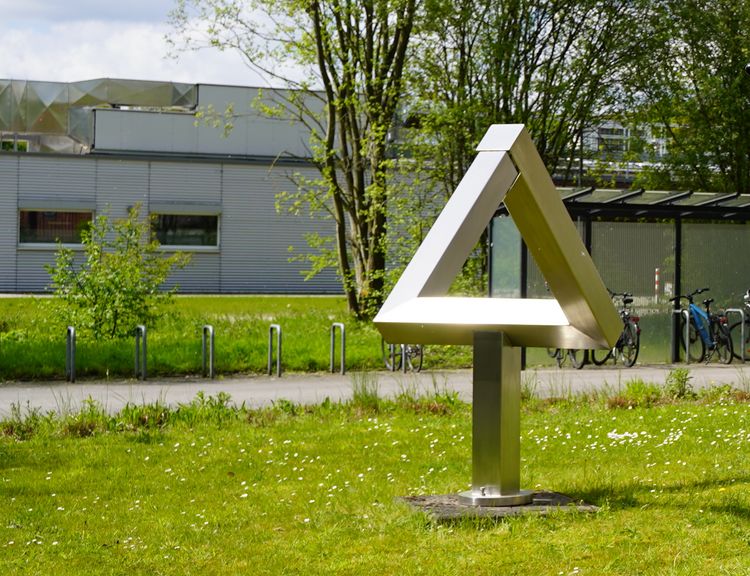
The fact that the NeSSy building is about sensory perception and its - thoroughly complex! - processing in the brain is symbolised by the larger-than-life Penrose triangle: viewed from the right direction, it appears as a closed but physically impossible triangle, because the positional relationship between two edges does not match the perceived position of the third edge.
It is thus reminiscent of the impossible figures by M.C. Escher, which inspired the mathematician and physicist Robert Penrose to publish the "Tribar" in the Journal of Psychology in 1958.
Here, however, the Penrose triangle is not realised as a two-dimensional figure on paper, but as a three-dimensional, rotatable sculpture. What's the trick?
The trick
When spatial, three-dimensional scenes are depicted in two dimensions, the third dimension (depth of the image) is lost and can only be depicted indirectly so that our brain interprets it into the image.
This is exploited in our sculpture because, when viewed from the correct direction, the front and rear parts of the sculpture lie directly next to each other and appear to merge. As a result, the right leg of the triangle, which protrudes forwards, is perceived as being directly connected to the left leg of the triangle at the upper end, even though this left leg protrudes backwards and is more than a metre away from the end of the right leg at the upper end!
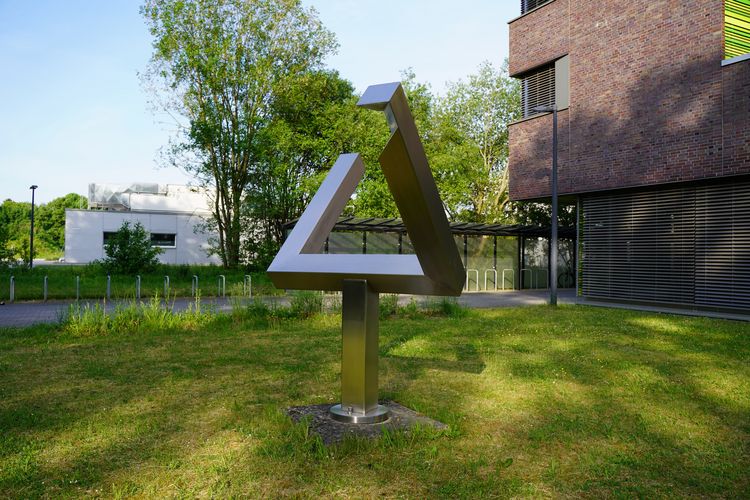
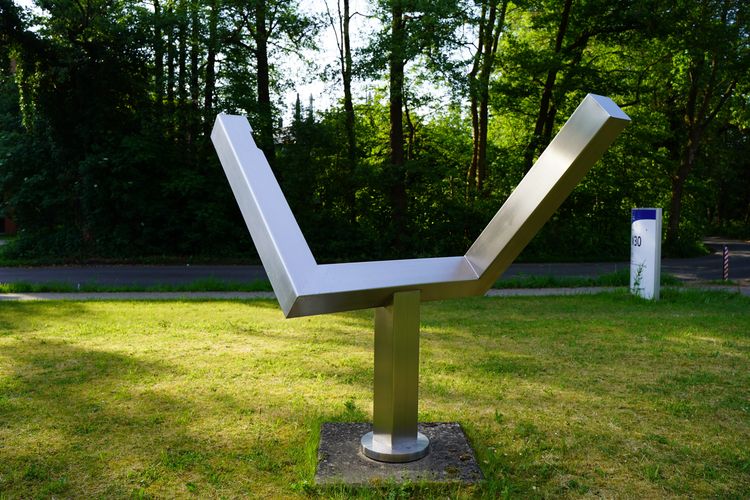
Two further perspectives
If the above explanation based on the picture is not enough, here is the "triangle" from two other perspectives. The right and left legs are really far apart and do not touch in the slightest.