
Inverted listening throne
Inverted listening throne
Super eavesdropper with tricks!
- How can you amplify the sound at the ear so that it seems twice as loud - without any electronics?
- What is the smallest difference between the two ears that you can hear?
- And what happens if you swap the ears?
You can find out these and other questions about hearing with two ears for yourself at the "inverse hearing throne" - open 24/7 in front of the Nessy building of the University of Oldenburg at Küpkersweg 74!
Prof Dr Dr Birger Kollmeier explains how it works in the video.
Here we reveal the tricks behind it
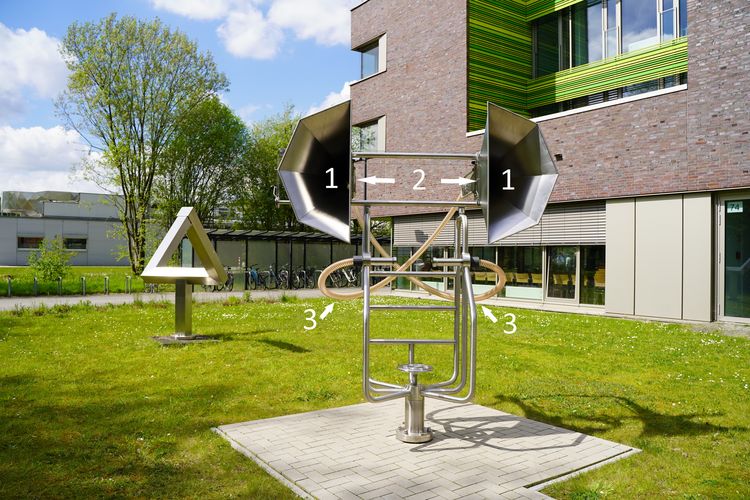
- Exponential funnel: This funnel shape is familiar from the gramophone or trombone because it is particularly favourable acoustically - even if the funnel is operated the other way round in the listening throne: The sound incident on the large input surface of the listening funnel is transmitted to the small surface at the output. This works best - and with the exponential form with the lowest losses - at high frequencies. In the case of the ear trumpet, the surface area is reduced by a factor of about 100 - and the sound intensity is increased by the same factor, which corresponds to a gain of 10 dB. This is almost exactly a doubling of the perceived loudness - so everything sounds twice as loud with a listening throne! Please try it out!
- Variable distance between the ears: Humans have an ear distance of approx. 16 cm and can resolve an angular difference of approx. 1 degree - this corresponds to a time difference between the ears of just 20 µs (20 times the millionth part of a second), incredible!!! If the distance between the ears is increased, the time difference that occurs between the ears when sound is coming from a certain direction increases to the same extent: if we increase the difference between the funnels of the ear trumpet to ten times the ear distance, i.e. over 1.6 metres, we can therefore improve the smallest audible angular difference by a factor of ten! Please try it out!
- Direction exchanger: If the sound is directed from the left side to the right ear and vice versa, we perceive the sound exactly from the opposite side: A car travelling from left to right past the inverse listening ear appears acoustically from right to left - a contradiction between acoustic perception (ears) and visual perception (eyes). This contradiction increases as the funnel distance increases - does the visual or the acoustic impression win? Please try it out!