
Source
Source
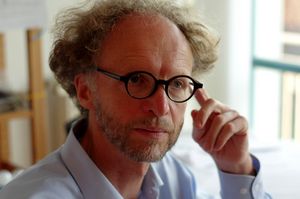
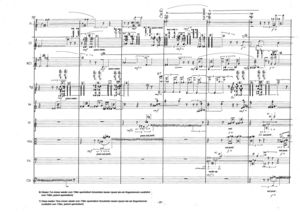
Statement
The need to sense the unspeakable, to give presence to the distant, the ou-topos, becomes the driving force of unbounded musical fantasy.
Credo
For me, composing essentially has something to do with listening into the unheard, transcendere, so to speak, transcending the world of the material, the objective, opening up into the world of the not-yet-graspable and at the same time doing so from a complex structural organisation of the musical material.
Thus my works are first and foremost understood as autonomous music that, following its own laws, creates its own language, its own musical cosmos. Nevertheless and at the same time, all my compositional work is always essentially about the vital search for the explicitly spiritual in music. This is not a contradiction, but rather a consequence (in the sense of Klaus Heinrich's rejection of the "either/or" of classical philosophy).
Worlds of thought from (borderline) areas of quantum and astrophysics, philosophy, literature, etc. merge with imaginary worlds of specific musical structure, interpenetrate and mutually condition each other and thus allow something completely new to emerge on a newly opened virtual level that would not have been conceivable in this form from either side.
... and then suddenly the supposed determinations of categories such as cognition and intuition, of the tangible and the not-yet-tangible, disappear and open up - as a kind of 'musical sculpture' - a space whose horizon can range from the extreme physicality of structural and material overdensity, a kind of 'musical plasma', to complete emptiness, a 'tense silence', in which time seems to melt away and the space-time continuum seems to dissolve.
Short biography
Born in 1960, he studied classical guitar, music education and musicology at the Frankfurt University of Music from 1981-85 as well as philosophy and theology at the J. W. Goethe University. At the same time, he studied composition with Hans-Ulrich Engelmann and from 1985-89 in the masterclass with Rolf Riehm. Michael Quell lives as a composer in Fulda and has been a lecturer in music theory, analysis and aesthetics at the Musicology Institute of the J. W. Goethe University Frankfurt since 2008. He also regularly receives invitations as a guest lecturer at various universities.
Since 1995, he has directed the concert series 'New Chamber Music' in Fulda, which he founded.
Quell has received numerous commissions for compositions, his works have been honoured with several international composition prizes (including the 1989 Frankfurt Art Prize, Elisabeth Schneider Composition Prize 2003, Barlow Commissioning Award 2011, USA, Composition Prize of Bowling Green State University 2013, USA, etc.) and performed at international festivals such as the Festival de musique Montreux.B. Festival de musique Montreux/Vevey, Gaudeamus Musikwoche Amsterdam, Darmstädter Ferienkurse, Los Angeles Chamber Music America Festival, ZeitRäume Basel, SoundScape Festival Pavia and Maccagno, Músicaviva Festival Cuenca, Ecuador etc. as well as in renowned concert series e.g. in Berlin, London, Montréal, Vienna, Hiroshima, Chengdu, La Plata etc.
One of Michael Quell's main areas of work is the exploration of the opportunities and possibilities of composition in interdisciplinary dialogue.
Publications with TONOS-Musikverlag, Baden Baden and Edition Gravis, Berlin. CD recordings (NEOS: two portrait CDs, Bayer, Dabringhaus etc.) and musicological publications with Lit and Wolke Verlag.
Selection of works
String III - Branes |
for violin, accordion and piano (2019) |
energeia aphanés III - physis |
for ensemble (flute, clarinet, violin, violoncello, accordion) and dancer (2019) |
energeia aphanés II |
for double bass clarinet and accordion (2018) |
Dust aggregation |
for flute, double bass and piano (2017) |
Meister Eckhart and Suhrawardi: the sound of the wing of Gabriel - hikmat al-ishraq |
for four microtonal guitars and piano (2017) |
φαντασία - let the molecules race |
for soprano and additional speaking pianist (2016) |
String II - Graviton |
for ensemble in nonet instrumentation |
String I |
| for oboe solo (2012/13) |
A Blurring Cloud - Creatures of the journey |
for violin, guitar and piano (2011/12) |
Dark Matter |
for oboe, clarinet and bassoon (2010/11) |
Achronon |
for accordion and guitar (2008/09) |
| Enigma |
- of the magic of the opposite way of thinking for violin and guitar (2005) |
Snapshots/ Caprichos - Reflections on Goya ... and beyond ... |
for guitar solo (2004) |
Anamorphosis II (-Polymorphia) |
for ensemble in different spatial constellations (2002/03) Fl. (BFl.), Ob., Cl. (BCl.), Klav., Perc., Vl., Vla. and Vc. |
anisotropy - (four) (aggregate) - states for piano |
| piano solo (2001) |
Satori - 5 Haiku" |
for guitar orchestra (1999) |
Inside ... out |
hommage à R. Barthes, Paul Feyerabend, Diogenes and the Cynics (1997) for large orchestra (1997) |
String trio - le son d'un monde secret et couvert (1994) |
| nešāmā- näpäš -rūªḥ |
based on Hebrew, Akkadian and Ugaritic text relics for soprano and ensemble (fl., mr., 2 vl., vla., vc., 2 guit. and perc.) (1990/91) |
Ekstare |
for flute, oboe, violin, viola and cello (1988) |
peri tu ontos - ḥu ṣā'aq 4,6692 aḥ |
for a multi-instrumentalist: |
lacrimae luce perfusae |
Mirror of tears and light for 16-part mixed chamber choir, chamber orchestra and percussion (1985/86) |
Alpha - Omega |
for 5 guitars and organ (1982) |