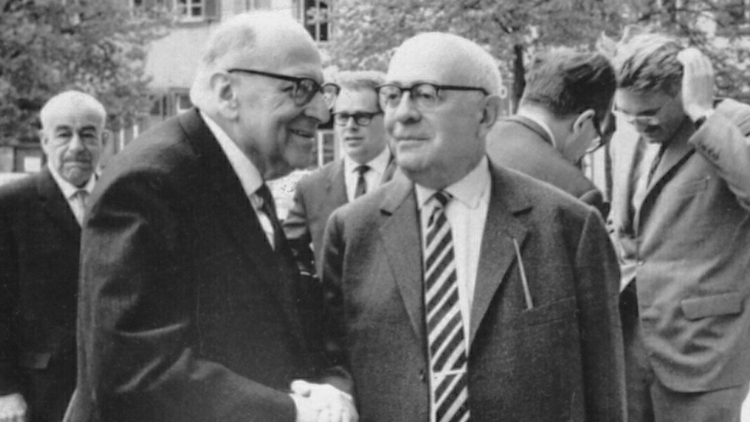

The philosopher and sociologist Theodor W. Adorno died 50 years ago. Oldenburg sociologist Stefan Müller-Dohm, Adorno biographer and founder of the Adorno Research Centre at the University of Oldenburg, looks at the intellectual's work.
6 August marks the fiftieth anniversary of the day on which the philosopher and sociologist Theodor W. Adorno died unexpectedly while on holiday in the Swiss mountains at the foot of the Matterhorn. This event was very much in the news at the time. The international press outdid itself with tributes. Radio and television broadcast numerous documentaries about the eventful life and work of the thinker, who was born in 1903. He attempted to confront all the evils of the world, including death ("a disgrace of man"), with the means of critical reflection, always transcending the boundaries of individual scientific disciplines.
He has a reputation for being a complicated, dialectical thinker of certain negation. However, this attribution overlooks the fact that after 15 years of exile in England and the USA, where he was forced to flee as a result of Hitler's dictatorship, Adorno also dealt with very practical issues after his remigration to post-war Germany. These included, for example, the reorganisation of political education and the reform of teacher training.
Intellectual role model
With the aim of "education for maturity", one of his critical impulses was directed towards the educational crisis and educational decline, which is once again an explosive issue today. Even more central - and at the time more offensive - was his call for an education that took into account what had become a monstrous fact of history with the crime against humanity of Auschwitz. The journalistically highly committed critic of the times, whose articulate language and concise voice had a high recognition value, could be heard almost weekly on the evening programmes of the radio - one of the media he used extensively for his mission of sociological enlightenment - about "What does it mean to come to terms with the past" or about the causes of anti-Semitism, about the threat to the young democracy posed by a resurgence of extreme right-wing radicalism. For him, who provoked with the sentence that a poem after Auschwitz was barbaric, the past had only been dealt with when the causes of the past inherent in society had been eliminated: These include, first and foremost, the powerlessness of the individual in the face of opaque, overpowering tendencies of the social whole.
In the role of the public intellectual, Adorno, like Hannah Arendt and Karl Jaspers, risked leaving the ivory tower of pure science in order to address the tabooed topics in the land of the perpetrators. However, this influence on the history of mentalities in the post-war years is not the main reason for his topicality 50 years after his death. The fact that Adorno's social-theoretical way of thinking has not become dusty is not only proven by the many reprints of his most popular book, the collection of aphorisms on 'damaged life' entitled "Minima Moralia", but also by the annual conferences and meetings that centre on the tension between negativism and an ethic of right living reflected by Adorno.
Rediscovered authoritarianism
A not unknown but previously unpublished essay on "Aspects of the New Right-Wing Radicalism", a lecture originally held in Vienna in 1967, has been published in the month of the anniversary of his death, now with an instructive epilogue by historian Volker Weiß. In this lecture, Adorno analyses phenomena of right-wing radicalism, which he describes as the "spectre of a spectre", which can certainly be applied to today's variants of right-wing populism, for which Adorno's formula of an interplay between a 'delusional system and technological perfection' does indeed seem to apply.
Equally remarkable is the current debate that has been triggered in the USA by Harvard historian Peter E. Gordon. As the editor of the latest edition of the book "Authoritarian Personality", originally published by Adorno, he has raised the question of the extent to which Adorno's sociological research on the authoritarian personality contains an explosive potential for interpretation that helps to explain Donald Trump's success. His voters are said to have a tendency towards authoritarianism, which goes hand in hand with stereotypical thinking and the defamation of foreigners and minorities - all paranoid traits that Adorno identified as authoritarian reaction patterns in his study from the late 1940s.
Sociological explanation
The American historian argues in favour of Adorno's interpretation that the authoritarian character cannot primarily be explained psychologically. Rather, the syndrome is the product of an internalisation of experiences of instrumentalisation and external control of people in modern society, experiences that contribute to the weakening of the individual. At the time, Adorno emphasised this specific sociological perspective in his "Remarks on the Authoritarian Personality", which are now available for the first time and were not published in the study at the time, and which sociologist Eva-Maria Ziege has translated for the first time on this occasion and made available in a volume with a reader-friendly foreword and epilogue.
For Gordon, Trumpism is the result of pathological developments in society and politics. He also explicitly cites the decline of serious journalism, which is being supplanted by demagogic opinion-making and entertainment. Of course, Adorno was unable to foresee the current signs of decline in the public sphere and communication, particularly in social media. But his research on so-called clichéd "ticket thinking" and his analyses of the omnipresence of the "culture industry" help to sensitise us to the "untrue". According to Adorno, this sensitisation is a prerequisite for developing an awareness of what he had in mind as the right life.
Guest article: Prof Dr Stephan Müller-Doohm