

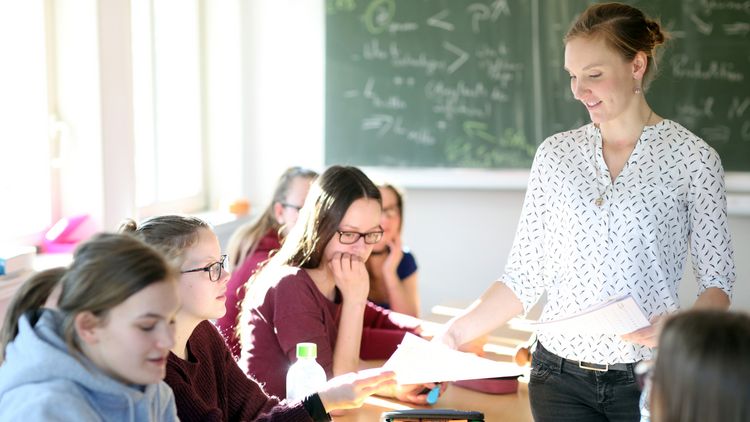


As part of a joint project, a team of scientists led by biology education specialist Corinna Hößle is investigating what school pupils know about so-called genome editing and how they assess it from an ethical perspective. The researchers aim to raise awareness of the topic amongst young people and their teachers.
All it took was a prolonged infusion last autumn to introduce certain molecules – known as gene scissors – into the bloodstream of a 44-year-old American man. These were designed to eliminate a faulty gene in his liver cells that causes a serious hereditary disease. The patient was the first person ever to receive such gene therapy directly into his body.
Admittedly, the outcome of this specific procedure is still uncertain. However, it is part of a growing trend: scientists and doctors are able to intervene in the genetic material of living organisms with ever-greater precision using so-called genome editing. They hope that this rapid and cost-effective method will enable them to cure hereditary diseases, HIV or cancer in the future. But how safe is this technique? And what ethical questions does it raise?
Young people, in particular, should engage with these questions, says Prof. Dr Corinna Hößle, a biology education specialist from Oldenburg. After all, it is they who will have to deal with this method in the future. “So we should prepare them for this, including from an ethical perspective,” she adds. This is precisely the aim of a joint project led by Hößle, in which scientists are surveying school pupils and university students on their views and aim to equip them with ethical and moral competencies in the long term. In the project ‘Ethical judgement and everyday imaginations of young people and students regarding the possibilities of genome editing’, the Oldenburg team is collaborating with scientists and medical professionals from the University of Hamburg and Hannover Medical School (MHH).
Ethically problematic
The method of genome editing has developed rapidly since 2012: it was then that scientists discovered the so-called CRISPR/Cas complex in bacteria. It is now possible to use this molecular complex to specifically cut out individual genes or larger sections of the genome in specific cells of an organism and, if necessary, replace them with a healthy gene. As a rule, medical professionals have so far taken the patient’s own cells for this purpose and treated them outside the body. Clinical trials involving cancer patients are already underway in China, and Europe could soon follow suit. The method raises particular ethical concerns when used on so-called germ cells, as this means the genetic changes would be passed on to future generations.
In this project, funded by the Federal Ministry of Education and Research (BMBF), the researchers now aim to find out: What do young people know about genome editing? What ethical standards do they use to assess the method? And would they be prepared to use it? To this end, doctoral candidate Laura Heinisch, together with Hößle and education researcher Prof. Dr Ulrike Krause, has developed a detailed questionnaire for school pupils.
A preliminary study involving 18 pupils in a Year 11 class has already shown that young people are open-minded about genome editing, but take a nuanced view of it. “For example, the pupils felt that decisions on when to use the method should be made on a case-by-case basis,” explains Heinisch. However, the pupils found it difficult to adopt a perspective other than their own and to assess the consequences. Furthermore, they were often unable to explicitly name ethical values such as human dignity or well-being – although these emerged implicitly from their views.
A realistic scenario
Furthermore, most pupils – and even teachers – do not understand how genome editing actually works, says Dr Wiebke Rathje, who is coordinating the joint project. “It often takes up to ten years for new scientific findings to be incorporated into school lessons.” Heinisch cannot, therefore, assume that pupils have any specialist knowledge when she interviews them as part of the main study on genome editing. She has therefore developed a programme comprising two 90-minute lessons. In these, she covers not only the scientific fundamentals but also the ethical aspects: For example, are there risks associated with the technology using viruses? Or: is it ethically justifiable to make genetic modifications for cosmetic reasons?
Heinisch is now teaching a class of around 80 Year 11 pupils at a grammar school in Varel using this approach. The pupils are required to complete her questionnaire once before the lessons and, in a modified form, once after the lessons. This enables the doctoral candidate to ascertain what specialist knowledge and judgemental skills the pupils have acquired during the lessons.
The questionnaire first presents the young participants with a dilemma: Should a couple whose child carries a genetic predisposition to leukaemia decide to treat the child using genome editing? This is a thoroughly realistic scenario devised by experts at the MHH for their colleagues in Oldenburg. The pupils’ task will be to assess the situation independently – for example, what moral relevance the case has and what the possible consequences might be – and to justify their judgement. In addition, the young people indicate whether they have a particular interest in subjects such as biology or politics, and whether they are religious.
Responsible approach
By the end of the project, the scientists will not only have gained an insight into how well pupils can assess bioethical issues. Rather, the researchers also intend to pass on their findings to teachers as teaching materials. Heinisch says it is important to run the study in different variations: in one class, she will teach only specialist knowledge; in another, the basics of ethical evaluation. A third class will learn both, whilst a fourth – the control group – will receive no separate tuition. “This will allow us to see whether the concept is sound or whether we need to improve the lesson further,” explains the doctoral candidate.
For although bioethical topics have been part of the curriculum in secondary schools for several years now, ethics expert Hößle knows from previous studies that: teachers often do not know exactly how to teach ethical skills. In many cases, they also feel uncertain about making judgements themselves. This can result in them avoiding such topics and marking pupils’ work in class. “Using the materials we have developed, we want to encourage both experienced and trainee teachers to integrate bioethical topics into their lessons and to foster ethical judgement – not just because they are obliged to do so, but to promote the responsible use of new technologies,” says Hößle.