
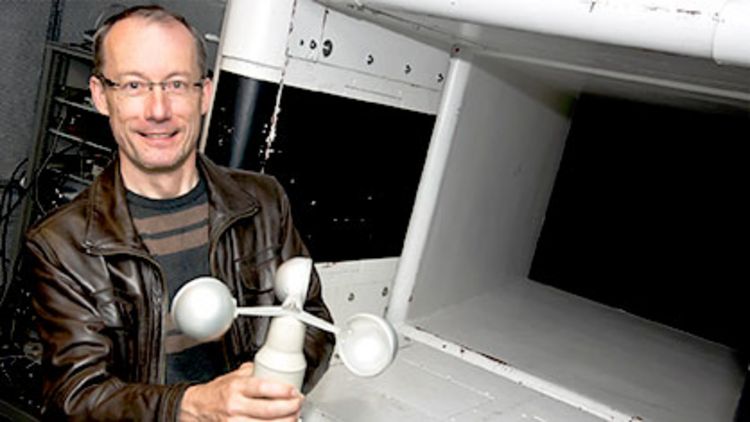

How can wind energy be fed into the electricity grid in a controlled manner? A question that poses challenges for science and industry. Oldenburg physicists show how turbulence affects the electricity production of large wind farms.
Wind farms with more than 100 turbines will no longer be a rarity in the near future. Even in wind farms of this size, turbulence influences the generation of wind energy and its feed-in to the electricity grid. This influence is even greater than previously assumed, as physicists Patrick Milan and Dr Matthias Wächter from the University of Oldenburg, led by turbulence expert Prof Dr Joachim Peinke, have now been able to prove for the first time in highly complex calculations. They have now published their results in the renowned journal "Physical Review Letters". Their paper "Turbulent Character of Wind Energy" is the first article on wind energy to be published in the journal.
"Despite their inertia when feeding into the energy grid, gas, coal, hydropower and nuclear energy have one major advantage - they can be fed into the grid in a controlled manner. This is currently not the case with wind energy and is therefore one of the biggest challenges for wind energy research," explains Peinke. The wind energy fed into the grid is characterised by a key turbulence feature, namely intermittency - i.e. short-term strong and complex fluctuations.
The Oldenburg physicists have already been able to demonstrate these fluctuations for individual wind turbines in their earlier work. Now they show: The intermittency is extremely high, especially in the small-scale range, and has an effect on the entire wind farm. By analysing wind farm measurement data, it was possible to determine the dynamics on the path from wind speed to electrical power more precisely and to demonstrate the turbulent nature of wind energy in detail. They discovered that the energy conversion process is subject to permanent turbulence and fluctuates every second. This process follows complex patterns with multi-fractal scale laws, which are known from turbulence research.
"When you look at a rotating wind turbine, you get the impression of smooth motion. In contrast, the power output as a result of the forces and torques within the machine shows very turbulent fluctuations," explains Peinke. Fluctuations of several megawatts within seconds are not uncommon. A wind turbine can therefore be compared to an aeroplane approaching under very turbulent wind conditions. From the outside, the movement of the aeroplane appears calm. However, a closer look reveals that the aircraft is exposed to turbulent dynamics. The situation is similar with wind turbines. To make matters worse for them, they are constantly exposed to turbulence over the years. Whereas aeroplanes can ascend into higher and therefore calmer air currents.
The scientists were able to prove this, for example: If the wind speed varies by eleven metres per second, this can affect the energy output of the turbine by 80 percent within a few seconds. The researchers see the reasons for this in the increased non-linear transmission process on the one hand. And secondly, the rapid reaction time of the turbines to the changing wind speeds.
These effects also have an impact on large wind farms: "In a wind farm with many turbines, you would actually think that these fluctuations in energy production would be balanced out by the fluctuation of the various turbines," explains Dr Matthias Wächter, physicist at the university. However, this is not the case. The Oldenburg scientists were the first research group to prove this: The intermittency of the electrical power output is maintained for the entire wind farm.
The effect can be explained by the correlations that are typically observed in wind data. While the wind farm analysed covers an area of four square kilometres, the wind structures with their turbulence extend over several hundred kilometres. And this extensive turbulence influences the wind turbines in the wind farm. The Oldenburg researchers therefore assume that the intermittency of the wind energy also affects the energy production of the wind farms over several hundred kilometres.
"Our research shows: Turbulent intermittency in wind energy plays a greater role than previously assumed. A deep understanding of turbulence is necessary in order to develop new energy storage technologies and new wind turbines in the future," says Peinke.
More on the topic
Working Group Turbulence, Wind Energy and Stochastics - TWISTContact
Prof. Dr Joachim Peinke
Institute of Physics
Tel: 0441-798/3536