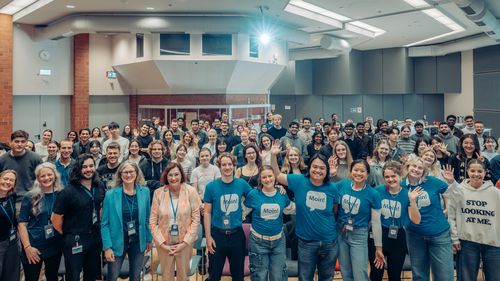


More than 300 speakers from 36 countries will be coming to the university at the end of May to present their findings, discuss them and network at the World Congress on Undergraduate Research.
From the Persian Gulf to northern Germany: after the first World Congress on Undergraduate Research took place in Doha (Qatar) in 2016, the University of Oldenburg is now hosting the "2nd World Congress on Undergraduate Research" - or World CUR for short. The patron is Lower Saxony's Science Minister Björn Thümler. From 23 to 25 May, the event offers students from all over the world and from all disciplines a platform to present their research work from Bachelor's, Master's and Diploma degree programmes.
"Research-based teaching and learning have characterised the profile of the University of Oldenburg for years. Students learn skills that prepare them for a potential academic career as well as for demanding or managerial activities in professional life," emphasises Prof. Dr Sabine Kyora, Vice President for Studies, Teaching and Gender equality. By organising the World CUR, the university is taking on a pioneering role nationwide in making student research visible.
Since last autumn, students around the world have been invited to apply for the conference with contributions on various topics, such as the environment, health or economics. An international committee of experts reviewed and evaluated the submissions - those who were accepted were allowed to register for the conference. More than 300 speakers from 36 countries and over 70 disciplines have now registered - including more than 60 students from emerging and developing countries, whose participation has been made possible by the Lower Saxony Ministry of Science (MWK).
"We are expecting twice as many participants as at the first World Congress," says Dr Susanne Haberstroh, advisor for research-based learning and one of the organisers of the World CUR. The diversity of the Oldenburg conference is also remarkable: "The congress has become much more international. There are many students from countries where student research is not as well established as in the USA or here in Germany, for example."
Anyone interested in the topics and perspectives of student researchers can register to attend the event free of charge - as long as there are still places available ; the conference language is English.