

School V - School of Medicine and Health Sciences has drawn attention to the impending shortage of space with a staged lecture. Despite rising student numbers, no go-ahead has yet been given for a new teaching building.
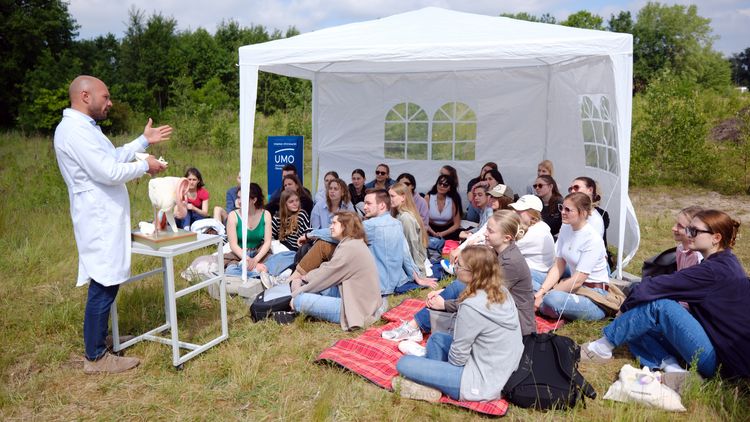
Instead of sitting in a lecture theatre, medical students are gathered on the undeveloped site on Pophankenweg, where the buildings of University Medicine Oldenburg (UMO) are one day to be built. The young men and women are trying to listen to the lecturer’s explanations. Modern teaching methods are out of the question because there is no electricity to power them. At least the temperatures in the open air are no longer as freezing as they were during the winter semester. This bleak scenario for the future has now been painted by students and lecturers at School V - School of Medicine and Health Sciences. Through this campaign, they drew attention to the fact that, twelve years after the medical degree programme was established, the UMO still lacks its own teaching building – despite rising demand.
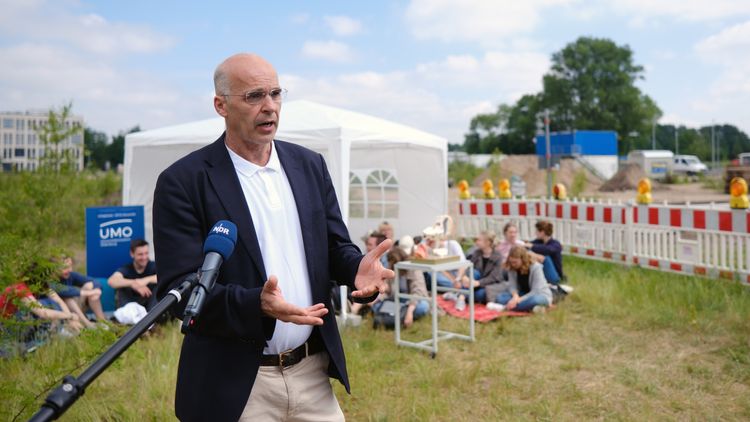
“In order to be able to offer at least 200 places for first-year students in future, as planned by the state government, we need not only a corresponding adjustment to the annual state funding allocated to the UMO, but also investment funds for urgently needed buildings,” emphasised Dean Prof. Dr Hans Gerd Nothwang.
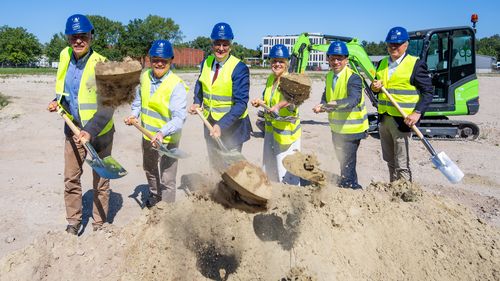
The UMO is short of almost 20,000 square metres of space for research and teaching if it is to admit 200 first-year students annually. This has been calculated by the Planning Institute for Higher Education Development (HIS-HE). Construction work is due to begin this year on Pophankenweg for the first phase of a research building, which will include, amongst other things, a wet anatomy facility built by the University of Oldenburg using its own funds. However, for the second phase of construction, only planning funds have so far been allocated from Hanover – the actual construction costs of around 84 million euros still need to be included in the budget. As for the urgently needed teaching building, which is intended to complete the UMO building complex on Pophankenweg, there has so far been no positive signal whatsoever from Hanover. “For twelve years, the university has, with great planning effort, repeatedly created space in its buildings in various locations, so that we have always been able to meet our high standards of education despite steadily rising student numbers in medicine,” emphasises Nothwang. However, if 200 people start their medical studies each year in future, there will be over 1,000 medical students on the campus – around twice as many as there are today. “We can only meet this space requirement with a new teaching building,” stresses Nothwang.
Taking into account the expected planning and construction time, it is important that the state government, under Minister-President Stephan Weil, lays the groundwork in the 2025 state budget for a teaching building of around 4,900 square metres. The estimated costs for this amount to around 83 million euros.
The UMO is campaigning to ensure that the costs for this urgently needed building complex are taken into account at the upcoming budget retreat in Hanover in June, alongside the promised increase in annual state funding. Under the heading “Doctors don’t just fall from the sky”, people from the region can currently lend their support to this call by signing the petition – online at uol.de/bestemedizin or at any of the more than 200 UMO teaching practices in the north-west.