

Inaugural visit by Björn Thümler to the university: Lower Saxony's Science Minister emphasised the central role of the OFFIS research institute in the state's digitalisation offensive. The university's position in medical training will be further strengthened by the expansion of study places at the European Medical School.
"The University of Oldenburg has exciting years ahead of it: as a key part of the planned competence network operating throughout Lower Saxony, the OFFIS research institute will play a central role in the implementation of the state government's digitalisation offensive. The expansion of study places at the European Medical School will also further strengthen the university's position in Lower Saxony's medical training programme. And rightly so: the cooperation with the Rijksuniversiteit Groningen is a unique and successful project that Lower Saxony can be proud of" - these were the words used by Lower Saxony's Science Minister Björn Thümler to summarise his inaugural visit to the University of Oldenburg today.
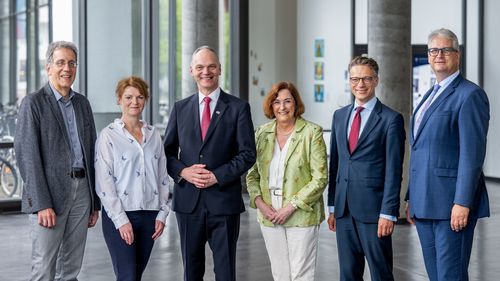
The first topic of the visit: Oldenburg's role in the state's digitalisation offensive. Thümler discussed this with University President Prof Dr Dr Hans Michael Piper, other members of the Executive Board, the Dean of School II Computing Science, Economics and Law, Prof Dr Ernst-Rüdiger Olderog, and OFFIS Chairman Prof Dr Wolfgang Nebel.
The European Medical School Oldenburg-Groningen and thus the Oldenburg medical studies programme formed the second part of the visit programme. The Minister learned about the experiences, results and future developments of medical studies in Oldenburg from the university management, the acting Dean of School V - School of Medicine and Health Sciences, Prof. Dr Hans Gerd Nothwang, and the Dean of Studies, Prof. Dr Dr Klaus P. Kohse.
Minister Thümler then visited the Clinical Training Centre (KTZ) of the School of Medicine to talk to students. He was told how the prospective doctors learn to apply their theoretical knowledge in practice at the KTZ. The KTZ offers students of human medicine the opportunity to practise and deepen their practical clinical skills on models and simulators. Students also learn basic skills such as taking blood samples, inserting catheters and using ECG and ultrasound equipment. Another focus of the training is to practise communication with patients. Specially trained "actor-patients" are available for this purpose. In this way, the future doctors learn how to interpret symptoms, use examination methods and ask the right questions for a diagnosis.