Getting to know a research project straight after school and getting hands-on experience: the Voluntary Academic Year (FWJ) makes it possible. Rieke Wahlen, a school-leaver, has been working in the Hydrogeology research group for five months – here’s an interim report.
QUESTION: Since 2015, the University of Oldenburg has been one of only a few universities in Germany to offer an FWJ. How did you manage to secure a place?
ANSWER: I first heard about it from a teacher at my sixth-form college. Whilst doing my research, I came across the University of Oldenburg and the research groups offering an FWJ. As I wanted to try something related to biology and geography, I listed hydrogeology as my first choice. After a face-to-face meeting with Victoria Burke, who heads the junior research group on veterinary pharmaceuticals, everything fell into place very quickly.
QUESTION: On the spur of the moment, you moved from your home town of Jork in the Altes Land to the Hunte last summer…
ANSWER: Right away, I was faced with one of the first challenges of student life: finding a flat share in Oldenburg is quite a challenge!
QUESTION: Why a FWJ of all things?
ANSWER: I’m doing this mainly for myself: I want to find out whether a degree course is really the right thing for me. I’m actually quite practically minded and enjoy working outdoors in the fresh air – for example, back in 2015 I spent four months working on an alpine dairy in the Allgäu. At the same time, though, I’m also interested in research and lab work: I want to know exactly what a scientist actually does.
QUESTION: Did you know what to expect in hydrogeology?
ANSWER: At school, biology was my oral exam subject and geography was my advanced course. I already had some understanding of soil parameters and knew how photosynthesis works. So I had a few basic building blocks. However, I wasn’t prepared for the day-to-day work at a research institution, as I’d had no previous experience of it.
QUESTION: What exactly do you do?
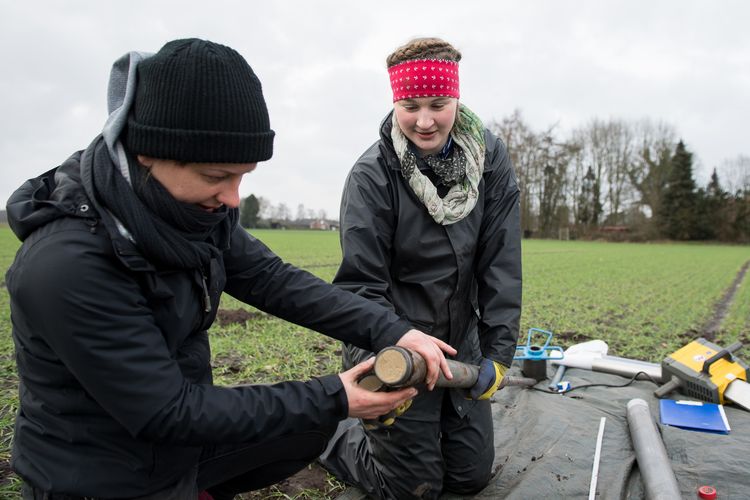
ANSWER: Using field, lysimeter and laboratory experiments, our research group takes a closer look at the degradation and transport behaviour of various veterinary medicines in soil and groundwater. In doing so, we ask ourselves what implications this has for the environment. It’s a very wide-ranging and varied field. For example, I get to help out in the lab, carry out rapid tests or take samples at the lysimeter – a facility near the university that we use to collect soil leachate samples.
QUESTION: Which tasks do you particularly enjoy?
ANSWER: There are lots of them. For example, I find the column experiments particularly exciting, and I’m even allowed to carry out one myself. This is how we find out how veterinary medicines change in the soil and at what concentrations they would subsequently be present in the groundwater. I get to be involved in every stage of the process – from preparing the samples and taking measurements on large pieces of equipment to analysing the results on the computer.
QUESTION: All voluntary service programmes include accompanying training days – including at our university. What are these about?
ANSWER: The 25 training days are organised partly by the Workers’ Welfare Association (Arbeiterwohlfahrt). The main aim is to exchange ideas with other volunteers, including those on the social and environmental year schemes. The university itself also offers training days, for example on good academic practice. An Excel course is also coming up soon. We also pay brief visits to other university facilities, such as the Clinical Training Centre for medical students.
QUESTION: You’ve still got around seven months to go. What are you hoping for?
ANSWER: I’ve been made to feel very welcome here. Everyone is very open and helpful, and I already have quite a lot of freedom – depending on how much I trust myself to take on. What I’d like to see is an even more intensive exchange with the other FWJ volunteers at the university – perhaps even through a short-term job swap. Or we could work together as a tandem for a day to get to know each other’s areas of work. It would also be great to have a semester public transport pass for volunteers, just like the students already have. Otherwise, I naturally hope to be able to make a decision at the end about what I want to do next after the FWJ.