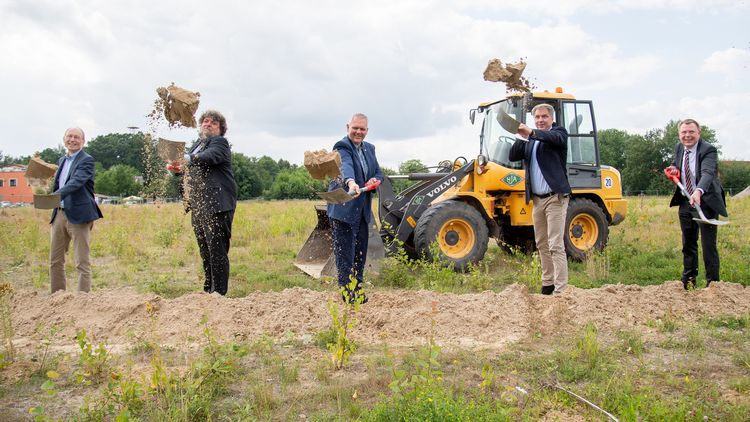

The ground-breaking ceremony for the new Oldenburg Helmholtz Institute has been held. Lower Saxony's Science Minister Björn Thümler took the opportunity to hand over the grant notification totalling 15 million euros.
The symbolic ground-breaking ceremony today marked the start of construction of the new Helmholtz Institute for Functional Marine Biodiversity at the University of Oldenburg (HIFMB). Over the next two years, a three-storey building with almost 2,000 square metres of floor space will be built in the Technology Park in Oldenburg-Wechloy. In addition to 85 office workstations, the building will also offer around 650 square metres of laboratory space, creating ideal conditions for marine biodiversity research.
"The new building is another important step towards creating optimal research conditions in Oldenburg," said Lower Saxony's Science Minister Björn Thümler. "Thanks to the continuous further development in co-operation with the University of Oldenburg and the Alfred Wegener Institute, Helmholtz Centre for Polar and Marine Research, we have the opportunity to enable cutting-edge research in the research areas 'Causes and Drivers of Marine Biodiversity', 'Biodiversity and Functioning of Ecosystems' as well as Marine Conservation and Ecosystem Services. With their research into marine ecosystems, the scientists at the HIFMB are making an important contribution to understanding climate change, among other things."
Strong partnerships
At the ground-breaking ceremony, Thümler presented the €15 million grant to Dr Karsten Wurr, Administrative Director of the Alfred Wegener Institute, Helmholtz Centre for Polar and Marine Research (AWI). Wurr emphasised: "Big challenges require strong partnerships: I am extremely pleased that we are able to significantly expand research into the pressing issues in the field of marine biodiversity research in partnership with the University of Oldenburg. Thanks to the funds from the state of Lower Saxony for the new building, we are creating a future home for the HIFMB with today's ground-breaking ceremony in order to develop forward-looking concepts for the sustainable use of the oceans and create a scientific basis for better marine protection."
University President Prof Dr Dr Hans Michael Piper emphasised: "The scientists at the AWI and the University of Oldenburg have been cooperating successfully in numerous projects for a long time. The HIFMB is a very special example of this outstanding and fruitful alliance." He congratulated founding director Professor Hillebrand and all his colleagues at the HIFMB on their excellent research into novel conservation strategies and wished them good working conditions in their future institute building.
The HIFMB currently uses rented premises on Ammerländer Heerstraße. The new building is being constructed in the immediate vicinity of the university campus and in particular the Institute of Chemistry and Biology of the Marine Environment (ICBM). Lord Mayor Jürgen Krogmann commented: "Science and city administration have been working successfully hand in hand in Oldenburg for a long time. This has also proven to be a successful approach with the founding of the Helmholtz Institute for Functional Marine Biodiversity. I was very much in favour of the city being able to support the new building with this ideal site." This will further strengthen Oldenburg as a research location with the dynamic development of the university institutes. The science axis in Wechloy with the technology park offers Oldenburg great opportunities, said Krogmann at the ceremony.
Sustainable protection concepts
The HIFMB was founded in 2017 as an institutional co-operation between the University of Oldenburg and the AWI. The research centres on the question of how biodiversity in the oceans is changing and what consequences this has for the functioning of marine ecosystems and their contribution to human well-being. On this basis, the scientists develop sustainable protection concepts for adaptable ecosystem management. The Institute is 90 per cent funded by the federal government and 10 per cent by the state of Lower Saxony.
For HIFMB Director Prof. Dr Helmut Hillebrand, the ground-breaking ceremony is a special signal for the young Institute, whose first years were characterised by development and growth. "We are about to fill the last two of our four professorships, so our research has a solid foundation in all areas. Now the new building is coming, which will offer us ideal research opportunities. All of this will ensure that we can put all our energy into biodiversity research and marine conservation."
The office and laboratory building will have a total area of 3,320 square metres. Reinforced concrete and clinker brick will be used on the ground floor, while the upper floors will be built in timber. A special feature are the movable façade louvres with organically shaped millings, which create a link to the research inside the building. Many communication areas are intended to promote the exchange of ideas that is essential for research and teaching.
The foundation stone is scheduled to be laid in spring 2022. Completion and occupation are expected to take place in autumn 2023.