Contact

Press & Communication

+49 (0) 441 798-5446

More

Contact

Philipp Gronotte

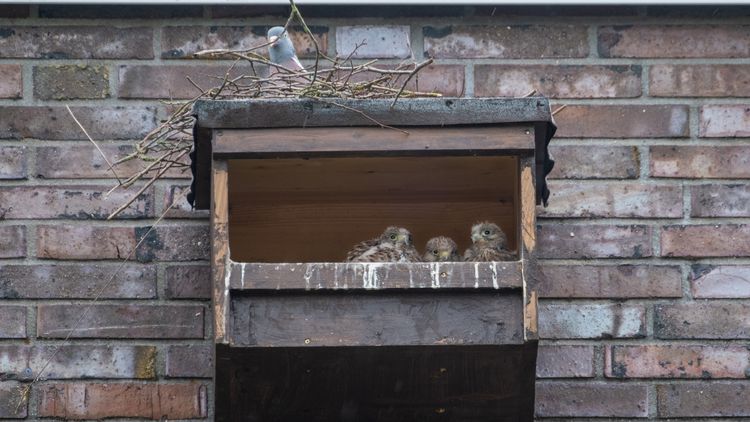
  • Close-up of the nesting box, three young falcons sitting close together in the right-hand corner, the pigeon in its nest on the roof.

    Bold neighbourhood: A pigeon temporarily nested on the dwelling of the three young kestrels. Photo: University of Oldenburg/Markus Hibbeler

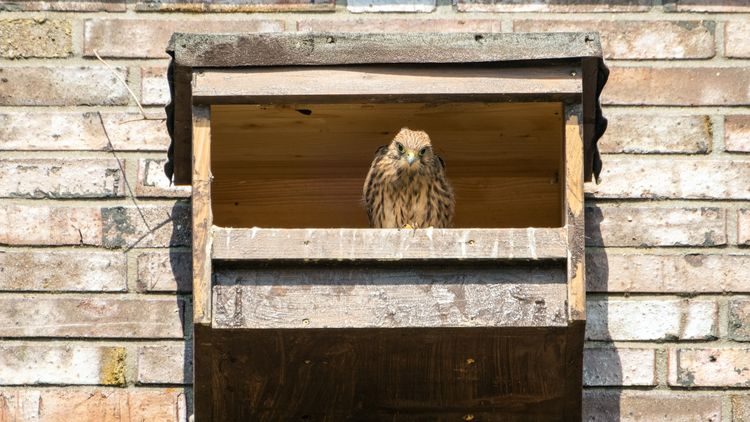
  • Adult falcon looking out of the nest box.

    The mother falcon visiting the nesting box. Photo: University of Oldenburg/Markus Hibbeler

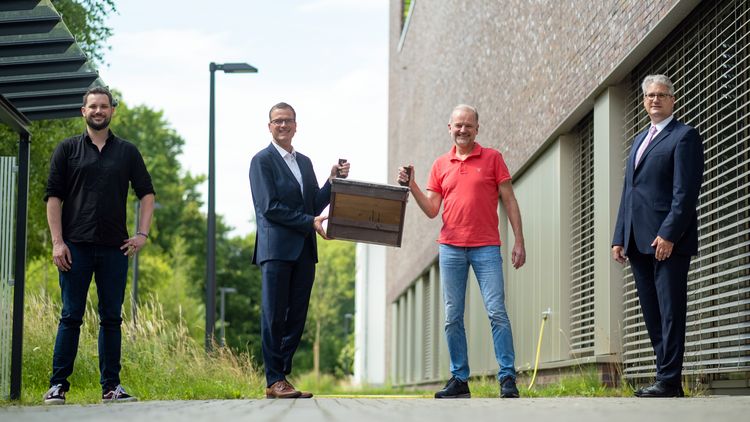
  • The four gentlemen are standing next to each other in front of the NeSSy building, Mr Edeling and Mr Bartner are holding a nesting box together.

    A nesting box for kestrels has slightly different dimensions than one for tits (from left to right): Philipp Gronotte (building management), Dr Klaus-Ferdinand Edeling (OLB-Treuhandstiftung), Dr Johannes Bartner (NABU) and University Vice President Jörg Stahlmann. Photo: University of Oldenburg/Markus Hibbeler

Kestrels nest on campus

The UNiversity is supporting a NABU project to protect kestrels with nesting boxes at lofty heights. Three young birds are currently growing up on the Wechloy campus.

The university is supporting a NABU project to protect kestrels with nesting boxes at lofty heights. Three young birds are currently growing up on the Wechloy campus.

The scientists in the NeSSy research building at the University of Oldenburg on Küpkersweg currently have some unusual housemates: Three young kestrels are living in a nesting box on the façade of the building. Dr Johannes Bartner from the Nature and Biodiversity Conservation Union (NABU) Oldenburger Land installed the nesting aid at the highest point of the building at a height of 14 metres at the beginning of the year with the support of the university's building management. Bartner installed another nesting box on the roof of building A6 on the Haarentor campus. However, this nesting aid, which is around 25 metres high, remained empty this year.

The university is thus supporting the kestrel project of NABU Oldenburger Land. Bartner launched the project a few years ago in order to stabilise the declining population of the small birds of prey. Kestrels feel at home in open areas and normally breed in cliff faces, but also like to use niches on tall buildings such as church towers to raise their young. Bartner has already installed around 200 nesting boxes in Oldenburg and the surrounding area. The OLB-Treuhandstiftung Weser-Ems, represented by Dr Klaus-Ferdinand Edeling, supported the installation of the nesting boxes at the university financially.
This might also be of interest to you:

Campus Life International affairs

Researchers from around the world

The University of Oldenburg is international. Here we introduce people from all over the world who have chosen to come to Oldenburg. The following…

more: Researchers from around the world
A woman wearing a black T-shirt and with shoulder-length brown hair is smiling at the camera. Blurred green hedges can be seen in the background.
University of Oldenburg / Daniel Schmidt
Vocational training Campus Life

Supporting and guiding volunteers

Marina Bartels from the Study and Career Counselling Service coordinates the Voluntary Academic Year (FWJ) at the University of Oldenburg. She is…

more: Supporting and guiding volunteers
eine große Menschenmasse steht bei bewöktem Himmel draußen. Eine bunte Wimpelkette hängt über ihnen. Sie feiern, unterhalten sich und stehen herum.
Markus Hibbeler
Campus Life Landingpage [Discover] Personal International affairs

From cloudburst to summer bliss

The rain didn't put off this year's participants at the International Summer Fest. They enjoyed delicacies such as poffertjes and dorayaki, and a…

more: From cloudburst to summer bliss
(Changed: 21 Jul 2026)  Kurz-URL:Shortlink: https://uol.de/p82n5234en
Zum Seitananfang scrollen Scroll to the top of the page

This page contains automatically translated content.